Downtown, Stockton
Updated · 5,762 residents
Downtown Stockton serves as a dense, walkable civic core defined by its historic grid and proximity to the waterfront. Residents experience a vibrant urban environment with varied local dining, though the area is marked by high noise levels from traffic and limited private outdoor space.
Key Highlights
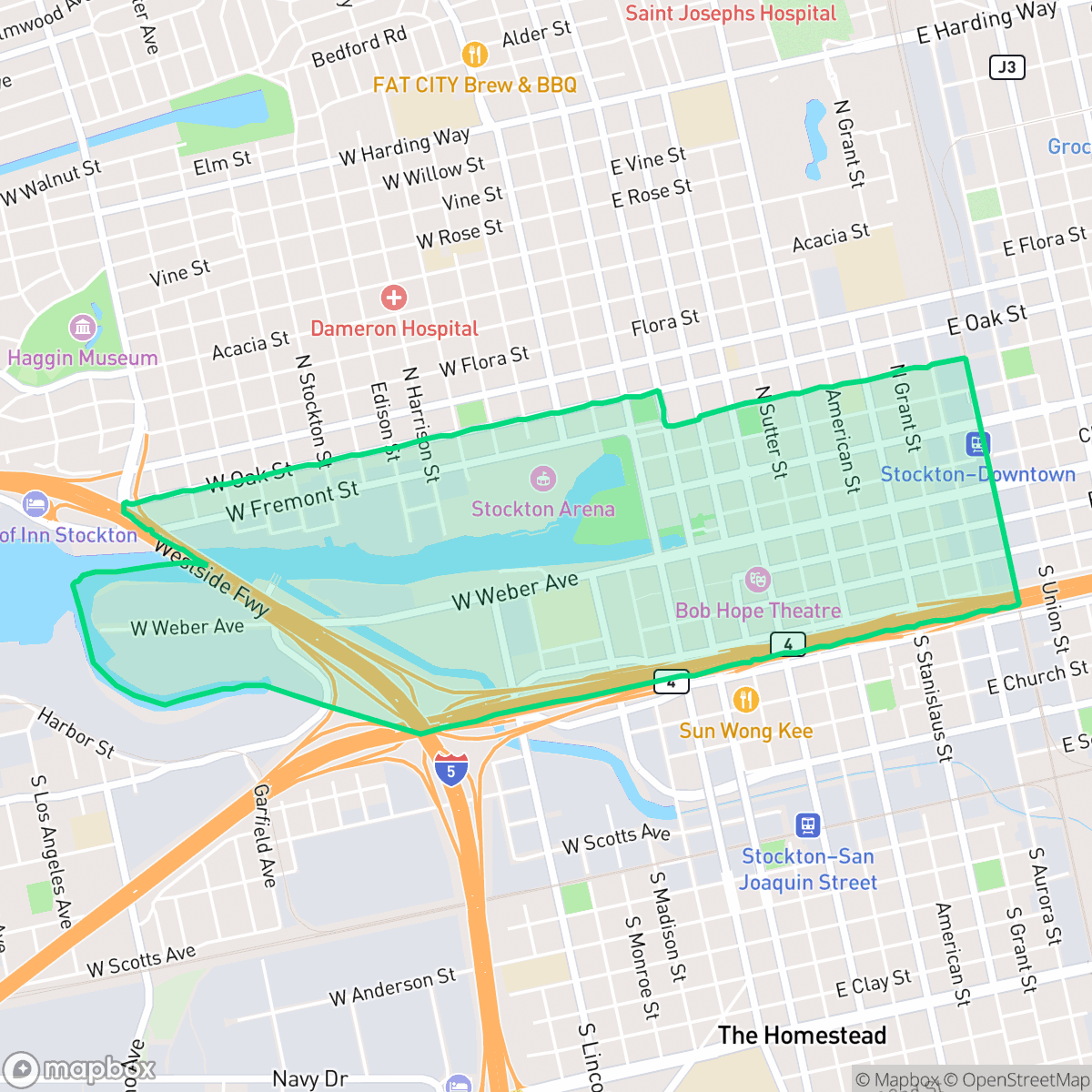
About Downtown
Founded in 1849 by Captain Charles Maria Weber, Downtown Stockton served as a vital inland port and supply hub for gold seekers during the California Gold Rush. The area’s historic core is defined by its grid-based layout and significant early 20th-century architecture, including the 1910 Hotel Stockton and the 1930 Fox California Theatre, a Spanish Colonial Revival landmark now known as the Bob Hope Theatre. Historically, the neighborhood was home to a vibrant Chinatown and centered around Hunter Square, a plaza modeled after Spanish traditions. Known as “the brick city” for its dense collection of commercial masonry buildings, downtown transitioned from a mining supply point to an agricultural shipping center. Today, it retains its cultural identity through preserved historic facades and its enduring role as the administrative and civic heart of Stockton.
The neighborhood functions as the administrative and civic heart of the city, characterized by a dense urban grid that supports a mix of commercial, institutional, and residential properties. Its layout promotes functional pedestrian access, allowing residents to navigate easily between local eateries and the waterfront. According to iHuus data, the area maintains a strongly liberal-leaning demographic, contributing to a diverse and energetic atmosphere that differentiates it from surrounding suburban zones. The aesthetic is largely utilitarian, featuring high-density architecture and limited private yards, which reflects its role as a concentrated urban hub rather than a traditional residential neighborhood.
Prospective residents should consider several livability trade-offs, including higher noise levels stemming from frequent railroad activity and heavy traffic. The area also presents challenges regarding health insurance coverage and academic performance within the local school district. While the neighborhood offers proximity to essential services and cultural landmarks, it is also situated near industrial zones and areas with potential environmental considerations. It is best suited for individuals who prioritize walkability and access to urban amenities over the quiet, spacious living conditions found in less developed parts of the city.
Neighborhood Scores Across 15 Qualities
Building density is higher than the Stockton average, resulting in narrow gaps between structures and limited private yard buffers. Some areas feature closely packed buildings with minimal distance between neighbors.
A grid of wide streets and dedicated sidewalks allows for easy movement between residential areas and the waterfront. While the sidewalk network is extensive, it is slightly less comprehensive than the average for Stockton.
Residential structures consist largely of high-density, boxy architecture with minimal yard space. This landscape offers less visual variety and fewer luxury amenities than the typical Stockton neighborhood, according to iHuus data.
Access to public green space and waterfront parks provides good walking areas for pets, though the neighborhood offers fewer wide verges and smaller private yards than the city average. According to iHuus data, most residential lots feature narrow sidewalks and limited accessible greenery.
A dense urban grid of low-rise residential and institutional buildings characterizes this area. According to iHuus data, the landscape is slightly more developed than the city average, showing fewer open fields or wooded areas.
Diverse dining and commercial hubs provide a higher level of activity than the Stockton average. The area features a mix of high-energy suburban blocks and quieter industrial zones alongside essential services.
Frequent noise from nearby railroad tracks and heavy traffic is a notable feature of this area. According to iHuus data, acoustic comfort is lower than the average for the rest of Stockton.
Air quality levels in this area typically fluctuate between acceptable and unhealthy. According to iHuus data, these conditions are consistent with the city average.
Residential areas blend with active commercial zones and large warehouses, resulting in lower industrial density than the Stockton average. Residents should be aware of nearby heavy freight traffic and the presence of a local EPA Superfund site with potential soil and groundwater implications, according to iHuus data.
Health insurance access among residents is notably lower than the Stockton average, according to iHuus data. This indicates a higher proportion of uninsured individuals living in the area compared to the rest of the city.
Voting patterns and census indicators show a significantly more liberal leaning than the rest of Stockton. According to iHuus data, this area maintains a much higher concentration of liberal-leaning residents compared to the city average.
Residents live alongside a balanced mix of young adults, families, and older populations. This demographic spread is consistent with the broader Stockton area according to iHuus data.
Flood safety levels in this area are lower than the Stockton average due to a lack of detailed federal studies for the region. Residents should exercise caution as the precise risk level remains undetermined according to iHuus data.
Address-Level Insights for Downtown


iHuus Neighborhood Intelligence Insights
Get address-level neighborhood insights for Downtown
- Street-level scores — see how individual blocks compare, not just neighborhood averages
- Micro-zone boundaries — identify quiet pockets, flood boundaries, and walkable clusters before you visit
- 15 dimensions in full — walkability, noise, air quality, school quality, insurance coverage, population age profile, urban/rural index, and more
- Boundary risk alerts — know if your address sits near a block boundary where scores drop, the kind of detail no listing will ever mention
- School insights — individual school ratings and insights, not just district-level data
- Compare before you commit — side-by-side data across neighborhoods, down to block precision
No credit card required
Compare with Any Neighborhood
| Dimension | Downtown | Anderson |
|---|---|---|
| 🚶 Walkabilityavg 8.33 | ||
| 🔊 Acoustic Comfortavg 3.04 | ||
| 🤫 Privacy Indexavg 5.32 | ||
| 🎨 Visual Appealavg 6.38 | ||
| 🐕 Dog Friendlinessavg 6.44 | ||
| 🗺️ Urban-Rural Indexavg 6.82 | ||
| ✨ Neighborhood Vibeavg 4.6 | ||
| 🏥 Health Insurance Coverageavg 6.72 | ||
| 🌿 Air Qualityavg 6 | ||
| 🏭 Industrial Proximityavg 7.71 | ||
| 🌊 Flood Safetyavg 5.9 | ||
| 🗳️ Ideological Leanavg 8.5 | ||
| 👥 Population Age Profileavg 4.59 | ||
| 🔥 Fire Safety | ||
| 🏫 School Quality |
Downtown Rankings
School Districts Serving Downtown
School Insights for Downtown
Below average outcomes; significant attendance and academic challenges.
School Insights
See what's really behind every school rating near Downtown
- Individual school ratings — each school's own score with outcome context, not just a district average
- Enrollment & class size data — student-to-teacher ratio and how it compares to the state average
- Full demographics breakdown — ethnicity and gender composition for every school in the enrollment zone
- Every school in the district — all schools within the enrollment boundary ranked by rating, not just the closest one
- Grade levels & benchmarks — elementary through high school, with below/above state-average flags
No credit card required