Quito, Saratoga
Updated · 2,313 residents
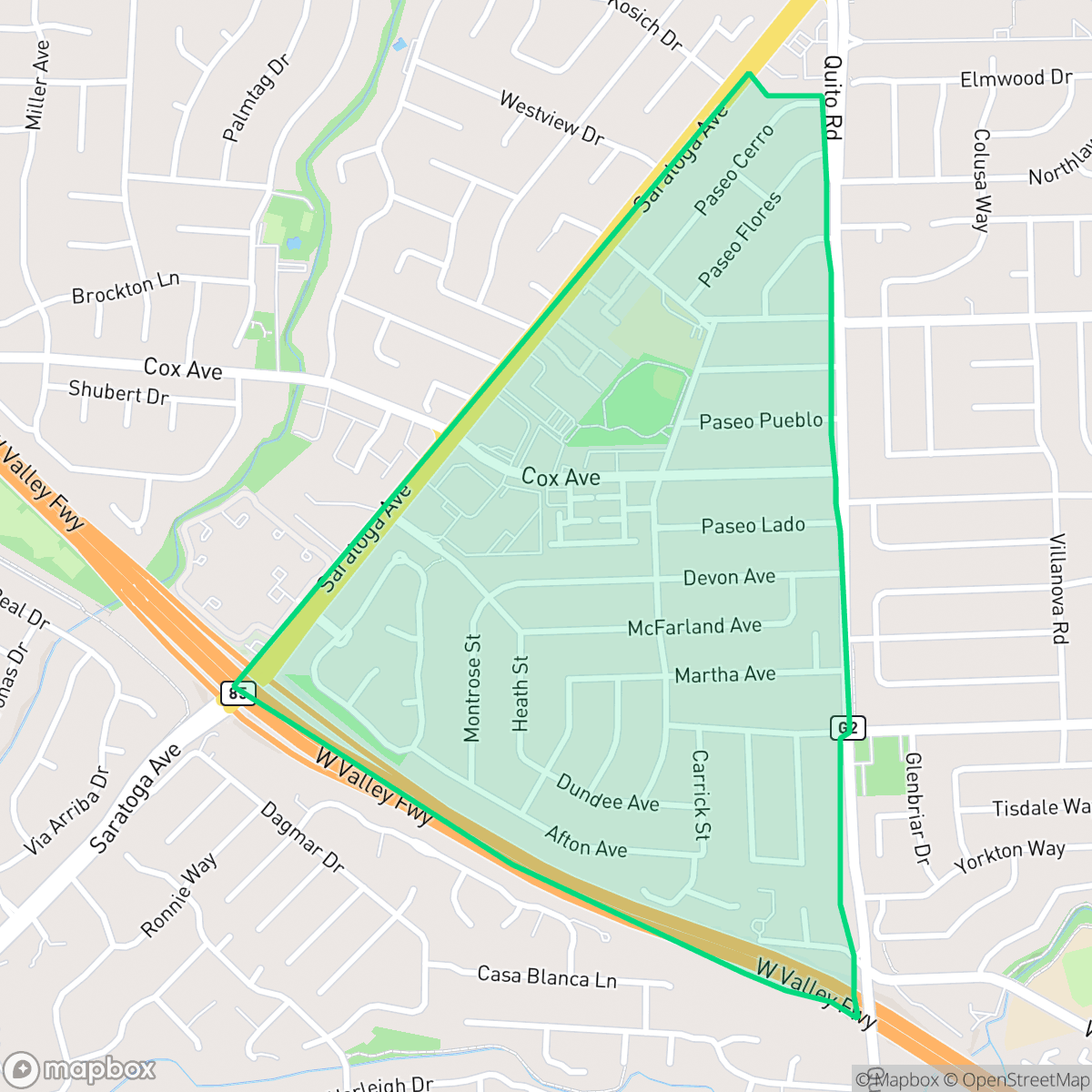
Quito is a quiet, suburban neighborhood in Saratoga characterized by its transition from historic orchard land to a residential community. It offers exceptional walkability for a suburban setting, allowing residents easy access to local amenities and community spaces. While it maintains a peaceful atmosphere, residents should note that proximity to major roads results in consistent traffic noise.
Key Highlights
About Quito
The Quito neighborhood in Saratoga, California, traces its origins to Rancho Quito, a 13,310-acre Mexican land grant awarded in 1841. In the late 19th and early 20th centuries, the area thrived as part of the agricultural San Tomas District, dominated by sprawling prune, cherry, and apricot orchards. A notable architectural remnant of this era is the Frank Mitchell House on Quito Road, a Craftsman Bungalow built circa 1909. Following World War II, the orchards were subdivided into residential tracts, including El Quito Park and San Tomas Acres in 1950. The neighborhood’s former commercial center, Quito Village, once hosted the Quito Park Library until 1978 and has recently been redeveloped into a mixed-use townhome community.
The neighborhood serves as a residential enclave that balances suburban tranquility with surprising accessibility. Its layout features a mix of established homes and green spaces, providing a distinct sense of community that benefits from proximity to top-tier educational institutions like the Los Gatos-Saratoga Joint Union and Saratoga Union school districts. These schools remain a primary draw for families looking to settle in a region known for academic excellence and long-term property stability.
Prospective residents should weigh the benefits of high walkability against the acoustic reality of living near major thoroughfares. While the area offers a serene, low-density environment, the ambient noise from road traffic is a constant factor. It is best suited for families and professionals who prioritize school district quality and neighborhood connectivity over absolute silence, and who value living in a well-established part of the Silicon Valley landscape.
Neighborhood Scores Across 15 Qualities
Residential spacing is mixed, with some homes positioned closely in a grid layout. According to iHuus data, this level of density is slightly lower than the Saratoga average.
Sidewalks and safe crossings are widely available, making the area slightly more walkable than the Saratoga average. While mature trees occasionally obscure path continuity in suburban cul-de-sacs, traffic remains low and pedestrian-friendly.
Properties feature large homes and spacious driveways, though the visual variety is slightly lower than the Saratoga average due to some standard tract housing layouts. According to iHuus data, the area maintains a pleasant aesthetic with frequent upscale amenities and private backyard pools.
Private yards are largely fenced and sidewalk verges are narrow, offering fewer opportunities for off-leash walking compared to the Saratoga average. According to iHuus data, there is minimal visible public park access within the immediate area.
Residential tracts feature consistent high-density housing with very little open land. This area feels more densely developed than the more semi-rural parts of Saratoga.
Suburban streets and green spaces offer a steady, low-key atmosphere that is slightly more active than the Saratoga average. While some dining and social hubs are accessible, much of the area remains car-dependent with limited commercial density.
Frequent noise from nearby major transit routes and flight paths makes this area significantly louder than the Saratoga average, according to iHuus data.
Air quality in this area fluctuates between acceptable and unhealthy levels. According to iHuus data, conditions are slightly lower than the Saratoga average, which may cause occasional concern for sensitive groups.
Zero industrial facilities, warehouses, or hazard sites are present within the neighborhood. This area is exclusively residential and offers a cleaner environment than the Saratoga average, according to iHuus data.
Most residents in this area are covered by health insurance, though the rate of coverage is slightly lower than the Saratoga city average according to iHuus data.
Voting patterns and census indicators reflect a predominantly liberal community, which is slightly more pronounced than the Saratoga average according to iHuus data.
Residents live alongside a balanced mix of young adults, families, and older individuals. This demographic spread is relatively consistent with the broader Saratoga area, according to iHuus data.
Flood risk in this area is higher than the Saratoga average, as portions of the neighborhood sit within a designated floodplain. According to iHuus data, residents may find that flood insurance is typically required for properties here.
Address-Level Insights for Quito


iHuus Neighborhood Intelligence Insights
Get address-level neighborhood insights for Quito
- Street-level scores — see how individual blocks compare, not just neighborhood averages
- Micro-zone boundaries — identify quiet pockets, flood boundaries, and walkable clusters before you visit
- 15 dimensions in full — walkability, noise, air quality, school quality, insurance coverage, population age profile, urban/rural index, and more
- Boundary risk alerts — know if your address sits near a block boundary where scores drop, the kind of detail no listing will ever mention
- School insights — individual school ratings and insights, not just district-level data
- Compare before you commit — side-by-side data across neighborhoods, down to block precision
No credit card required
Compare with Any Neighborhood
| Dimension | Quito | Congress Springs |
|---|---|---|
| 🚶 Walkabilityavg 8.04 | ||
| 🔊 Acoustic Comfortavg 3.52 | ||
| 🤫 Privacy Indexavg 6.46 | ||
| 🎨 Visual Appealavg 8.6 | ||
| 🐕 Dog Friendlinessavg 6.84 | ||
| 🗺️ Urban-Rural Indexavg 7.19 | ||
| ✨ Neighborhood Vibeavg 3.73 | ||
| 🏥 Health Insurance Coverageavg 9.5 | ||
| 🌿 Air Qualityavg 6.51 | ||
| 🏭 Industrial Proximityavg 9.76 | ||
| 🌊 Flood Safetyavg 4.09 | ||
| 🗳️ Ideological Leanavg 9.2 | ||
| 👥 Population Age Profileavg 5.5 | ||
| 🔥 Fire Safetyavg 0.3 | ||
| 🏫 School Quality |
Quito Rankings
School Districts Serving Quito
School Insights for Quito
Below average outcomes; significant attendance and academic challenges.
School Insights
See what's really behind every school rating near Quito
- Individual school ratings — each school's own score with outcome context, not just a district average
- Enrollment & class size data — student-to-teacher ratio and how it compares to the state average
- Full demographics breakdown — ethnicity and gender composition for every school in the enrollment zone
- Every school in the district — all schools within the enrollment boundary ranked by rating, not just the closest one
- Grade levels & benchmarks — elementary through high school, with below/above state-average flags
No credit card required