Fruitvale, Saratoga
Updated · 5,360 residents
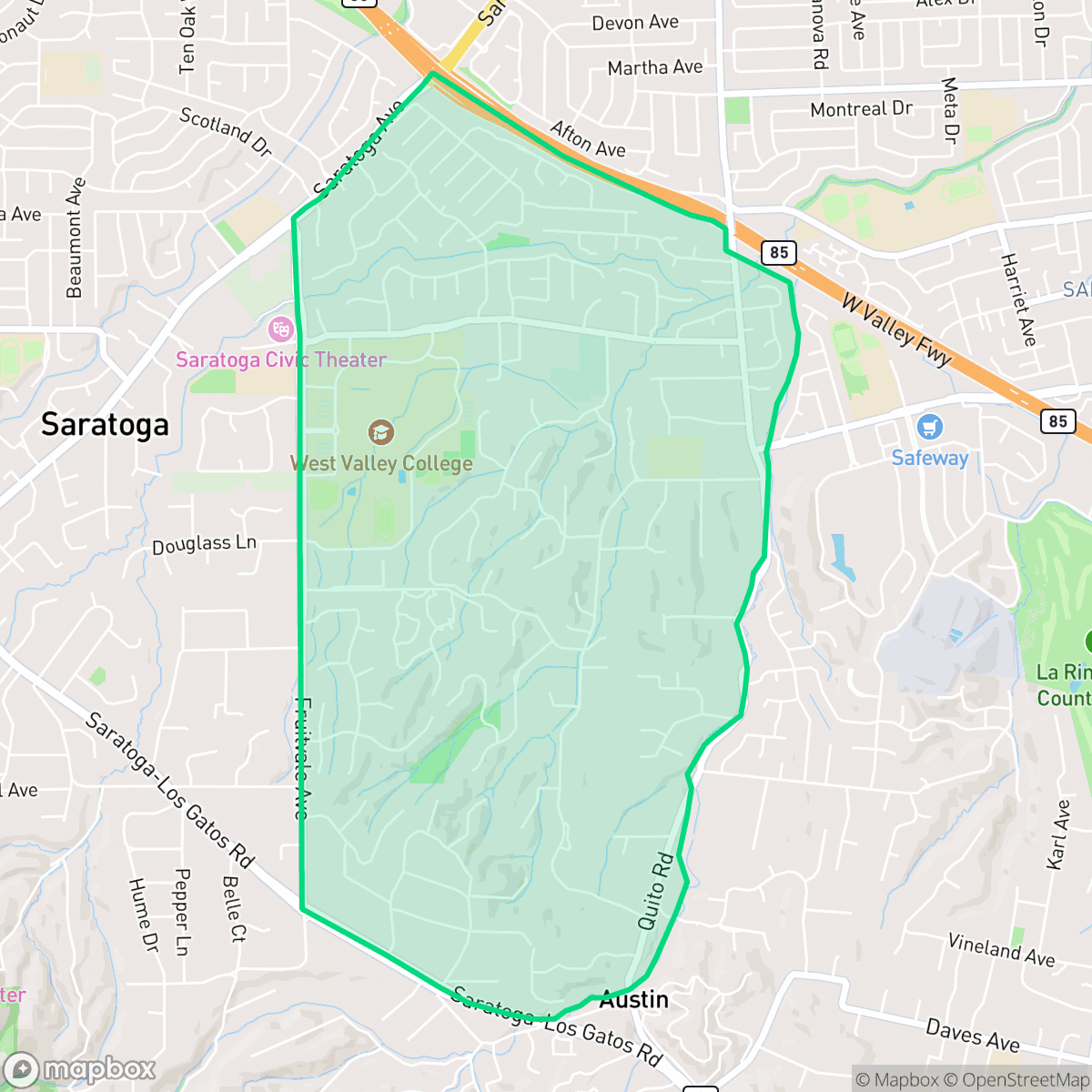
Fruitvale is a quiet, low-density neighborhood in Saratoga defined by its rural landscape, preserved agricultural heritage, and high visual appeal. While it offers a serene environment with significant open space, the area is primarily residential and lacks a dense commercial core.
Key Highlights
About Fruitvale
The Fruitvale neighborhood in Saratoga, California, named for its agricultural roots during the region's late 19th-century horticultural boom, preserves a rich legacy of historic orchards and architecture. A prominent local landmark is the 1912 Odd Fellows Home (now the Saratoga Retirement Community) on Fruitvale Avenue, a Mission Revival-style building designed by Ralph Warren Hart with formal gardens landscaped by John McLaren. The neighborhood also features historic residences like the Folk Victorian Ellis House (c. 1885) and Novakovich Farms. Purchased in 1925 by Yugoslavian immigrants Matt and Mary Novakovich, the farm features an 1890 Queen Anne farmhouse and remains one of Saratoga's last family-run orchards. Since 1975, the Novakovich family has also managed the city-owned Heritage Orchard on Fruitvale Avenue, preserving the agricultural character of the "Valley of Heart's Delight".
The area maintains a distinct rural aesthetic characterized by large plots, greenery, and minimal commercial development. With high marks for visual appeal, it provides a tranquil setting for those looking to escape the bustle of more urbanized Silicon Valley corridors. The landscape is predominantly residential, featuring scattered housing and extensive open space that preserves the character of the region.
Living here requires a reliance on personal vehicles, as the neighborhood features limited walkability and few local businesses. According to iHuus data, residents benefit from proximity to elite school districts, making it an attractive option for families prioritizing education. Prospective residents should note the moderate road noise from nearby highways and the necessity of proactive fire safety measures given the local environmental conditions.
Neighborhood Scores Across 15 Qualities
Large lots with significant separation provide a sense of seclusion, though privacy levels are roughly in line with the Saratoga city average according to iHuus data.
Safe crossings and sidewalks on one side of the street facilitate pedestrian movement, though accessibility is slightly lower than the Saratoga average according to iHuus data.
Custom architecture and private greenery define the area, offering a level of aesthetic polish that is slightly higher than the Saratoga average. Large privacy buffers and high-end amenities contribute to a premium visual environment, according to iHuus data.
Connected green spaces and wide paths provide a safe environment for pets away from traffic. This level of accessibility for dogs is slightly above the Saratoga average, according to iHuus data.
Open land and woodland are frequently interspersed with scattered homes, creating a landscape slightly more rural than the Saratoga average. According to iHuus data, the area also features pockets of dense suburban development with a significant tree canopy.
This area is notably more tranquil and secluded than the rest of Saratoga, characterized by low-density housing and significant open space. Residents will find very little commercial activity or local business density, making the neighborhood a car-dependent environment focused on residential privacy.
Proximity to major transit corridors and railway lines results in audible disturbances. According to iHuus data, acoustic comfort in this area is slightly below the Saratoga average.
Air quality remains consistently good with only rare instances of elevated readings. This level of air purity is slightly higher than the average found throughout Saratoga.
Residential streets and open green spaces dominate the area, though a wastewater treatment plant is located at the southeastern edge of the neighborhood. This lack of industrial presence is slightly lower than the Saratoga average due to this single utility facility.
Health insurance access is nearly universal among residents, though it remains slightly below the Saratoga city average according to iHuus data.
Voting patterns and census indicators in Fruitvale reflect a predominantly liberal leaning, which is very similar to the broader Saratoga area according to iHuus data.
Residents live among a diverse range of age groups, including young adults, families, and seniors. This demographic spread is roughly in line with the broader Saratoga area, according to iHuus data.
Properties in this area are situated within a designated floodplain, which presents a higher risk of flooding than the Saratoga average. According to iHuus data, residents may find that flood insurance is typically required for homes in this neighborhood.
Wildfire hazards in this area are critical and represent a significant danger to residents. This level of risk is slightly higher than the average found across Saratoga, according to iHuus data.
Address-Level Insights for Fruitvale


iHuus Neighborhood Intelligence Insights
Get address-level neighborhood insights for Fruitvale
- Street-level scores — see how individual blocks compare, not just neighborhood averages
- Micro-zone boundaries — identify quiet pockets, flood boundaries, and walkable clusters before you visit
- 15 dimensions in full — walkability, noise, air quality, school quality, insurance coverage, population age profile, urban/rural index, and more
- Boundary risk alerts — know if your address sits near a block boundary where scores drop, the kind of detail no listing will ever mention
- School insights — individual school ratings and insights, not just district-level data
- Compare before you commit — side-by-side data across neighborhoods, down to block precision
No credit card required
Compare with Any Neighborhood
| Dimension | Fruitvale | Congress Springs |
|---|---|---|
| 🚶 Walkabilityavg 8.04 | ||
| 🔊 Acoustic Comfortavg 3.52 | ||
| 🤫 Privacy Indexavg 6.46 | ||
| 🎨 Visual Appealavg 8.6 | ||
| 🐕 Dog Friendlinessavg 6.84 | ||
| 🗺️ Urban-Rural Indexavg 7.19 | ||
| ✨ Neighborhood Vibeavg 3.73 | ||
| 🏥 Health Insurance Coverageavg 9.5 | ||
| 🌿 Air Qualityavg 6.51 | ||
| 🏭 Industrial Proximityavg 9.76 | ||
| 🌊 Flood Safetyavg 4.09 | ||
| 🗳️ Ideological Leanavg 9.2 | ||
| 👥 Population Age Profileavg 5.5 | ||
| 🔥 Fire Safetyavg 0.3 | ||
| 🏫 School Quality |
Fruitvale Rankings
School Districts Serving Fruitvale
School Insights for Fruitvale
Below average outcomes; significant attendance and academic challenges.
School Insights
See what's really behind every school rating near Fruitvale
- Individual school ratings — each school's own score with outcome context, not just a district average
- Enrollment & class size data — student-to-teacher ratio and how it compares to the state average
- Full demographics breakdown — ethnicity and gender composition for every school in the enrollment zone
- Every school in the district — all schools within the enrollment boundary ranked by rating, not just the closest one
- Grade levels & benchmarks — elementary through high school, with below/above state-average flags
No credit card required