China Camp, Santa Venetia
Updated · 79 residents
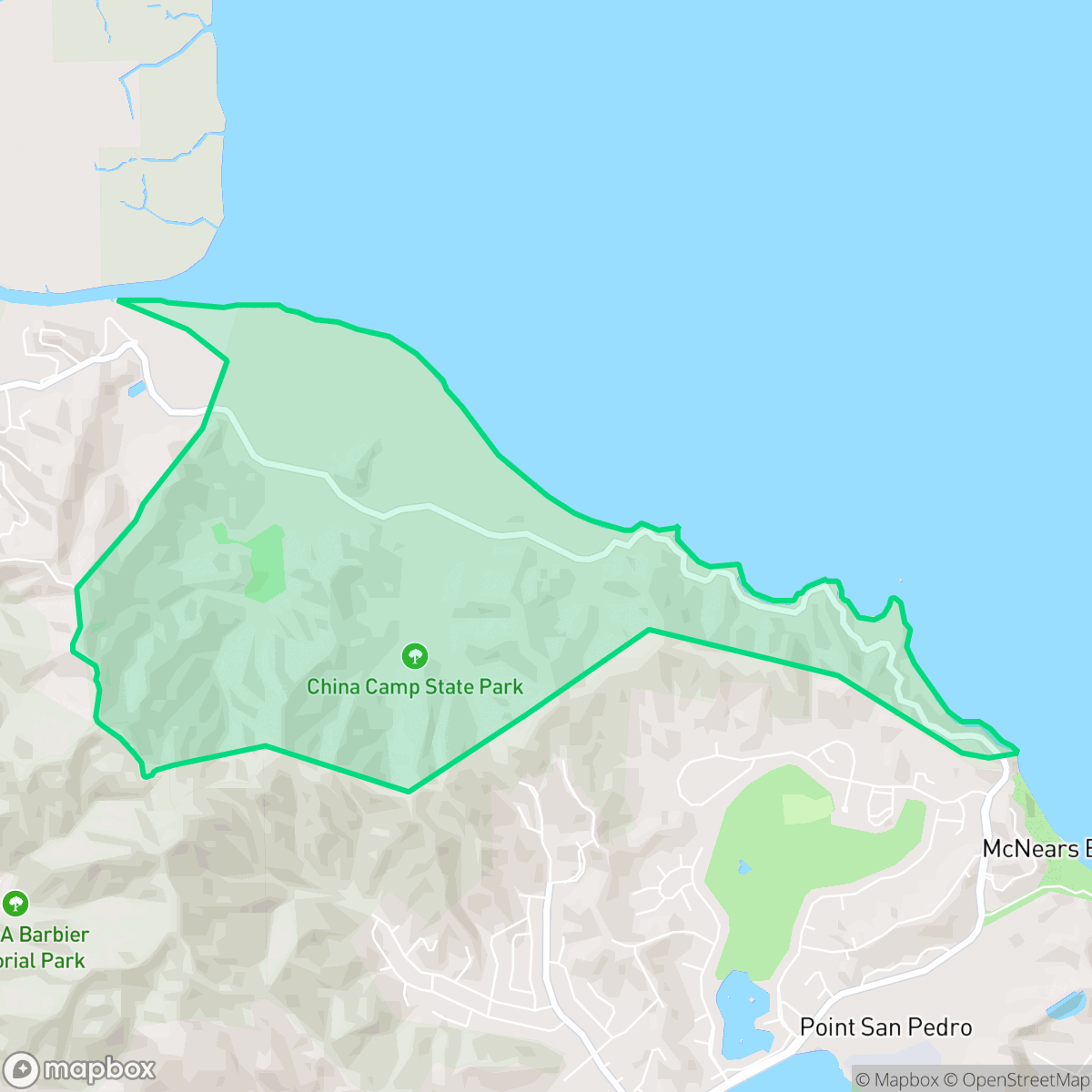
China Camp is a quiet, rural enclave situated along the shores of San Pablo Bay, defined by its expansive open spaces and serene atmosphere. While the area offers high levels of privacy and is exceptionally dog-friendly, it remains a remote destination with limited commercial activity and a very low-key, tranquil lifestyle.
Key Highlights
About China Camp
Established in the late 1860s by Chinese immigrants who had worked on the transcontinental railroad, China Camp emerged as a vital, self-sustaining Chinese shrimp-fishing village on the shores of San Pablo Bay. By the 1880s, the settlement grew to nearly 500 residents living in dozens of wooden structures, including general stores and a marine supply shop. Residents utilized traditional Chinese junk boats and bag nets to harvest and dry millions of pounds of shrimp annually for export. Although early 20th-century discriminatory legislation outlawing shrimp exports and traditional nets decimated the industry, the site was preserved in 1977 as China Camp State Park. Frank Quan, the last active shrimp fisherman and descendant of early settlers, maintained his residency and operated a local cafe here until his death in 2016.
The neighborhood is a sparsely populated, rural-leaning area characterized by minimal development and proximity to natural landscapes. Unlike the more developed parts of Santa Venetia, this community prioritizes seclusion and environmental preservation. Residents benefit from high acoustic comfort and a peaceful environment, though the lack of local businesses necessitates travel for daily errands and services. According to iHuus data, the area maintains a distinct, low-density character that stands in contrast to the more bustling, walkable sections of the broader San Rafael region.
This area is best suited for those who value quietude and outdoor access over urban convenience. Potential residents should consider the environmental factors, including moderate risks related to fire and flood safety, as well as the limited access to local infrastructure. The neighborhood offers a unique opportunity to live in a setting that values space and natural beauty, making it an ideal choice for those who prefer a slower pace of life.
Neighborhood Scores Across 15 Qualities
Residential lots feature significant separation between structures, providing more privacy than the typical city average. According to iHuus data, the neighborhood layout favors seclusion due to the wide spacing between properties.
Pedestrian movement is supported by safe crossings and sidewalks on one side of the street, though walkability is slightly lower than the city average.
Large residential properties and frequent upscale amenities contribute to a visual landscape that is slightly more polished than the city average, according to iHuus data.
Extensive trail networks and open spaces provide ample opportunities for pet exercise. This availability of nearby parks and natural terrain is slightly higher than the city average, according to iHuus data.
Expansive forests and agricultural land dominate the landscape, offering a much more secluded environment than the typical city setting. According to iHuus data, this area features very low building density and minimal urban development.
A serene and low-density landscape characterizes this area, which features vast open spaces and minimal commercial activity. According to iHuus data, the lack of local businesses and services results in a much lower level of liveliness compared to the city average.
Steady traffic noise from a nearby busy street is present, though levels remain comparable to the city average according to iHuus data.
Air quality remains consistently high with negligible health concerns. This level of cleanliness is slightly above the city average according to iHuus data.
Industrial presence is non-existent here, as the area consists entirely of residential streets and open green spaces. This lack of warehouses or hazard sites makes the neighborhood even more secluded than the city average.
Health insurance access is prevalent among residents, sitting above the city average according to iHuus data.
Political leanings in this area are primarily liberal, though the community is slightly less progressive than the broader city average according to iHuus data.
A balanced demographic of young adults, families, and seniors characterizes this area. According to iHuus data, this age distribution is slightly more varied than the city average.
Located within a designated hundred-year floodplain, this area faces significantly higher flood risks than the city average. Residents should prepare for potential inundation and the likely requirement of flood insurance according to iHuus data.
Elevated fire hazards exist in this area compared to the city average, necessitating standard seasonal mitigation and precaution. Local terrain and vegetation levels contribute to a higher risk profile than most parts of the city.
Address-Level Insights for China Camp


iHuus Neighborhood Intelligence Insights
Get address-level neighborhood insights for China Camp
- Street-level scores — see how individual blocks compare, not just neighborhood averages
- Micro-zone boundaries — identify quiet pockets, flood boundaries, and walkable clusters before you visit
- 15 dimensions in full — walkability, noise, air quality, school quality, insurance coverage, population age profile, urban/rural index, and more
- Boundary risk alerts — know if your address sits near a block boundary where scores drop, the kind of detail no listing will ever mention
- School insights — individual school ratings and insights, not just district-level data
- Compare before you commit — side-by-side data across neighborhoods, down to block precision
No credit card required
Compare with Any Neighborhood
| Dimension | China Camp | Santa Venetia |
|---|---|---|
| 🚶 Walkabilityavg 7.9 | ||
| 🔊 Acoustic Comfortavg 5.66 | ||
| 🤫 Privacy Indexavg 6.02 | ||
| 🎨 Visual Appealavg 7.77 | ||
| 🐕 Dog Friendlinessavg 9.62 | ||
| 🗺️ Urban-Rural Indexavg 7.64 | ||
| ✨ Neighborhood Vibeavg 3.18 | ||
| 🏥 Health Insurance Coverageavg 8.29 | ||
| 🌿 Air Qualityavg 9.46 | ||
| 🏭 Industrial Proximityavg 9.34 | ||
| 🌊 Flood Safetyavg 3.21 | ||
| 🗳️ Ideological Leanavg 9.66 | ||
| 👥 Population Age Profileavg 5.65 | ||
| 🔥 Fire Safetyavg 1.43 | ||
| 🏫 School Quality |
China Camp Rankings
School Districts Serving China Camp
School Insights for China Camp
Below average outcomes; significant attendance and academic challenges.
School Insights
See what's really behind every school rating near China Camp
- Individual school ratings — each school's own score with outcome context, not just a district average
- Enrollment & class size data — student-to-teacher ratio and how it compares to the state average
- Full demographics breakdown — ethnicity and gender composition for every school in the enrollment zone
- Every school in the district — all schools within the enrollment boundary ranked by rating, not just the closest one
- Grade levels & benchmarks — elementary through high school, with below/above state-average flags
No credit card required