Corby/Beachwood, Santa Rosa
Updated · 1,084 residents
Corby/Beachwood is a highly walkable neighborhood characterized by a mix of residential tract housing and light industrial zones. While residents benefit from strong health insurance coverage and a community-oriented environment, the area faces challenges regarding noise levels from nearby rail and freeway traffic as well as elevated flood risks.
Key Highlights
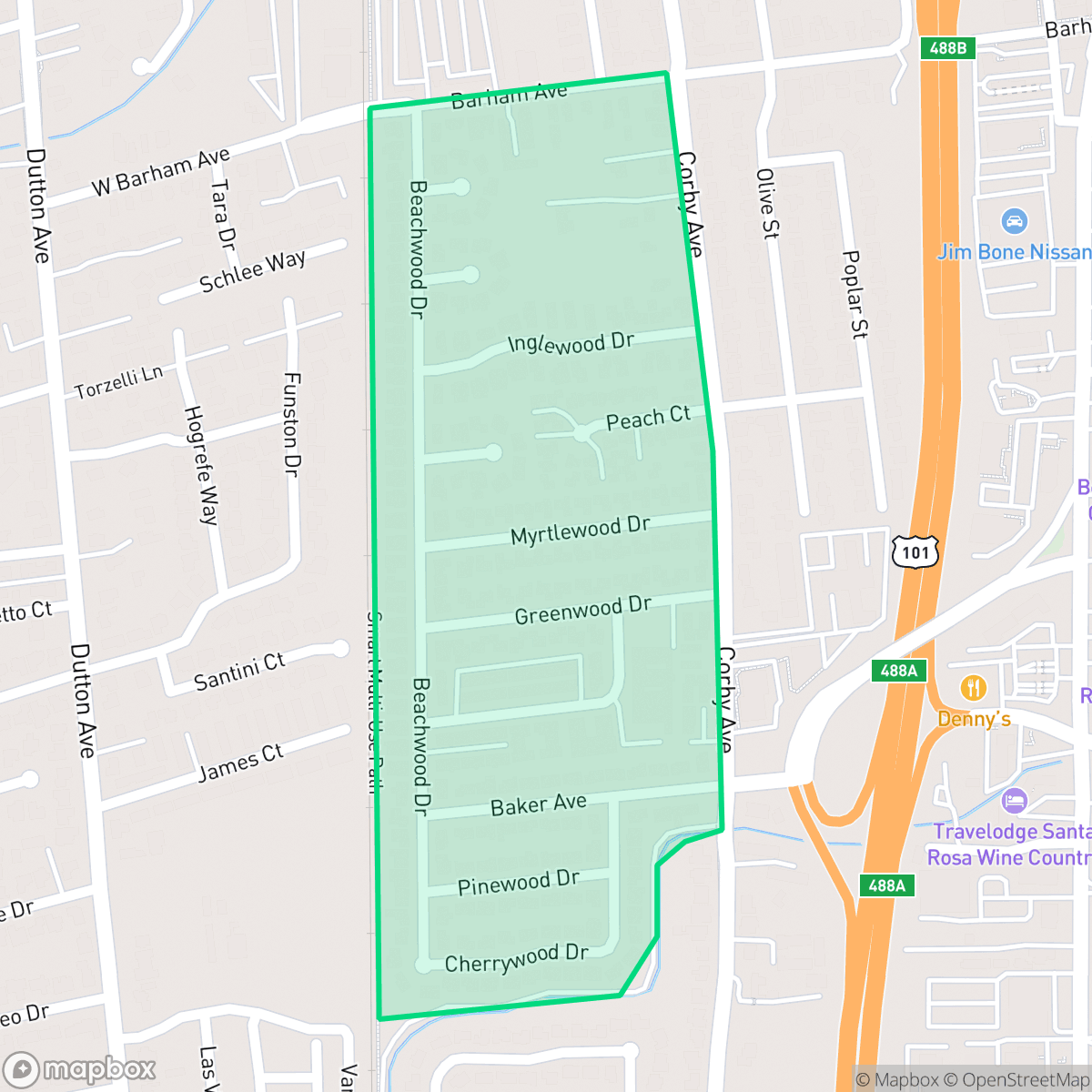
About Corby/Beachwood
Corby/Beachwood presents a semi-rural character where open, wooded spaces intersect with established residential pockets and light industrial facilities. The neighborhood maintains a consistent pedestrian network that makes local travel easy, though the visual landscape is primarily defined by uniform housing layouts. Politically, the area leans strongly liberal, reflecting a demographic that values community support and maintains high levels of health insurance coverage.
Prospective residents should weigh the benefits of high walkability against several notable trade-offs. The neighborhood experiences frequent noise due to its proximity to major transportation corridors, and the local geography carries a significant risk of flooding. Families considering the area should be aware that the local school districts are currently navigating periods of fiscal instability and academic transition, which may impact long-term educational planning.
Neighborhood Scores Across 15 Qualities
Residential spacing varies between homes with shared walls and properties featuring modest buffers. According to iHuus data, privacy levels are roughly comparable to the rest of Santa Rosa.
Pedestrian routes are easy to navigate due to a comprehensive sidewalk network and safe crossings. This level of connectivity for walking is consistent with the rest of Santa Rosa.
Modest lot sizes and uniform rooflines characterize this area of tract housing and multi-unit complexes. According to iHuus data, the visual variety in this neighborhood is slightly lower than the Santa Rosa average.
Large open fields and consistent sidewalks with green verges provide ample space for dog walking, though overall accessibility is slightly below the Santa Rosa average according to iHuus data.
Open land and wooded areas are frequently interspersed with residential pockets, though the area feels slightly less urbanized than the Santa Rosa average. According to iHuus data, the landscape features a mix of scattered homes and denser suburban layouts.
Suburban blocks offer a steady rhythm of residential life and light industrial use, providing a slightly more active environment than the typical Santa Rosa neighborhood. While a few dining options and services are accessible, most essential businesses are not within immediate walking distance.
Frequent noise from nearby railroad tracks and heavy freeway traffic impacts the area. According to iHuus data, acoustic comfort is lower than the Santa Rosa average.
Air quality in this area is consistent with the Santa Rosa average. Residents may experience a mix of acceptable and unhealthy days, which occasionally presents concerns for sensitive groups according to iHuus data.
Light industrial buildings and warehouses are present along the central and southeastern portions of the area, making the level of industrial proximity lower than the Santa Rosa average. Residents may encounter increased daytime traffic and activity near these commercial zones, according to iHuus data.
Health insurance access is notably higher than the Santa Rosa average. According to iHuus data, a significant majority of residents in this area maintain coverage.
Voting patterns and census indicators show a predominantly liberal leaning that is slightly more pronounced than the Santa Rosa average, according to iHuus data.
A balanced variety of age groups resides here, including young adults, families, and seniors. According to iHuus data, this demographic spread is slightly less varied than the Santa Rosa average.
Located in a coastal high-hazard zone subject to wave action, this area faces significantly greater flood risk than the rest of Santa Rosa. According to iHuus data, residents should anticipate elevated or potentially prohibitive flood insurance costs.
Address-Level Insights for Corby/Beachwood


iHuus Neighborhood Intelligence Insights
Get address-level neighborhood insights for Corby/Beachwood
- Street-level scores — see how individual blocks compare, not just neighborhood averages
- Micro-zone boundaries — identify quiet pockets, flood boundaries, and walkable clusters before you visit
- 15 dimensions in full — walkability, noise, air quality, school quality, insurance coverage, population age profile, urban/rural index, and more
- Boundary risk alerts — know if your address sits near a block boundary where scores drop, the kind of detail no listing will ever mention
- School insights — individual school ratings and insights, not just district-level data
- Compare before you commit — side-by-side data across neighborhoods, down to block precision
No credit card required
Compare with Any Neighborhood
| Dimension | Corby/Beachwood | Aston Ave |
|---|---|---|
| 🚶 Walkabilityavg 8.16 | ||
| 🔊 Acoustic Comfortavg 4.3 | ||
| 🤫 Privacy Indexavg 5.6 | ||
| 🎨 Visual Appealavg 6.73 | ||
| 🐕 Dog Friendlinessavg 7.28 | ||
| 🗺️ Urban-Rural Indexavg 7.07 | ||
| ✨ Neighborhood Vibeavg 4.43 | ||
| 🏥 Health Insurance Coverageavg 7.43 | ||
| 🌿 Air Qualityavg 6 | ||
| 🏭 Industrial Proximityavg 8.62 | ||
| 🌊 Flood Safetyavg 3.62 | ||
| 🗳️ Ideological Leanavg 9.57 | ||
| 👥 Population Age Profileavg 5.13 | ||
| 🔥 Fire Safety | ||
| 🏫 School Quality |
Corby/Beachwood Rankings
School Districts Serving Corby/Beachwood
School Insights for Corby/Beachwood
Below average outcomes; significant attendance and academic challenges.
School Insights
See what's really behind every school rating near Corby/Beachwood
- Individual school ratings — each school's own score with outcome context, not just a district average
- Enrollment & class size data — student-to-teacher ratio and how it compares to the state average
- Full demographics breakdown — ethnicity and gender composition for every school in the enrollment zone
- Every school in the district — all schools within the enrollment boundary ranked by rating, not just the closest one
- Grade levels & benchmarks — elementary through high school, with below/above state-average flags
No credit card required