Wilshire/Montana, Santa Monica
Updated · 13,912 residents
Wilshire/Montana is an exceptionally walkable neighborhood defined by its bustling boutique commercial corridor and manicured residential streets. Residents enjoy clean air and a vibrant social atmosphere, though the area is characterized by densely packed housing and a notable risk of fire.
Key Highlights
About Wilshire/Montana
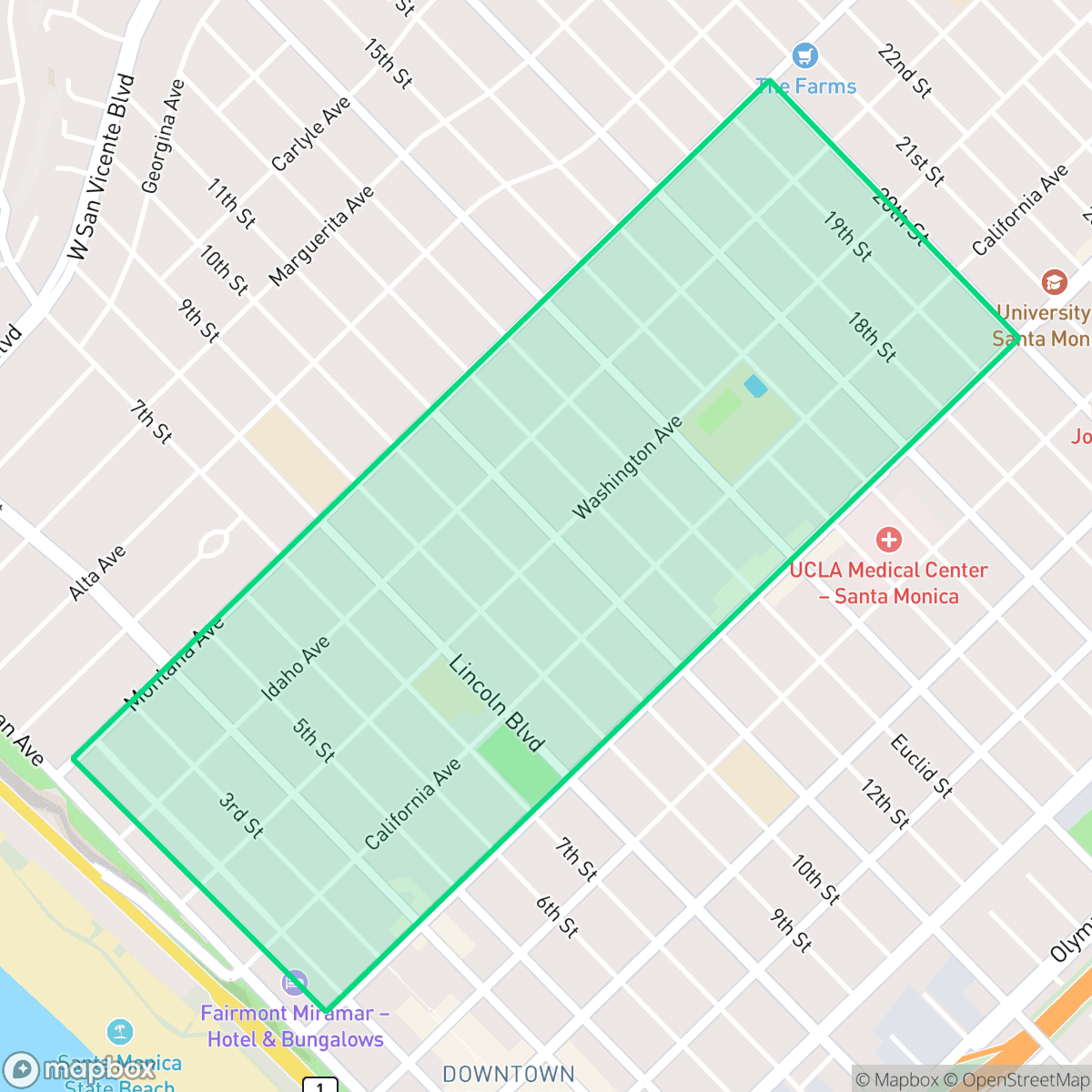
The Wilshire/Montana neighborhood in Santa Monica is defined by the area between Wilshire Boulevard and Montana Avenue, characterized by its transition from historic residential streets to a prominent commercial corridor. Montana Avenue, once a collection of local mom-and-pop shops serving the community, evolved into a premier boutique destination while retaining its pedestrian-friendly, neighborhood-scale charm. A defining landmark of the district is the Aero Theatre, built in 1940 in the Streamline Moderne style to serve employees of the nearby Douglas Aircraft Company. Originally operating on a 24-hour schedule to accommodate factory shifts, the theater remains a cultural anchor today. The neighborhood’s residential stock reflects early 20th-century development, featuring a mix of architectural styles that distinguish it from the city's more tourist-oriented downtown and coastal districts.
The area maintains a balanced suburban feel, blending low-rise apartment blocks with single-family homes that feature well-maintained landscaping. Local dining and social hubs create a lively environment that surpasses the city average for activity, providing residents with convenient access to amenities without the presence of industrial zones. According to iHuus data, the neighborhood attracts a diverse age range, making it a common choice for families and professionals seeking a central location within Santa Monica.
Living here involves navigating specific trade-offs, including a higher density of housing that limits personal privacy and a significant risk of fire. While the street grid is designed for easy pedestrian movement, residents may experience a steady hum of traffic noise from nearby thoroughfares. The local school system, managed by the Santa Monica-Malibu Unified School District, offers high academic prestige but is currently undergoing a period of structural and fiscal transition. Despite these factors, the neighborhood remains a highly desirable, clean-air environment for those prioritizing walkability and proximity to boutique commerce.
Neighborhood Scores Across 15 Qualities
Residential structures are situated in close proximity with minimal separation between buildings. According to iHuus data, this level of density is slightly higher than the Santa Monica average, with many homes featuring narrow side yards or shared walls.
Extensive sidewalk networks and frequent marked crosswalks make navigating this area on foot exceptionally easy. The street grid is even more pedestrian-friendly than the Santa Monica average, according to iHuus data.
Well-maintained residential structures and private backyard pools characterize this area, providing a visual landscape that is largely consistent with the Santa Monica average. Large homes and landscaped greenery are frequent throughout the neighborhood according to iHuus data.
Green verges and street trees provide decent walking space, though access to large public parks is somewhat limited compared to the Santa Monica average. Residents can utilize sidewalk parkways for short walks, but the area lacks the extensive park access found in other parts of the city.
Residential streets and green spaces exist in equal measure to the urbanized areas of the neighborhood. This balance of low-rise apartment blocks and single-family homes reflects the broader city average for density.
Concentrated pockets of dining and social hubs create a sense of activity that is notably higher than the Santa Monica average. While some blocks offer a calm suburban atmosphere, many areas feature a steady flow of movement around local cafes and restaurants.
Steady noise from local traffic along major thoroughfares is present, though levels remain more tranquil than the typical Santa Monica average according to iHuus data.
Air quality remains consistently good with infrequent periods of elevated readings. This level of air cleanliness is in line with the average for Santa Monica.
Industrial activity, warehouses, and hazardous facilities are entirely absent from this area. Residents benefit from a purely residential and light commercial environment that is even cleaner of heavy industry than the Santa Monica average.
Health insurance enrollment is widespread among residents, though it remains slightly below the Santa Monica average according to iHuus data.
Voting patterns and census indicators show a highly liberal political leaning that is consistent with the broader Santa Monica area. According to iHuus data, the ideological landscape here closely reflects the citywide average.
A balanced mix of young adults, families, and older residents characterizes the area. This demographic spread is roughly in line with the broader Santa Monica average, according to iHuus data.
Flood safety levels in this area are slightly below the Santa Monica average. According to iHuus data, the lack of a detailed FEMA study means the specific risk level for this neighborhood remains undetermined.
Fire hazards in this area are severe and represent a significant danger, slightly higher than the Santa Monica average according to iHuus data.
Address-Level Insights for Wilshire/Montana


iHuus Neighborhood Intelligence Insights
Get address-level neighborhood insights for Wilshire/Montana
- Street-level scores — see how individual blocks compare, not just neighborhood averages
- Micro-zone boundaries — identify quiet pockets, flood boundaries, and walkable clusters before you visit
- 15 dimensions in full — walkability, noise, air quality, school quality, insurance coverage, population age profile, urban/rural index, and more
- Boundary risk alerts — know if your address sits near a block boundary where scores drop, the kind of detail no listing will ever mention
- School insights — individual school ratings and insights, not just district-level data
- Compare before you commit — side-by-side data across neighborhoods, down to block precision
No credit card required
Compare with Any Neighborhood
| Dimension | Wilshire/Montana | Downtown/Third Street Promenade |
|---|---|---|
| 🚶 Walkabilityavg 9.69 | ||
| 🔊 Acoustic Comfortavg 3.61 | ||
| 🤫 Privacy Indexavg 4.03 | ||
| 🎨 Visual Appealavg 6.88 | ||
| 🐕 Dog Friendlinessavg 6.18 | ||
| 🗺️ Urban-Rural Indexavg 6.16 | ||
| ✨ Neighborhood Vibeavg 5.81 | ||
| 🏥 Health Insurance Coverageavg 8.84 | ||
| 🌿 Air Qualityavg 8 | ||
| 🏭 Industrial Proximityavg 9.21 | ||
| 🌊 Flood Safetyavg 5.32 | ||
| 🗳️ Ideological Leanavg 9.87 | ||
| 👥 Population Age Profileavg 5.34 | ||
| 🔥 Fire Safetyavg 0.19 | ||
| 🏫 School Quality |
Wilshire/Montana Rankings
School Districts Serving Wilshire/Montana
School Insights for Wilshire/Montana
Below average outcomes; significant attendance and academic challenges.
School Insights
See what's really behind every school rating near Wilshire/Montana
- Individual school ratings — each school's own score with outcome context, not just a district average
- Enrollment & class size data — student-to-teacher ratio and how it compares to the state average
- Full demographics breakdown — ethnicity and gender composition for every school in the enrollment zone
- Every school in the district — all schools within the enrollment boundary ranked by rating, not just the closest one
- Grade levels & benchmarks — elementary through high school, with below/above state-average flags
No credit card required