Wilshire/Montana, Santa Monica
Updated · 13,912 residents
Wilshire/Montana is a highly walkable neighborhood in Santa Monica known for its consistent grid-based layout and proximity to diverse dining hubs. Residents enjoy a dense urban environment where daily errands are easily completed on foot, though the area features tightly packed housing with limited private space.
Key Highlights
About Wilshire/Montana
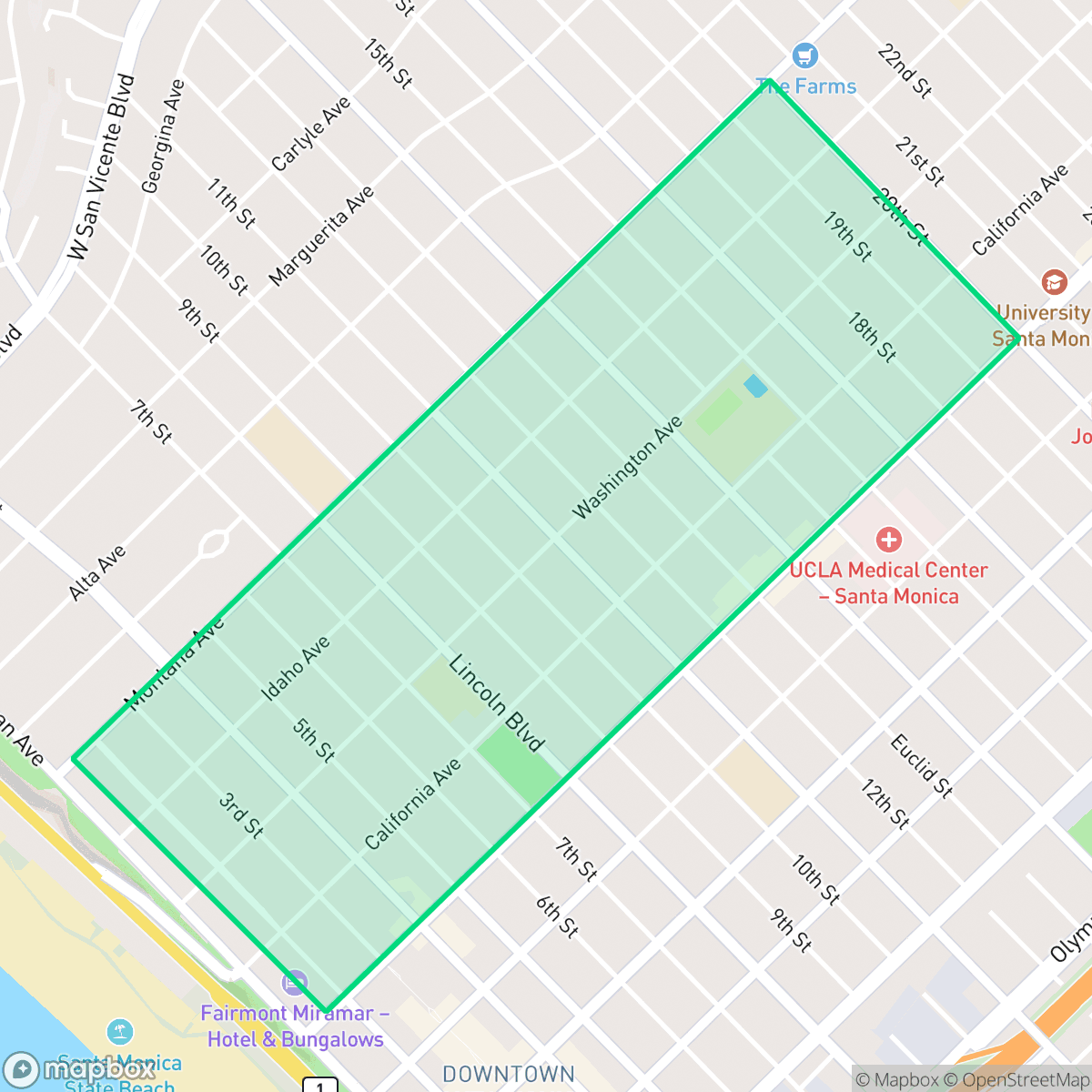
The Wilshire/Montana neighborhood in Santa Monica, bounded by Montana Avenue, Wilshire Boulevard, and Ocean Avenue, is historically defined by its architectural diversity and early aviation history. Developed primarily in the 1920s, the neighborhood retains a significant collection of early 20th-century Craftsman bungalows, with dozens designated as historic structures of merit alongside mid-century multi-family residences. A central landmark is the 10.7-acre Douglas Park, designed by Ed Howard and completed in 1933. The park occupies the former site of a silent movie studio and the original 1922 factory and airfield of the Douglas Aircraft Company, founded by aviation pioneer Donald Douglas. Because the area's tall eucalyptus trees made takeoffs difficult, the plant relocated in 1927. Today, the park is celebrated for its historic ponds and its lawn bowling green, which has hosted local players since 1949.
The neighborhood serves as a vibrant urban center defined by its exceptional walkability and efficient street design. It integrates a mix of multi-family residences and light commercial establishments, creating a lively atmosphere with access to numerous social hubs and restaurants. According to iHuus data, the area maintains high standards for air quality and remains free from industrial hazards, making it a functional choice for those who prioritize proximity to essential services and community amenities.
Living in this area involves certain trade-offs, particularly regarding privacy and acoustic comfort. Due to the high density of residential buildings, homes are often situated in close proximity to one another, which can limit personal outdoor space. While the neighborhood is generally quiet regarding aviation and rail noise, road traffic contributes to a moderate ambient sound level. Prospective residents should also note the ongoing structural transition within the local school district, which balances academic prestige with current fiscal adjustments.
Neighborhood Scores Across 15 Qualities
Buildings are situated in close proximity with minimal separation between structures. This density is slightly higher than the Santa Monica average, meaning many residences feature narrow side yards or shared walls.
Pedestrian navigation is seamless due to a continuous grid of wide sidewalks and frequent, well-marked crosswalks. This level of accessibility for foot traffic is even higher than the Santa Monica average, according to iHuus data.
Large residential structures with well-maintained landscaping and private backyard pools characterize this area. The visual environment is largely consistent with the city average for Santa Monica.
Green verges and street trees provide decent walking space, though access to large public parks is somewhat limited compared to the Santa Monica average. Residents can utilize sidewalk parkways for short walks, but the area lacks the extensive park access found in other parts of the city.
A mix of multi-unit apartments and single-family homes provides a balance of paved urban density and residential green space. This character aligns closely with the typical urban-rural balance found throughout Santa Monica.
Steady activity defines this area, with a concentration of social hubs and dining options that makes the neighborhood more vibrant than the Santa Monica average. While some blocks offer a calm suburban feel, many streets feature a noticeable presence of local cafes and restaurants.
Steady traffic noise from nearby thoroughfares is a consistent feature of this area, though it remains notably quieter than the Santa Monica city average according to iHuus data.
Air quality remains consistently good with infrequent periods of elevated readings. This level of air cleanliness is in line with the average for Santa Monica.
Residential and light commercial uses dominate the area with no detectable heavy industry, warehouses, or hazardous facilities. This neighborhood maintains a cleaner profile than the Santa Monica average, according to iHuus data.
Health insurance access remains high for residents in this area, though it sits slightly below the Santa Monica city average according to iHuus data.
Voting patterns and census indicators show a highly liberal political landscape, mirroring the broader trends seen across Santa Monica.
Residents live among a balanced demographic of young professionals, families, and older adults. This age distribution is largely consistent with the broader Santa Monica area.
Flood risk levels for this area remain uncertain because a detailed federal study has not yet been completed; according to iHuus data, this uncertainty is slightly higher than the average seen across Santa Monica.
Extreme fire hazards are present in this area, which represents a risk level slightly higher than the Santa Monica average. Residents should be aware of the heightened necessity for maximum fire protection measures according to iHuus data.
Address-Level Insights for Wilshire/Montana


iHuus Neighborhood Intelligence Insights
Get address-level neighborhood insights for Wilshire/Montana
- Street-level scores — see how individual blocks compare, not just neighborhood averages
- Micro-zone boundaries — identify quiet pockets, flood boundaries, and walkable clusters before you visit
- 15 dimensions in full — walkability, noise, air quality, school quality, insurance coverage, population age profile, urban/rural index, and more
- Boundary risk alerts — know if your address sits near a block boundary where scores drop, the kind of detail no listing will ever mention
- School insights — individual school ratings and insights, not just district-level data
- Compare before you commit — side-by-side data across neighborhoods, down to block precision
No credit card required
Compare with Any Neighborhood
| Dimension | Wilshire/Montana | Downtown/Third Street Promenade |
|---|---|---|
| 🚶 Walkabilityavg 9.69 | ||
| 🔊 Acoustic Comfortavg 3.61 | ||
| 🤫 Privacy Indexavg 4.03 | ||
| 🎨 Visual Appealavg 6.88 | ||
| 🐕 Dog Friendlinessavg 6.18 | ||
| 🗺️ Urban-Rural Indexavg 6.16 | ||
| ✨ Neighborhood Vibeavg 5.81 | ||
| 🏥 Health Insurance Coverageavg 8.84 | ||
| 🌿 Air Qualityavg 8 | ||
| 🏭 Industrial Proximityavg 9.21 | ||
| 🌊 Flood Safetyavg 5.32 | ||
| 🗳️ Ideological Leanavg 9.87 | ||
| 👥 Population Age Profileavg 5.34 | ||
| 🔥 Fire Safetyavg 0.19 | ||
| 🏫 School Quality |
Wilshire/Montana Rankings
School Districts Serving Wilshire/Montana
School Insights for Wilshire/Montana
Below average outcomes; significant attendance and academic challenges.
School Insights
See what's really behind every school rating near Wilshire/Montana
- Individual school ratings — each school's own score with outcome context, not just a district average
- Enrollment & class size data — student-to-teacher ratio and how it compares to the state average
- Full demographics breakdown — ethnicity and gender composition for every school in the enrollment zone
- Every school in the district — all schools within the enrollment boundary ranked by rating, not just the closest one
- Grade levels & benchmarks — elementary through high school, with below/above state-average flags
No credit card required