Santa Monica Pier Area/Ocean Avenue, Santa Monica
Updated · 6,140 residents
Defined by the iconic Santa Monica Pier and the scenic stretch of Ocean Avenue, this neighborhood offers a highly walkable, dense coastal environment. Residents enjoy proximity to expansive beach access and green spaces, though the area experiences significant noise from local traffic and high-density living conditions.
Key Highlights
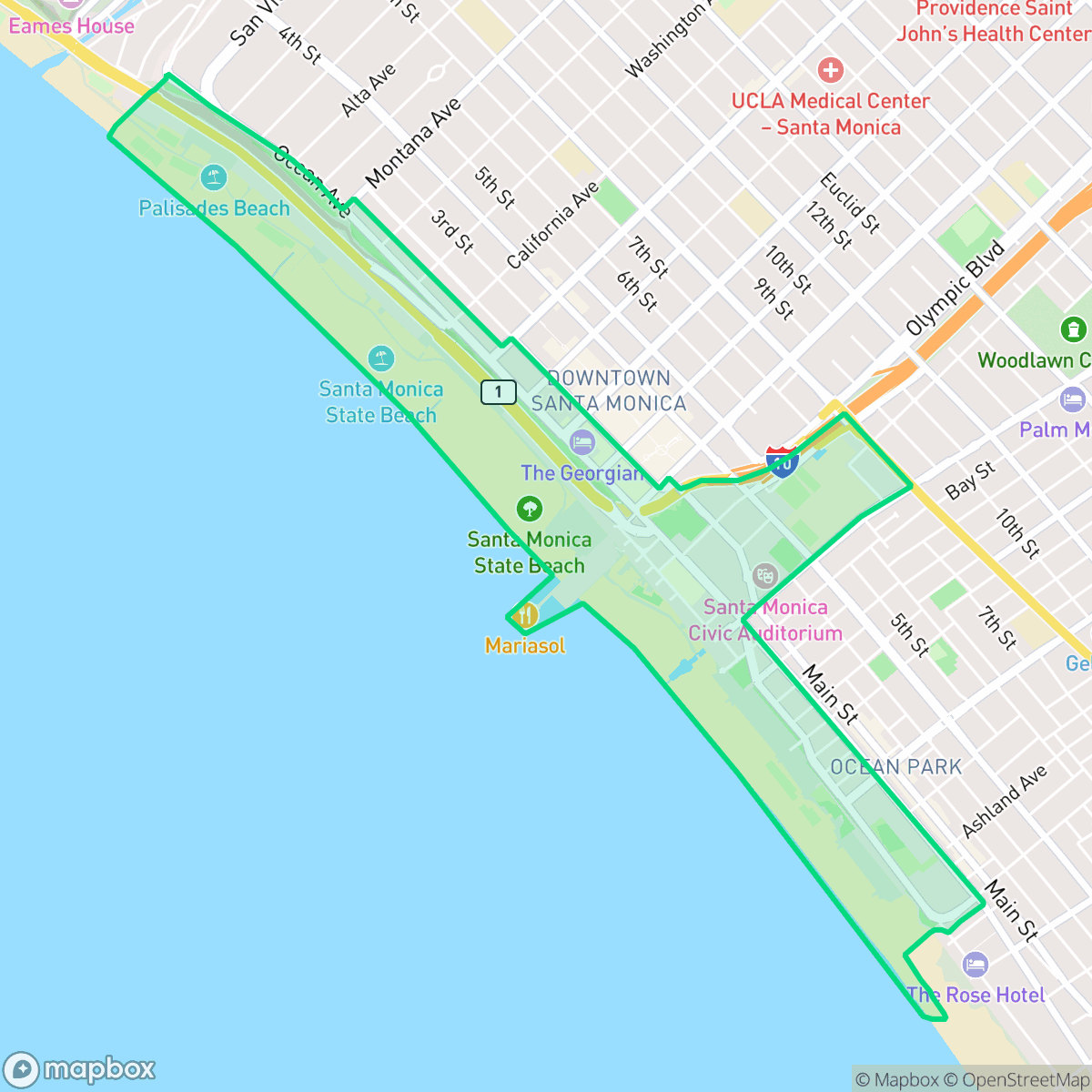
About Santa Monica Pier Area/Ocean Avenue
The Santa Monica Pier and Ocean Avenue area originated from two distinct 20th-century structures: the 1909 Municipal Pier, built for sewage outfall, and the 1916 'Pleasure Pier' developed by entrepreneur Charles Looff. The Looff Hippodrome, a National Historic Landmark featuring Byzantine and Moorish architectural elements, remains the site's most significant historic building. The area transitioned from a bustling 1920s resort hub to a site of intense preservation activism in the 1970s, when residents successfully blocked city plans to replace the pier with a resort island. Following devastating 1983 storms, the pier was restored as a civic icon. Nearby, the 2013 opening of Tongva Park on Ocean Avenue transformed a former parking lot into an urban oasis, bridging the historic civic center with the coastline, which historically served as a sanctuary for African American beachgoers at 'The Inkwell.'
The area surrounding the Santa Monica Pier and Ocean Avenue is a vibrant, pedestrian-centric hub characterized by its dense, upscale coastal architecture and immediate access to the Pacific shoreline. It features a balanced energy where lively commercial corridors meet quiet residential pockets, all while maintaining excellent air quality and a complete lack of industrial activity. According to iHuus data, the neighborhood is highly favored for its walkability, with expansive pathways that connect residents to the beach and local parks, making it an ideal environment for those who prioritize outdoor activity and a direct connection to the coast.
Living in this dense urban environment involves certain trade-offs, including high noise levels from frequent traffic and a lack of privacy due to tightly packed residential structures. Prospective residents should also be aware of the extreme fire risk associated with the area and the moderate potential for localized flooding. Families considering the neighborhood will find themselves within the Santa Monica-Malibu Unified School District, which is currently undergoing a significant administrative transition, or the Los Angeles Unified School District, which offers a wide range of specialized programs alongside broader systemic challenges.
Neighborhood Scores Across 15 Qualities
Residential structures are situated in close quarters with minimal separation between properties. According to iHuus data, this level of density is slightly higher than the average for Santa Monica.
Extensive sidewalk networks and dedicated beach paths ensure easy movement on foot. This area offers a superior level of walkability compared to the rest of Santa Monica, featuring consistent crosswalks and a dense, navigable grid.
High-value coastal real estate featuring modern architecture and premium amenities defines this area. According to iHuus data, the prevalence of large homes and rooftop features makes the visual landscape more attractive than the Santa Monica average.
Extensive access to the sandy beach and several linear green parks with walking paths makes this area significantly more dog friendly than the Santa Monica average. Residents benefit from wide, connected pathways that are largely separated from heavy traffic.
Dense coastal development and multi-story structures characterize this area, providing a mix of built environment and street space that is slightly more urban than the Santa Monica average.
Lively social hubs and diverse dining options coexist with quieter, suburban coastal blocks. This area offers a slightly more active atmosphere than the Santa Monica average, blending accessible amenities with pockets of calm green space.
Frequent noise from nearby transit corridors and heavy traffic characterizes this area. According to iHuus data, acoustic comfort is significantly lower than the Santa Monica average.
Air quality remains consistently high with rare instances of elevated readings. According to iHuus data, these levels are typical for the city average.
Industrial presence is virtually nonexistent in this area, consisting entirely of residential and commercial zones. According to iHuus data, this neighborhood remains free of warehouses, heavy industry, or hazardous facilities, even surpassing the city average for industrial separation.
Health insurance enrollment is nearly universal among residents, sitting well above the Santa Monica average according to iHuus data.
Voting patterns and census indicators reflect a very liberal political landscape, consistent with the broader Santa Monica area according to iHuus data.
Residents live in a demographic mix of young professionals, families, and seniors. This age distribution is slightly more varied than the average found across Santa Monica, according to iHuus data.
Flood risk levels are slightly above the Santa Monica average, though official FEMA studies for this specific area remain incomplete. Residents should remain aware of localized vulnerabilities common to coastal zones.
Fire hazards in this area are significantly higher than the Santa Monica average. Residents should be aware of extreme risk levels that necessitate maximum protection measures.
Address-Level Insights for Santa Monica Pier Area/Ocean Avenue


iHuus Neighborhood Intelligence Insights
Get address-level neighborhood insights for Santa Monica Pier Area/Ocean Avenue
- Street-level scores — see how individual blocks compare, not just neighborhood averages
- Micro-zone boundaries — identify quiet pockets, flood boundaries, and walkable clusters before you visit
- 15 dimensions in full — walkability, noise, air quality, school quality, insurance coverage, population age profile, urban/rural index, and more
- Boundary risk alerts — know if your address sits near a block boundary where scores drop, the kind of detail no listing will ever mention
- School insights — individual school ratings and insights, not just district-level data
- Compare before you commit — side-by-side data across neighborhoods, down to block precision
No credit card required
Compare with Any Neighborhood
| Dimension | Santa Monica Pier Area/Ocean Avenue | Downtown/Third Street Promenade |
|---|---|---|
| 🚶 Walkabilityavg 9.69 | ||
| 🔊 Acoustic Comfortavg 3.61 | ||
| 🤫 Privacy Indexavg 4.03 | ||
| 🎨 Visual Appealavg 6.88 | ||
| 🐕 Dog Friendlinessavg 6.18 | ||
| 🗺️ Urban-Rural Indexavg 6.16 | ||
| ✨ Neighborhood Vibeavg 5.81 | ||
| 🏥 Health Insurance Coverageavg 8.84 | ||
| 🌿 Air Qualityavg 8 | ||
| 🏭 Industrial Proximityavg 9.21 | ||
| 🌊 Flood Safetyavg 5.32 | ||
| 🗳️ Ideological Leanavg 9.87 | ||
| 👥 Population Age Profileavg 5.34 | ||
| 🔥 Fire Safetyavg 0.19 | ||
| 🏫 School Quality |
Santa Monica Pier Area/Ocean Avenue Rankings
School Districts Serving Santa Monica Pier Area/Ocean Avenue
School Insights for Santa Monica Pier Area/Ocean Avenue
Below average outcomes; significant attendance and academic challenges.
School Insights
See what's really behind every school rating near Santa Monica Pier Area/Ocean Avenue
- Individual school ratings — each school's own score with outcome context, not just a district average
- Enrollment & class size data — student-to-teacher ratio and how it compares to the state average
- Full demographics breakdown — ethnicity and gender composition for every school in the enrollment zone
- Every school in the district — all schools within the enrollment boundary ranked by rating, not just the closest one
- Grade levels & benchmarks — elementary through high school, with below/above state-average flags
No credit card required