Pico District, Santa Monica
Updated · 8,897 residents
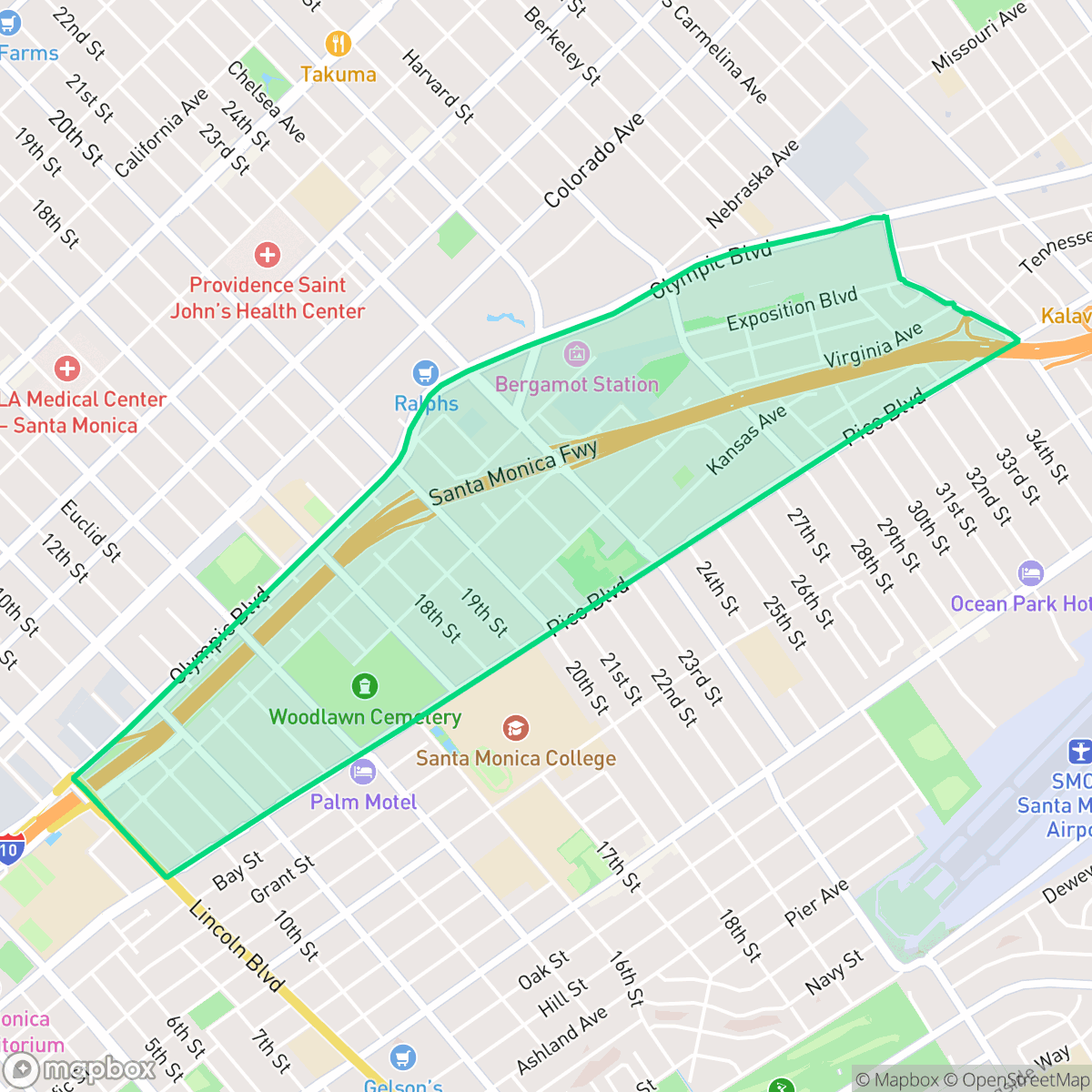
The Pico District is a culturally diverse enclave in Santa Monica characterized by a dense, urban grid and high walkability. While the neighborhood offers access to local heritage businesses and well-regarded schools, residents should be prepared for significant noise levels due to its proximity to the Santa Monica Freeway.
Key Highlights
About Pico District
Named after Alta California's last Mexican governor, Pío Pico, Santa Monica’s Pico District historically served as a vibrant, multicultural enclave. Formed in part by early 20th-century racially restrictive covenants that barred minority residents from other parts of the city, the neighborhood became a thriving hub for African American, Mexican American, and Asian American families. This rich diversity was severely disrupted in 1966 when the construction of the Santa Monica Freeway (I-10) bisected the neighborhood, displacing thousands of residents. This division is poignantly depicted in Ann Elizabeth Thiermann’s 1983 mural under the Stewart Street underpass. Despite these challenges, the Pico District remains Santa Monica’s most ethnically diverse area, anchored by historic institutions like Saint Anne Church (1908), Virginia Avenue Park, and local heritage businesses like McCabe’s Guitar Shop and Gilbert’s El Indio.
The area functions as a dense urban environment featuring a mix of multi-family apartments and low-rise commercial zones. It maintains high walkability, with continuous sidewalks and crosswalks facilitating pedestrian access throughout the grid. The local landscape is defined by its proximity to industrial sectors and major transportation corridors, which contributes to a distinct urban atmosphere. Families often gravitate toward the area for its access to top-tier educational facilities, such as the highly-rated Edison Elementary.
Living here involves specific trade-offs, particularly regarding acoustic comfort and privacy. Due to the high density of residential structures and the influence of the nearby freeway, noise levels are elevated compared to other parts of the city. According to iHuus data, the area is best suited for those who prioritize central urban accessibility and community diversity over quiet, suburban seclusion. While the neighborhood offers a rich cultural legacy, potential residents should weigh the trade-offs of living in a densely packed environment situated near major commercial and industrial infrastructure.
Neighborhood Scores Across 15 Qualities
Residential structures are closely packed with narrow side yards and frequent shared walls. This level of density is slightly higher than the Santa Monica average, according to iHuus data.
A continuous grid of sidewalks and clearly marked crosswalks allows for easy navigation on foot, though heavy traffic on major arterials and a nearby freeway corridor can impact the experience. This level of walkability is nearly on par with the rest of Santa Monica.
Varying property styles range from well-maintained homes with private pools to dense, utilitarian apartment blocks. This visual diversity makes the area slightly less manicured than the Santa Monica average according to iHuus data.
Access to public parks and green verges varies significantly depending on the specific block, with some areas offering proximity to large athletic fields and cemetery landscapes while others feature narrow, paved sidewalks. According to iHuus data, the availability of open space for pets is slightly below the Santa Monica average.
Characterized by a mix of low-rise residential blocks and large commercial footprints, this area presents a more developed urban fabric than the Santa Monica average. Significant asphalt coverage and multi-story residential buildings define the local landscape according to iHuus data.
Vibrant urban pockets near Bergamot Station coexist with quieter, suburban blocks characterized by light industrial units and green spaces. While certain areas offer diverse dining options, the neighborhood overall feels slightly less active than the Santa Monica average.
Frequent noise from nearby railroad tracks and heavy freeway traffic defines the acoustic environment. This area experiences significantly more disturbance than the Santa Monica average, according to iHuus data.
Air quality is consistently good with very few instances of elevated pollution levels. According to iHuus data, the air quality in this area is on par with the rest of Santa Monica.
Occasional warehouses and commercial loading zones introduce some heavy vehicle traffic to the area. This level of industrial activity is lower than the Santa Monica average, as much of the neighborhood remains residential or light commercial.
Health insurance enrollment is widespread among residents, though it remains slightly below the Santa Monica average according to iHuus data.
Voting patterns and census indicators show a strong liberal leaning that is consistent with the rest of Santa Monica. According to iHuus data, the political landscape here aligns closely with the city average.
Residents live alongside a balanced mix of young adults, families, and older populations. According to iHuus data, this demographic spread is largely consistent with the broader Santa Monica area.
Flood risk in this area is slightly higher than the Santa Monica average due to a lack of detailed federal studies for the district. According to iHuus data, current assessments for this neighborhood remain undetermined.
Address-Level Insights for Pico District


iHuus Neighborhood Intelligence Insights
Get address-level neighborhood insights for Pico District
- Street-level scores — see how individual blocks compare, not just neighborhood averages
- Micro-zone boundaries — identify quiet pockets, flood boundaries, and walkable clusters before you visit
- 15 dimensions in full — walkability, noise, air quality, school quality, insurance coverage, population age profile, urban/rural index, and more
- Boundary risk alerts — know if your address sits near a block boundary where scores drop, the kind of detail no listing will ever mention
- School insights — individual school ratings and insights, not just district-level data
- Compare before you commit — side-by-side data across neighborhoods, down to block precision
No credit card required
Compare with Any Neighborhood
| Dimension | Pico District | Downtown/Third Street Promenade |
|---|---|---|
| 🚶 Walkabilityavg 9.69 | ||
| 🔊 Acoustic Comfortavg 3.61 | ||
| 🤫 Privacy Indexavg 4.03 | ||
| 🎨 Visual Appealavg 6.88 | ||
| 🐕 Dog Friendlinessavg 6.18 | ||
| 🗺️ Urban-Rural Indexavg 6.16 | ||
| ✨ Neighborhood Vibeavg 5.81 | ||
| 🏥 Health Insurance Coverageavg 8.84 | ||
| 🌿 Air Qualityavg 8 | ||
| 🏭 Industrial Proximityavg 9.21 | ||
| 🌊 Flood Safetyavg 5.32 | ||
| 🗳️ Ideological Leanavg 9.87 | ||
| 👥 Population Age Profileavg 5.34 | ||
| 🔥 Fire Safetyavg 0.19 | ||
| 🏫 School Quality |
Pico District Rankings
School Districts Serving Pico District
School Insights for Pico District
Below average outcomes; significant attendance and academic challenges.
School Insights
See what's really behind every school rating near Pico District
- Individual school ratings — each school's own score with outcome context, not just a district average
- Enrollment & class size data — student-to-teacher ratio and how it compares to the state average
- Full demographics breakdown — ethnicity and gender composition for every school in the enrollment zone
- Every school in the district — all schools within the enrollment boundary ranked by rating, not just the closest one
- Grade levels & benchmarks — elementary through high school, with below/above state-average flags
No credit card required