Ocean Park, Santa Monica
Updated · 7,703 residents
Ocean Park is a highly walkable coastal neighborhood defined by its vibrant Main Street commercial corridor and dense residential grid. Residents enjoy easy access to local parks and the beach, though the area is characterized by tightly packed housing and consistent road traffic noise.
Key Highlights
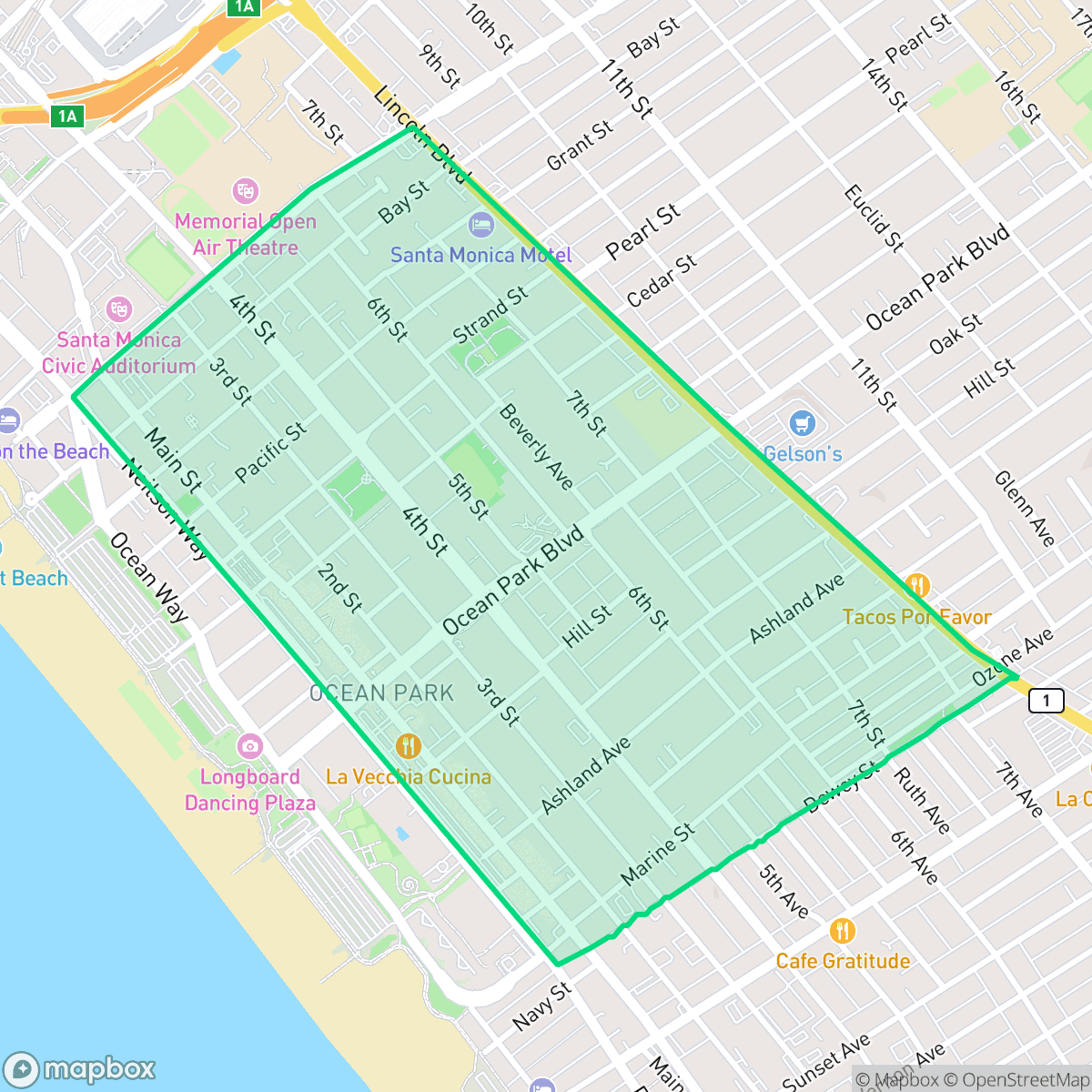
About Ocean Park
Established in 1895 by developers Abbot Kinney and Francis G. Ryan, Ocean Park is a historic beachside neighborhood in southern Santa Monica. Its central commercial artery, Main Street, dates back to the late 19th century, while local landmarks like the 1918 Carnegie-funded Ocean Park Branch Library highlight its early civic development. The neighborhood’s coastal identity was long defined by its amusement piers, culminating in the 1958 opening of the space-age Pacific Ocean Park (POP). After POP closed in 1967 and fell into decay, its dilapidated pier ruins—known as "the Cove"—became a legendary surfing and skateboarding hub. In the 1970s, this gritty environment birthed modern skateboarding culture, popularized by the local "Dogtown Z-Boys" who practiced their craft in the neighborhood's empty swimming pools and rough coastal streets.
The area functions as a dense, urban-residential enclave where daily life centers on the commercial activity of Main Street. According to iHuus data, the neighborhood achieves a perfect walkability score, allowing residents to access diverse dining options, social hubs like Hotchkiss Park, and the coastline without a vehicle. The architecture consists primarily of low-rise apartment blocks and closely situated single-family homes, creating a compact environment that fosters a strong sense of community connectivity.
Prospective residents should consider that the high density results in limited privacy and elevated ambient noise levels from road traffic. While the neighborhood benefits from excellent air quality and high health insurance coverage, the acoustic environment reflects its urban nature. Families may find the local school options, such as John Muir Elementary, to be a strong draw, though the broader district is currently navigating significant fiscal and structural transitions. It is an ideal location for those prioritizing transit-free living and proximity to the Pacific over the seclusion of a suburban estate.
Neighborhood Scores Across 15 Qualities
Residential structures are closely packed with narrow separations between buildings and frequent shared walls. According to iHuus data, this density results in less privacy than the Santa Monica average.
Extensive sidewalks, frequent crosswalks, and dedicated beach paths make navigating the area on foot easy. This level of accessibility is even higher than the typical Santa Monica average, according to iHuus data.
Prime beachfront real estate and modern architecture featuring private pools and manicured landscapes define much of the area. This visual quality is roughly in line with the overall Santa Monica average.
Extensive access to the beach and large parks with walking paths makes this area more dog friendly than the Santa Monica average. Wide grassy verges and connected green spaces provide safe routes for walking pets away from traffic.
Residential layouts feature a blend of single-family homes and multi-unit buildings, providing a slightly more open feel than the dense urban average of Santa Monica. According to iHuus data, the area maintains a low-rise urban fabric with significant coastal development.
A blend of quiet coastal blocks and active social hubs provides a level of liveliness that sits slightly above the Santa Monica average. Residents can access various dining options and green spaces, though the concentration of walkable amenities varies between the more suburban streets and the denser pockets of activity.
Frequent disturbances from nearby railroad tracks and major roadways characterize the area. According to iHuus data, acoustic comfort in this neighborhood is lower than the Santa Monica average.
Air quality remains consistently good with rare instances of elevated readings. This level of air cleanliness is on par with the rest of Santa Monica, according to iHuus data.
Industrial activity is virtually non-existent here, offering a landscape free from warehouses or hazardous facilities. This area maintains a higher level of separation from industrial zones than the Santa Monica average, according to iHuus data.
Nearly all residents in this area have access to health insurance, which is notably higher than the Santa Monica average according to iHuus data.
Voting patterns and census indicators show a strong liberal leaning that is consistent with the broader Santa Monica area, according to iHuus data.
Residents live alongside a balanced mix of young professionals, families, and seniors. This demographic variety is slightly more widespread than the average seen across Santa Monica, according to iHuus data.
Flood safety in Ocean Park is notably higher than the Santa Monica average, though some residual risk remains due to its location within a 500-year floodplain. According to iHuus data, residents should remain aware of potential seasonal flooding patterns common to this coastal area.
Address-Level Insights for Ocean Park


iHuus Neighborhood Intelligence Insights
Get address-level neighborhood insights for Ocean Park
- Street-level scores — see how individual blocks compare, not just neighborhood averages
- Micro-zone boundaries — identify quiet pockets, flood boundaries, and walkable clusters before you visit
- 15 dimensions in full — walkability, noise, air quality, school quality, insurance coverage, population age profile, urban/rural index, and more
- Boundary risk alerts — know if your address sits near a block boundary where scores drop, the kind of detail no listing will ever mention
- School insights — individual school ratings and insights, not just district-level data
- Compare before you commit — side-by-side data across neighborhoods, down to block precision
No credit card required
Compare with Any Neighborhood
| Dimension | Ocean Park | Downtown/Third Street Promenade |
|---|---|---|
| 🚶 Walkabilityavg 9.69 | ||
| 🔊 Acoustic Comfortavg 3.61 | ||
| 🤫 Privacy Indexavg 4.03 | ||
| 🎨 Visual Appealavg 6.88 | ||
| 🐕 Dog Friendlinessavg 6.18 | ||
| 🗺️ Urban-Rural Indexavg 6.16 | ||
| ✨ Neighborhood Vibeavg 5.81 | ||
| 🏥 Health Insurance Coverageavg 8.84 | ||
| 🌿 Air Qualityavg 8 | ||
| 🏭 Industrial Proximityavg 9.21 | ||
| 🌊 Flood Safetyavg 5.32 | ||
| 🗳️ Ideological Leanavg 9.87 | ||
| 👥 Population Age Profileavg 5.34 | ||
| 🔥 Fire Safetyavg 0.19 | ||
| 🏫 School Quality |
Ocean Park Rankings
School Districts Serving Ocean Park
School Insights for Ocean Park
Below average outcomes; significant attendance and academic challenges.
School Insights
See what's really behind every school rating near Ocean Park
- Individual school ratings — each school's own score with outcome context, not just a district average
- Enrollment & class size data — student-to-teacher ratio and how it compares to the state average
- Full demographics breakdown — ethnicity and gender composition for every school in the enrollment zone
- Every school in the district — all schools within the enrollment boundary ranked by rating, not just the closest one
- Grade levels & benchmarks — elementary through high school, with below/above state-average flags
No credit card required