Northeast, Santa Monica
Updated · 6,120 residents
Northeast Santa Monica is a highly walkable, affluent residential enclave known for its grid of university-themed streets and proximity to community-focused green spaces. According to iHuus data, the area offers a blend of quiet living and convenient access to local dining and parks, though residents should expect higher density and limited privacy in some sections.
Key Highlights
About Northeast
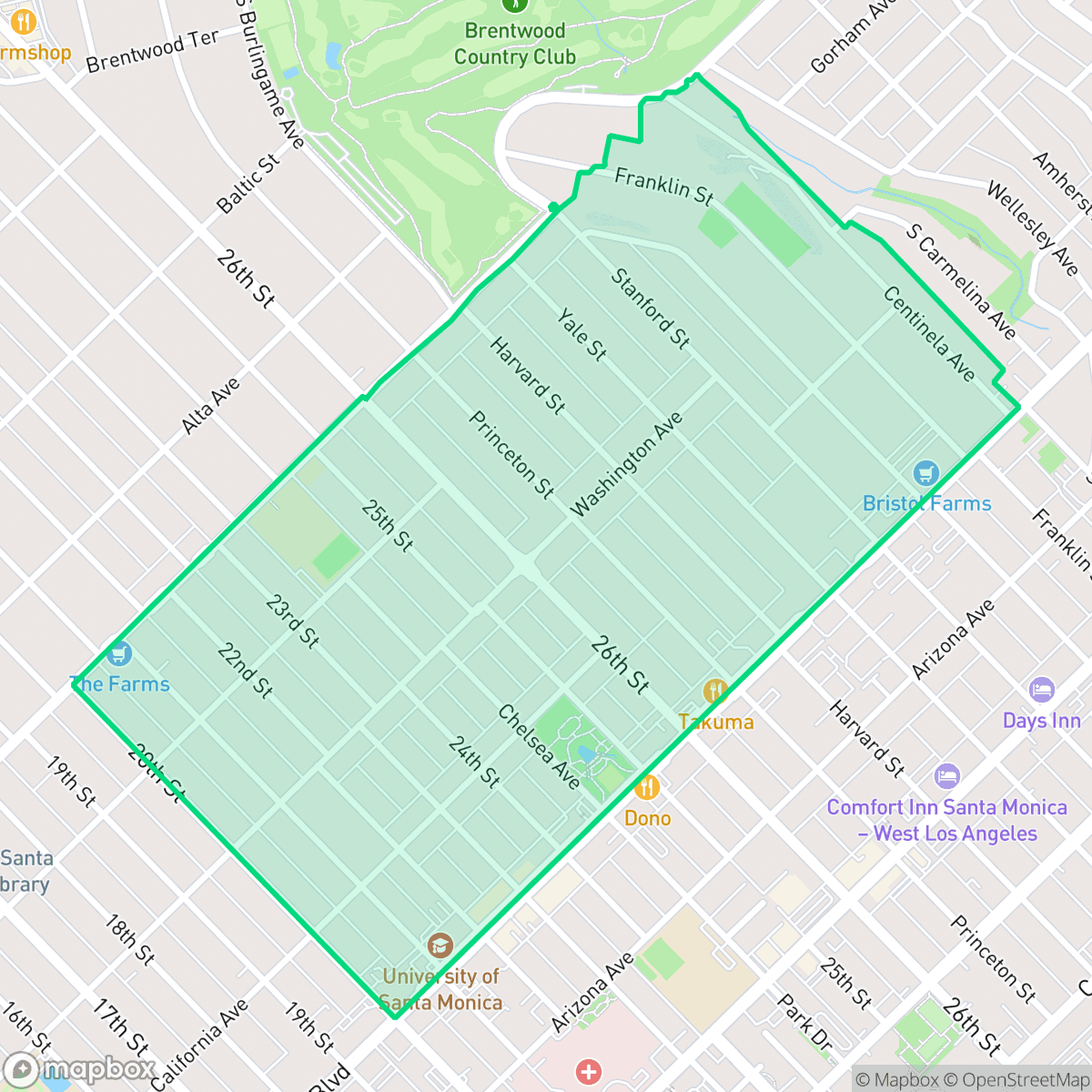
Northeast Santa Monica (bounded by Centinela Avenue, 22nd Street, Montana Avenue, and Wilshire Boulevard) is a quiet residential neighborhood represented by the Northeast Neighbors Association. Originally subdivided in the 1920s, the area features a distinct section known as the "College Streets," where streets are named after universities like Harvard, Yale, and Princeton. The neighborhood's central landmark is Douglas Park, which was established in 1933 on the former site of a movie studio and Donald Douglas's original 1922 aircraft factory and airfield. After the factory relocated in 1927, the land was transformed into a park designed by Ed Howard. Today, the park is famous for its three historic ponds and a lawn bowling green, home to the Santa Monica Lawn Bowls Club since 1949.
The area is defined by its tight residential grid and high walkability, making it an accessible neighborhood for those who prefer navigating on foot. Its character is shaped by a mix of well-maintained single-family homes and apartment complexes, providing a stable, suburban-urban hybrid environment. Residents benefit from excellent air quality and a complete lack of industrial hazards, contributing to a clean and safe living atmosphere. The proximity to local dining options and community hubs creates a balanced, moderate level of activity that appeals to those seeking convenience without the intensity of a major commercial district. While the neighborhood offers significant benefits, prospective residents should consider the trade-offs regarding density. Homes are often situated closely together, which can limit personal privacy in outdoor areas. The acoustic environment is generally stable, though consistent with typical urban traffic levels. Families are well-served by the local school system, including the highly-rated Franklin Elementary. According to iHuus, the area remains a desirable choice for those prioritizing school quality and neighborhood connectivity over expansive private space.
Neighborhood Scores Across 15 Qualities
Residential structures and multi-family units are placed with relatively limited buffers between neighbors. According to iHuus data, this density is roughly in line with the average for Santa Monica.
A continuous grid of sidewalks and frequent marked crosswalks makes navigating the area on foot exceptionally easy. This level of pedestrian connectivity is slightly higher than the average for Santa Monica, according to iHuus data.
Manicured landscapes, large homes, and private pools characterize much of the area. This level of visual appeal is largely consistent with the rest of Santa Monica.
Street trees and grass parkways offer sufficient space for dog walking, though the availability of large public parks is slightly below the Santa Monica average. According to iHuus data, certain pockets feature wider verges near the golf course, while other areas have narrower sidewalks and higher density.
A blend of residential streets and green space characterizes this area, offering a more suburban feel than the denser urban centers found elsewhere in Santa Monica. According to iHuus data, the neighborhood features a mix of low-rise apartment blocks and single-family homes integrated with significant grey infrastructure.
Diverse dining and local business hubs create a lively atmosphere that is significantly more active than the Santa Monica average. While many pockets offer high energy and frequent movement, some suburban areas remain quiet with fewer accessible amenities on foot.
Steady hums from nearby busy streets provide a level of acoustic activity that is slightly higher than the Santa Monica average. According to iHuus data, residents may experience consistent ambient noise from local vehicle transit.
Air quality remains consistently high with rare instances of elevated readings. This level of cleanliness is on par with the rest of Santa Monica, according to iHuus data.
No warehouses, factories, or industrial hazards are present in this area. This lack of heavy industry distinguishes the neighborhood from the city average, according to iHuus data.
Health insurance access among residents is widespread, though slightly lower than the Santa Monica city average according to iHuus data.
Voting patterns and census indicators show a highly liberal political leaning that is very similar to the broader Santa Monica area, according to iHuus data.
Residents live in a demographic landscape that features a relatively even distribution of young adults, families, and older individuals. This age profile is consistent with the broader Santa Monica average according to iHuus data.
Flood risk in this area remains undetermined due to a lack of detailed federal studies. According to iHuus data, the potential for flooding is slightly higher than the Santa Monica average.
Address-Level Insights for Northeast


iHuus Neighborhood Intelligence Insights
Get address-level neighborhood insights for Northeast
- Street-level scores — see how individual blocks compare, not just neighborhood averages
- Micro-zone boundaries — identify quiet pockets, flood boundaries, and walkable clusters before you visit
- 15 dimensions in full — walkability, noise, air quality, school quality, insurance coverage, population age profile, urban/rural index, and more
- Boundary risk alerts — know if your address sits near a block boundary where scores drop, the kind of detail no listing will ever mention
- School insights — individual school ratings and insights, not just district-level data
- Compare before you commit — side-by-side data across neighborhoods, down to block precision
No credit card required
Compare with Any Neighborhood
| Dimension | Northeast | Downtown/Third Street Promenade |
|---|---|---|
| 🚶 Walkabilityavg 9.69 | ||
| 🔊 Acoustic Comfortavg 3.61 | ||
| 🤫 Privacy Indexavg 4.03 | ||
| 🎨 Visual Appealavg 6.88 | ||
| 🐕 Dog Friendlinessavg 6.18 | ||
| 🗺️ Urban-Rural Indexavg 6.16 | ||
| ✨ Neighborhood Vibeavg 5.81 | ||
| 🏥 Health Insurance Coverageavg 8.84 | ||
| 🌿 Air Qualityavg 8 | ||
| 🏭 Industrial Proximityavg 9.21 | ||
| 🌊 Flood Safetyavg 5.32 | ||
| 🗳️ Ideological Leanavg 9.87 | ||
| 👥 Population Age Profileavg 5.34 | ||
| 🔥 Fire Safetyavg 0.19 | ||
| 🏫 School Quality |
Northeast Rankings
School Districts Serving Northeast
School Insights for Northeast
Below average outcomes; significant attendance and academic challenges.
School Insights
See what's really behind every school rating near Northeast
- Individual school ratings — each school's own score with outcome context, not just a district average
- Enrollment & class size data — student-to-teacher ratio and how it compares to the state average
- Full demographics breakdown — ethnicity and gender composition for every school in the enrollment zone
- Every school in the district — all schools within the enrollment boundary ranked by rating, not just the closest one
- Grade levels & benchmarks — elementary through high school, with below/above state-average flags
No credit card required