North of Montana, Santa Monica
Updated · 10,269 residents
North of Montana is a highly walkable, quiet residential enclave defined by its manicured landscaping and proximity to the Pacific coast. While the neighborhood offers a peaceful suburban atmosphere, residents live in a dense grid where homes are situated in close proximity to one another.
Key Highlights
About North of Montana
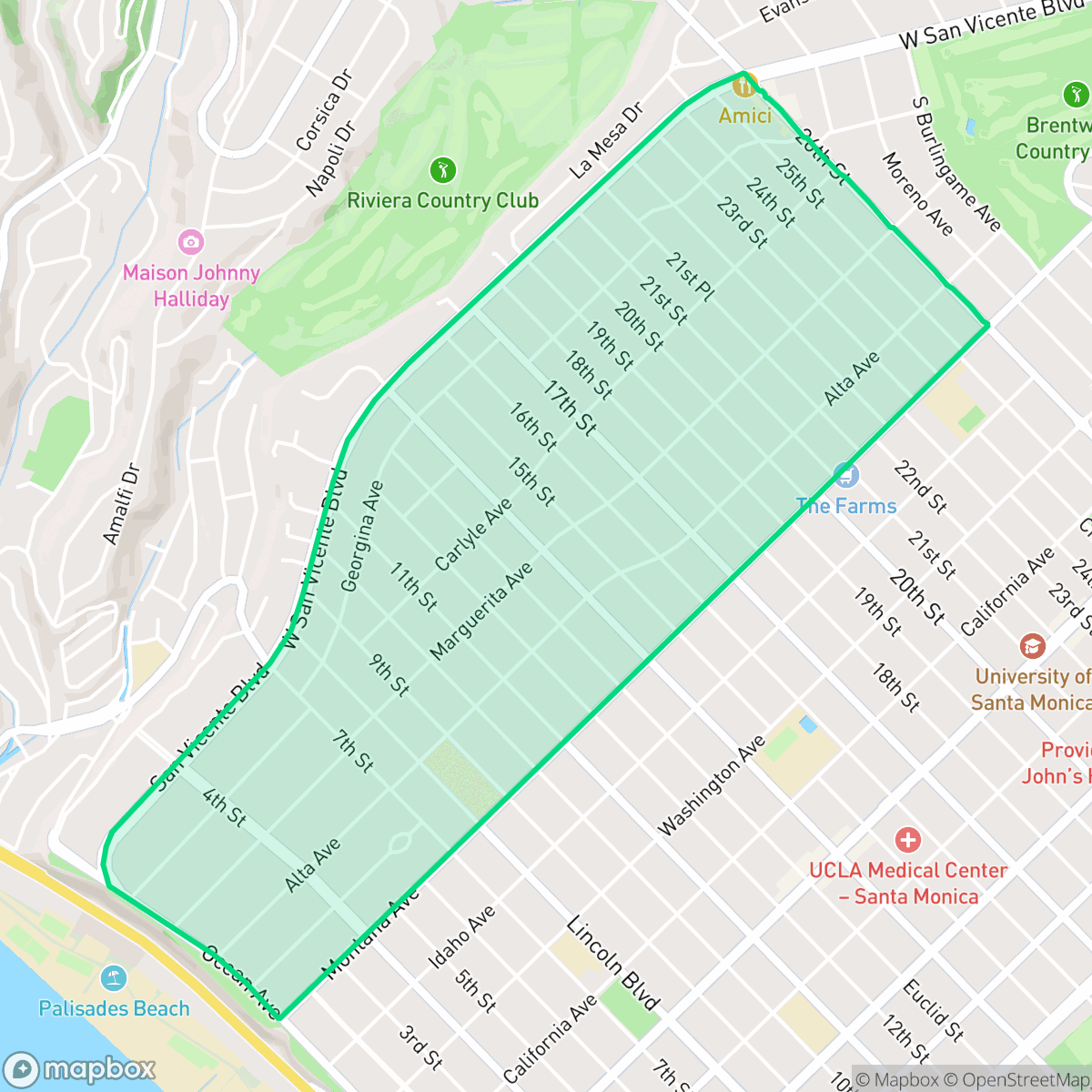
Bounded by Montana Avenue, San Vicente Boulevard, 26th Street, and the Pacific Ocean, the North of Montana neighborhood in Santa Monica emerged in the late 19th century. Its western Palisades tract developed as an exclusive enclave of ocean-view estates, while the area east of 7th Street was purchased and subdivided in the 1920s by safety razor inventor King C. Gillette, creating the spacious lots of Gillette Regent Square. The neighborhood is celebrated for its quiet, tree-lined streets and diverse historic architecture, featuring landmark Craftsman homes by Frederick Roehrig and Monterey Colonial Revival residences by Edla Muir. Culturally, the neighborhood’s commercial spine along Montana Avenue is anchored by the historic 1939 Art Deco Aero Theatre, built by the Donald Douglas Company. Today, it remains one of Southern California's most prestigious and tranquil residential communities.
The area serves as a quiet, affluent residential hub characterized by its dense grid of single-family homes and mid-sized multi-unit buildings. Residents benefit from consistent sidewalk infrastructure and wide green verges, which contribute to high walkability scores and a pleasant environment for dog owners. The visual landscape is defined by professional landscaping and private backyard amenities, maintaining a consistent aesthetic throughout the residential blocks.
While the neighborhood offers an exceptionally tranquil atmosphere, it functions primarily as a residential zone with limited daily commercial activity within immediate walking distance. Prospective residents should note the high density, which results in limited privacy between neighboring properties, and the elevated fire risk typical of the region. Families are well-served by local academic options, including the highly-rated Roosevelt Elementary, though the area remains best suited for those prioritizing a quiet, well-maintained environment over a vibrant, high-energy urban lifestyle.
Neighborhood Scores Across 15 Qualities
Residential spacing is moderate with some buffer between neighbors, sitting slightly higher than the Santa Monica average. Houses are often closely packed with narrow side yards, though many structures remain detached.
Continuous sidewalks and frequent, well-defined crosswalks make navigating the area on foot easy. This neighborhood offers a pedestrian-priority environment that is even more walkable than the rest of Santa Monica.
Large residential structures, manicured landscaping, and private pools characterize this area. According to iHuus data, the visual landscape is notably more premium than the Santa Monica average.
Wide green verges and continuous sidewalk parkways provide ample space for walking pets. According to iHuus data, these connected green spaces and proximity to large park-like areas make the area more dog friendly than the Santa Monica average.
Residential layouts consist of a dense suburban blend of single-family homes and low-rise multi-unit buildings. This area offers slightly more open space than the typical Santa Monica urban landscape according to iHuus data.
Low-density residential streets and green spaces define this area, which offers a more subdued pace of activity than the Santa Monica average. While select dining and wellness spots are available, the neighborhood remains primarily car-oriented due to the limited number of businesses within walking distance.
Steady traffic sounds from nearby thoroughfares are present, though levels are notably more tranquil than the average found across Santa Monica. According to iHuus data, the area experiences a consistent hum from local street activity.
Air quality remains consistently high with rare instances of elevated readings. According to iHuus data, the air quality in this area is on par with the rest of Santa Monica.
Industrial activity and heavy warehouses are entirely absent from this area. According to iHuus data, the neighborhood contains no detectable industrial hazards or factory facilities, making it even more residential than the Santa Monica average.
Health insurance enrollment among residents is high, although it remains slightly below the Santa Monica city average according to iHuus data.
Voting patterns and census indicators show a deep-seated liberal orientation that is nearly identical to the broader Santa Monica area.
A diverse mix of young professionals, families, and seniors characterizes the area. This demographic spread is slightly more varied than the average found across Santa Monica, according to iHuus data.
Residual flood risks exist within this area due to its location in a 500-year floodplain, though the safety level remains notably higher than the Santa Monica average according to iHuus data.
Fire risk in this area is significantly higher than the Santa Monica average. Residents should be prepared for extreme fire hazards that require maximum protection measures.
Address-Level Insights for North of Montana


iHuus Neighborhood Intelligence Insights
Get address-level neighborhood insights for North of Montana
- Street-level scores — see how individual blocks compare, not just neighborhood averages
- Micro-zone boundaries — identify quiet pockets, flood boundaries, and walkable clusters before you visit
- 15 dimensions in full — walkability, noise, air quality, school quality, insurance coverage, population age profile, urban/rural index, and more
- Boundary risk alerts — know if your address sits near a block boundary where scores drop, the kind of detail no listing will ever mention
- School insights — individual school ratings and insights, not just district-level data
- Compare before you commit — side-by-side data across neighborhoods, down to block precision
No credit card required
Compare with Any Neighborhood
| Dimension | North of Montana | Downtown/Third Street Promenade |
|---|---|---|
| 🚶 Walkabilityavg 9.69 | ||
| 🔊 Acoustic Comfortavg 3.61 | ||
| 🤫 Privacy Indexavg 4.03 | ||
| 🎨 Visual Appealavg 6.88 | ||
| 🐕 Dog Friendlinessavg 6.18 | ||
| 🗺️ Urban-Rural Indexavg 6.16 | ||
| ✨ Neighborhood Vibeavg 5.81 | ||
| 🏥 Health Insurance Coverageavg 8.84 | ||
| 🌿 Air Qualityavg 8 | ||
| 🏭 Industrial Proximityavg 9.21 | ||
| 🌊 Flood Safetyavg 5.32 | ||
| 🗳️ Ideological Leanavg 9.87 | ||
| 👥 Population Age Profileavg 5.34 | ||
| 🔥 Fire Safetyavg 0.19 | ||
| 🏫 School Quality |
North of Montana Rankings
School Districts Serving North of Montana
School Insights for North of Montana
Below average outcomes; significant attendance and academic challenges.
School Insights
See what's really behind every school rating near North of Montana
- Individual school ratings — each school's own score with outcome context, not just a district average
- Enrollment & class size data — student-to-teacher ratio and how it compares to the state average
- Full demographics breakdown — ethnicity and gender composition for every school in the enrollment zone
- Every school in the district — all schools within the enrollment boundary ranked by rating, not just the closest one
- Grade levels & benchmarks — elementary through high school, with below/above state-average flags
No credit card required