Downtown/Third Street Promenade, Santa Monica
Updated · 7,284 residents
Downtown Santa Monica is a highly walkable urban hub defined by its bustling pedestrian-only promenade and vibrant dining scene. While the area offers exceptional access to city amenities, residents should expect a dense living environment with significant ambient noise and limited private green space.
Key Highlights
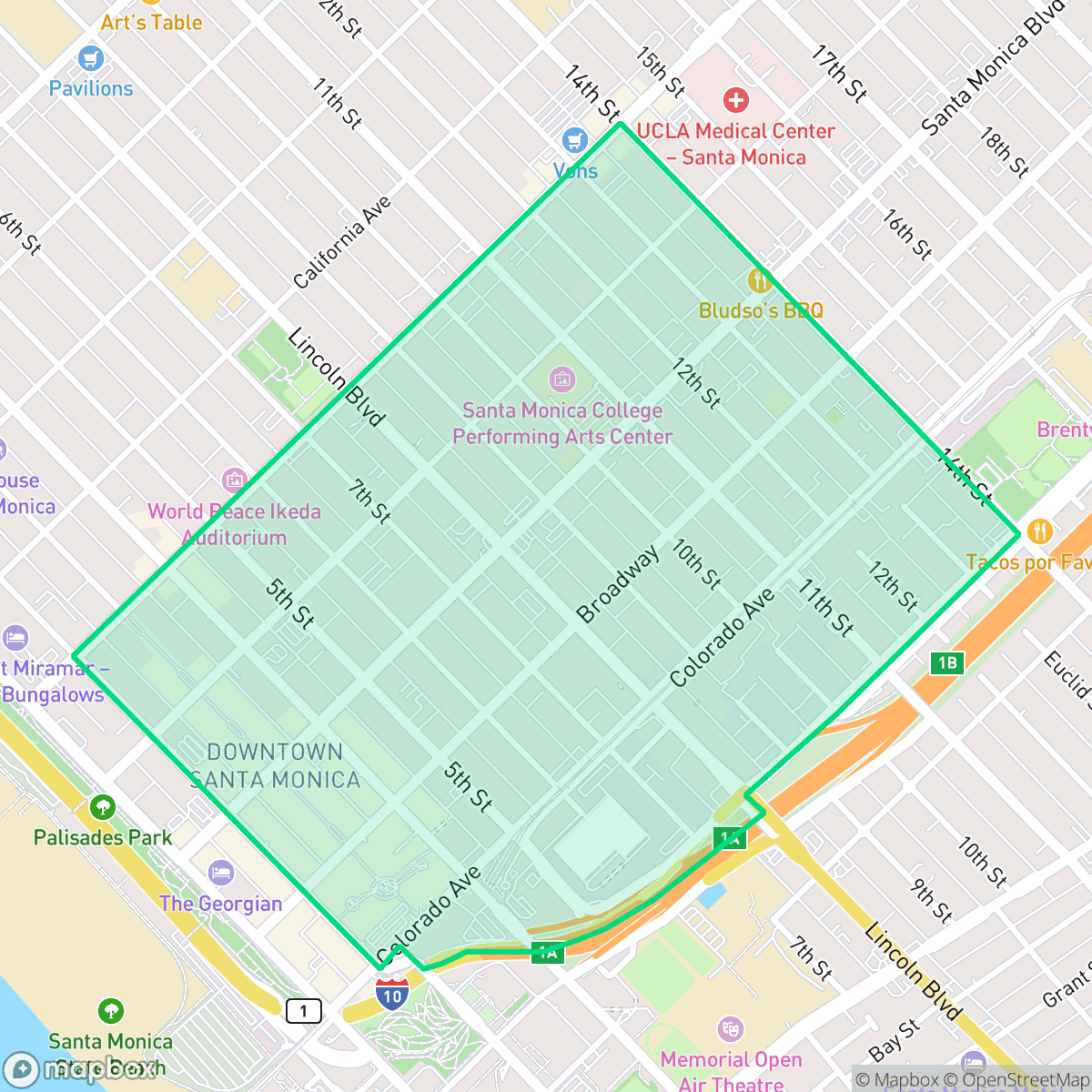
About Downtown/Third Street Promenade
Downtown Santa Monica’s Third Street has served as a commercial heart since the city's late 19th-century inception. In response to post-war suburban competition, the city converted three blocks into the pedestrian-only Santa Monica Mall on November 8, 1965. This early experiment in urban renewal aimed to reclaim the street for shoppers by banning automobiles. After struggling in the 1970s, the area underwent a significant $10 million revitalization, reopening on September 16, 1989, as the Third Street Promenade. This redesign introduced iconic topiary dinosaurs by Les LaLanne and fostered a vibrant culture of street performance and outdoor dining. Today, the Promenade remains a landmark of pedestrian-oriented public space, characterized by its mix of historic architecture and its role as a cultural backdrop for numerous films and television programs.
The neighborhood serves as a dense, high-energy core for the city, characterized by its grid of multi-story buildings and constant social activity. According to iHuus data, the area maintains a high level of liveliness due to its dense concentration of restaurants and diverse commercial offerings. It is a strictly urban environment that lacks heavy industry, providing a clean air profile despite the persistent ambient noise from nearby transit corridors and heavy traffic.
Prospective residents will find a community that values deep political liberalism and maintains high standards of health insurance coverage. While the neighborhood is exceptionally walkable, the trade-offs include a lack of private outdoor space and an elevated risk of flooding that may require specific insurance considerations. It is best suited for individuals who prioritize immediate access to urban culture and transit over quiet, suburban-style privacy. Families should note that the local school district is currently navigating a significant structural reorganization and fiscal transition.
Neighborhood Scores Across 15 Qualities
Buildings in this area are tightly packed with minimal separation between structures. According to iHuus data, this level of density is notably higher than the Santa Monica average.
Pedestrian connectivity is exceptional due to a dense street grid with wide sidewalks and frequent, well-marked crosswalks. This area offers a level of walkability that is even higher than the Santa Monica average.
Visual surroundings consist primarily of commercial buildings and high-density residential structures with uniform rooflines. This area presents a more functional, dense urban landscape than the Santa Monica average.
Public park access and green verges are relatively sparse in this area, falling below the Santa Monica average. While some proximity to athletic fields exists, much of the neighborhood consists of narrow sidewalks and paved surfaces.
High lot coverage and a dense grid of multi-story buildings create a predominantly urban environment that is slightly more built-up than the Santa Monica average. According to iHuus data, the area features a mix of low-rise commercial structures and residential apartments with limited open ground.
Social hubs and diverse dining options create a lively atmosphere that is notably more active than the Santa Monica average. According to iHuus data, the area features a dense concentration of restaurants and parks that maintain constant movement throughout the day.
Persistent auditory disturbances from nearby transit corridors and heavy traffic are common here. According to iHuus data, noise levels in this area are notably higher than the Santa Monica average.
Air quality in this area remains consistently good with rare instances of elevated readings. This level of cleanliness is in line with the Santa Monica average according to iHuus data.
No warehouses, heavy industry, or hazardous facilities are present in this area. This neighborhood maintains a very high level of separation from industrial activity, slightly higher than the Santa Monica average.
Health insurance access is exceptionally high among residents, slightly exceeding the Santa Monica average. According to iHuus data, nearly all inhabitants in this area are covered.
Voting patterns and census indicators reflect a deeply liberal political landscape that is consistent with the rest of Santa Monica.
Residents encounter a balanced demographic of young adults, families, and seniors. This age distribution is roughly in line with the average found across Santa Monica.
Properties in this area fall within a designated floodplain, which represents a higher risk of flooding than the Santa Monica average. According to iHuus data, residents may find that flood insurance is typically required for properties in this zone.
Address-Level Insights for Downtown/Third Street Promenade


iHuus Neighborhood Intelligence Insights
Get address-level neighborhood insights for Downtown/Third Street Promenade
- Street-level scores — see how individual blocks compare, not just neighborhood averages
- Micro-zone boundaries — identify quiet pockets, flood boundaries, and walkable clusters before you visit
- 15 dimensions in full — walkability, noise, air quality, school quality, insurance coverage, population age profile, urban/rural index, and more
- Boundary risk alerts — know if your address sits near a block boundary where scores drop, the kind of detail no listing will ever mention
- School insights — individual school ratings and insights, not just district-level data
- Compare before you commit — side-by-side data across neighborhoods, down to block precision
No credit card required
Compare with Any Neighborhood
| Dimension | Downtown/Third Street Promenade | Downtown/Third Street Promenade |
|---|---|---|
| 🚶 Walkabilityavg 9.69 | ||
| 🔊 Acoustic Comfortavg 3.61 | ||
| 🤫 Privacy Indexavg 4.03 | ||
| 🎨 Visual Appealavg 6.88 | ||
| 🐕 Dog Friendlinessavg 6.18 | ||
| 🗺️ Urban-Rural Indexavg 6.16 | ||
| ✨ Neighborhood Vibeavg 5.81 | ||
| 🏥 Health Insurance Coverageavg 8.84 | ||
| 🌿 Air Qualityavg 8 | ||
| 🏭 Industrial Proximityavg 9.21 | ||
| 🌊 Flood Safetyavg 5.32 | ||
| 🗳️ Ideological Leanavg 9.87 | ||
| 👥 Population Age Profileavg 5.34 | ||
| 🔥 Fire Safetyavg 0.19 | ||
| 🏫 School Quality |
Downtown/Third Street Promenade Rankings
School Districts Serving Downtown/Third Street Promenade
School Insights for Downtown/Third Street Promenade
Below average outcomes; significant attendance and academic challenges.
School Insights
See what's really behind every school rating near Downtown/Third Street Promenade
- Individual school ratings — each school's own score with outcome context, not just a district average
- Enrollment & class size data — student-to-teacher ratio and how it compares to the state average
- Full demographics breakdown — ethnicity and gender composition for every school in the enrollment zone
- Every school in the district — all schools within the enrollment boundary ranked by rating, not just the closest one
- Grade levels & benchmarks — elementary through high school, with below/above state-average flags
No credit card required