West End, San Rafael
Updated · 1,555 residents
The West End is a walkable neighborhood featuring a blend of Spanish Mediterranean and California bungalow architecture. It offers clean air and a semi-rural atmosphere while maintaining easy pedestrian access to local dining and community hubs.
Key Highlights
About West End
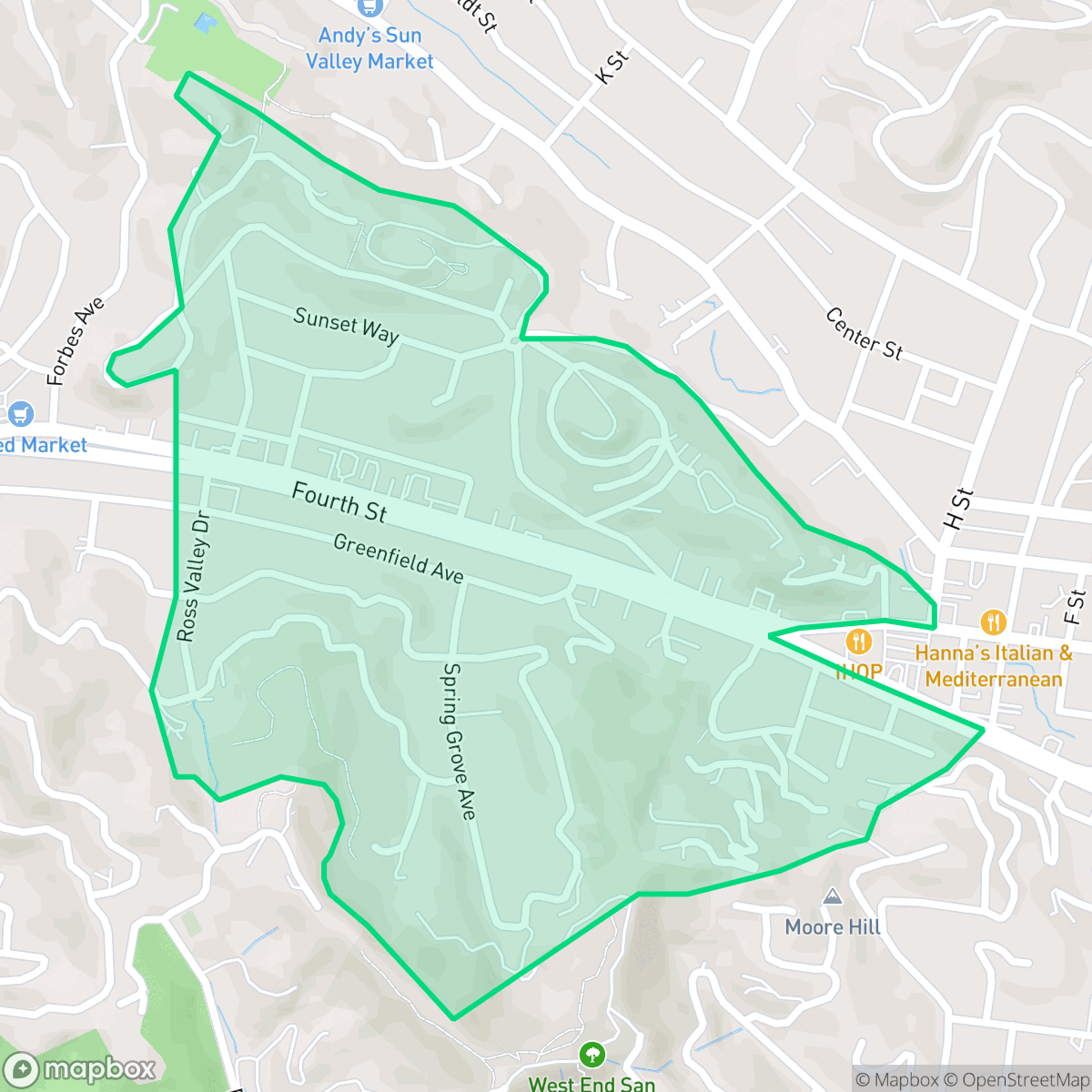
The West End neighborhood of San Rafael is a distinct residential and commercial area anchored by the eclectic West End Village along Fourth Street. Known for its bohemian character, the neighborhood features a diverse architectural blend ranging from Spanish Mediterranean styles to classic California bungalows. The area serves as a vibrant gateway to downtown San Rafael, with its community identity fostered by the West End Neighborhood Association (WENA), which was established in 1977. While the broader city of San Rafael is rooted in the 1817 Mission San Rafael Arcángel, the West End specifically distinguishes itself through its unique local merchant culture and its role as a walkable, vibrant transition between the downtown core and the surrounding residential hillside districts.
The area is characterized by an upscale, scenic aesthetic and a diverse population. Residents enjoy high rates of health insurance coverage and a strong sense of community, with the neighborhood serving as a peaceful residential enclave. The absence of industrial facilities contributes to a clean environment, though the proximity to major transportation corridors results in consistent traffic noise. The landscape balances quiet, low-density streets with vibrant commercial blocks, creating a unique transition between the downtown core and the surrounding hills.
Prospective residents should consider the trade-offs regarding environmental safety and noise. While the neighborhood is highly walkable and pet-friendly, it faces elevated fire and moderate flood risks, necessitating proactive preparedness. The area is served by several school districts, ranging from high-performing institutions like the Ross Elementary and Tamalpais Union High School districts to those currently navigating fiscal and demographic transitions. It is best suited for those who prioritize walkability and a scenic, liberal-leaning community over absolute silence or low-risk hazard zones.
Neighborhood Scores Across 15 Qualities
Residential spacing is moderately varied, ranging from dense downtown apartments to hillside homes with more buffer between neighbors. According to iHuus data, this level of separation is slightly higher than the San Rafael average.
A grid-based sidewalk network provides reliable pedestrian access to downtown amenities, offering slightly better walkability than the San Rafael average. Many daily errands can be completed on foot thanks to safe crossings and consistent infrastructure.
Large hillside estates, private pools, and well-manicured properties contribute to a visual landscape that is more polished than the San Rafael average. According to iHuus data, the presence of premium amenities and spacious lots creates a highly manicured aesthetic throughout the area.
Large parks and wide, grass-lined paths provide ample space for pets. This area offers a similar level of dog friendliness compared to the rest of San Rafael.
Open land and woodland are common throughout the area, providing a sense of space that is slightly more prevalent than in the rest of San Rafael. While some parts of the neighborhood feature a dense suburban downtown, the landscape remains largely characterized by scattered homes and natural surroundings according to iHuus data.
Active dining spots and community hubs create a more vibrant atmosphere than the San Rafael average, though some pockets remain quiet and rural. According to iHuus data, the area balances lively commercial blocks with serene, low-density landscapes.
Frequent noise from the nearby freeway and railroad tracks makes this area noisier than most parts of San Rafael. Residents may experience more consistent auditory disturbances compared to the city average, according to iHuus data.
Air quality remains exceptionally high with minimal health concerns. According to iHuus data, these levels are slightly better than the average found throughout San Rafael.
Residential life here is free from warehouses or heavy industrial facilities, offering a cleaner environment than the San Rafael average. According to iHuus data, the area consists of quiet streets and open green spaces with no detectable industrial hazards.
Health insurance access is widespread among West End residents, significantly outpacing the San Rafael average according to iHuus data.
Voting patterns and census indicators show a highly liberal political leaning, which is slightly more pronounced than the average for San Rafael. According to iHuus data, this reflects a very consistent partisan trend within the neighborhood.
Residents live alongside a balanced mix of young professionals, families, and seniors. This demographic variety is slightly more even than the average found across San Rafael, according to iHuus data.
Flood risk in this area is higher than the San Rafael average, though the specific level of danger remains undetermined due to a lack of detailed FEMA studies. Residents should remain aware of potential vulnerabilities during extreme weather events.
Significant fire hazards exist within this area, which represents a higher risk level than the San Rafael average according to iHuus data. Residents should prioritize enhanced mitigation measures and seasonal preparedness.
Address-Level Insights for West End


iHuus Neighborhood Intelligence Insights
Get address-level neighborhood insights for West End
- Street-level scores — see how individual blocks compare, not just neighborhood averages
- Micro-zone boundaries — identify quiet pockets, flood boundaries, and walkable clusters before you visit
- 15 dimensions in full — walkability, noise, air quality, school quality, insurance coverage, population age profile, urban/rural index, and more
- Boundary risk alerts — know if your address sits near a block boundary where scores drop, the kind of detail no listing will ever mention
- School insights — individual school ratings and insights, not just district-level data
- Compare before you commit — side-by-side data across neighborhoods, down to block precision
No credit card required
Compare with Any Neighborhood
| Dimension | West End | Bay Islands |
|---|---|---|
| 🚶 Walkabilityavg 7.77 | ||
| 🔊 Acoustic Comfortavg 4.28 | ||
| 🤫 Privacy Indexavg 5.75 | ||
| 🎨 Visual Appealavg 7.83 | ||
| 🐕 Dog Friendlinessavg 8.65 | ||
| 🗺️ Urban-Rural Indexavg 7.61 | ||
| ✨ Neighborhood Vibeavg 4 | ||
| 🏥 Health Insurance Coverageavg 7.38 | ||
| 🌿 Air Qualityavg 9.29 | ||
| 🏭 Industrial Proximityavg 9.06 | ||
| 🌊 Flood Safetyavg 3.6 | ||
| 🗳️ Ideological Leanavg 9.8 | ||
| 👥 Population Age Profileavg 5.25 | ||
| 🔥 Fire Safetyavg 1.32 | ||
| 🏫 School Quality |
West End Rankings
School Districts Serving West End
School Insights for West End
Below average outcomes; significant attendance and academic challenges.
School Insights
See what's really behind every school rating near West End
- Individual school ratings — each school's own score with outcome context, not just a district average
- Enrollment & class size data — student-to-teacher ratio and how it compares to the state average
- Full demographics breakdown — ethnicity and gender composition for every school in the enrollment zone
- Every school in the district — all schools within the enrollment boundary ranked by rating, not just the closest one
- Grade levels & benchmarks — elementary through high school, with below/above state-average flags
No credit card required