Peacock Gap, San Rafael
Updated · 1,899 residents
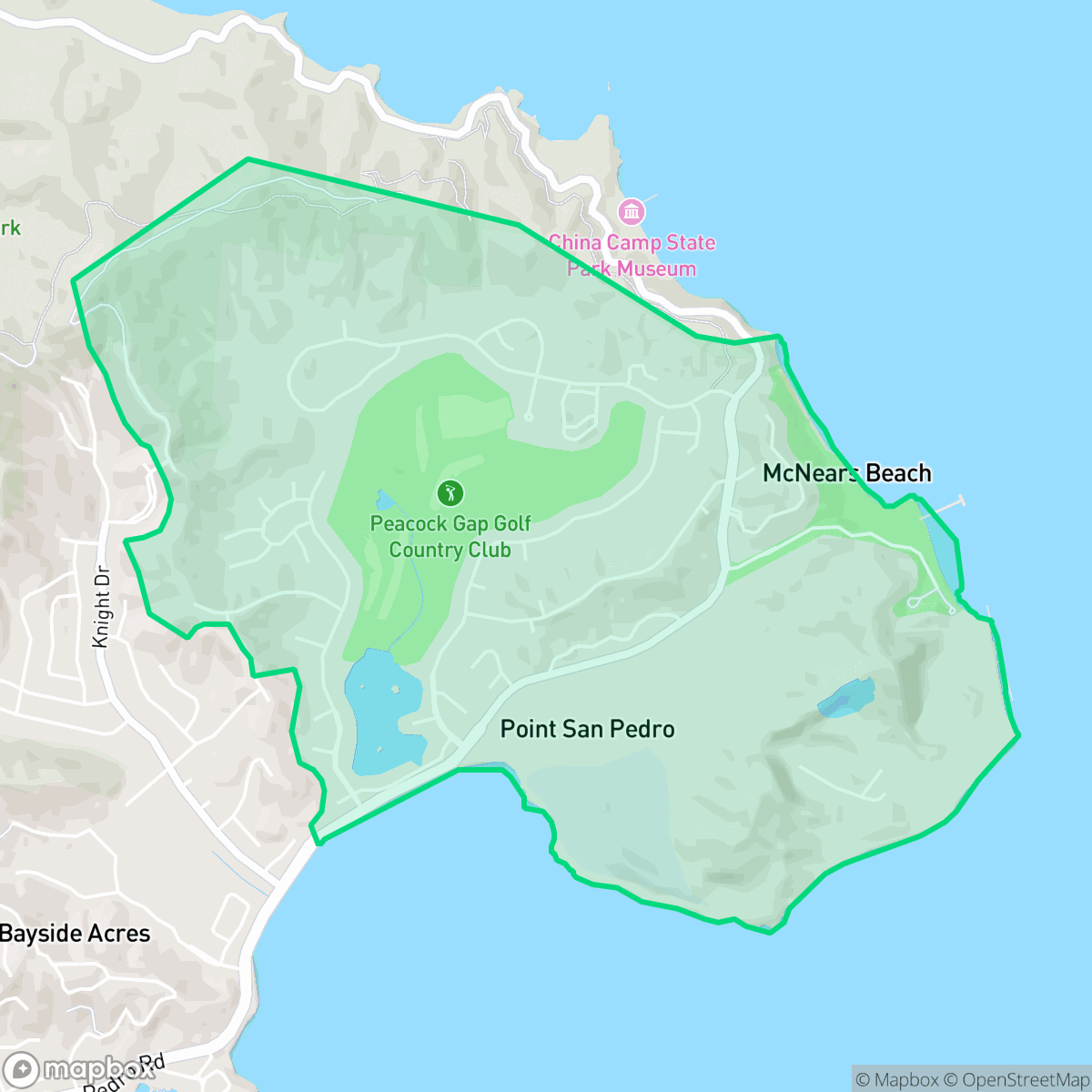
Peacock Gap is a quiet, coastal enclave in San Rafael characterized by its scenic golf course and expansive open spaces. While the area offers exceptional air quality and a serene, semi-rural atmosphere, residents face limited walkability and few local businesses.
Key Highlights
About Peacock Gap
Once an expanse of marshland and tidal flats owned by the McNear family in the late 19th century, Peacock Gap in San Rafael was named after Thomas Peacock, a dairyman who leased grazing land in the area. In the late 1950s, developers began converting the wetlands, initially planning a massive development called "Marin Bay" before developer Jerome Draper acquired and renamed the area in 1963. The neighborhood’s centerpiece, the Peacock Gap Golf Club, opened in 1960 with a championship course designed by William F. Bell. The club became a major social hub, hosting celebrity golf tournaments with stars like Bob Hope and Bing Crosby. Developed alongside an engineered lagoon system for flood management, the community grew in the 1960s into a premier coastal residential enclave defined by its scenic recreation and mid-century homes.
The neighborhood functions as a low-density residential community that prioritizes natural surroundings and quietude. With an urban-rural index that leans heavily toward rural, the area features significant green space and a high degree of visual appeal. According to iHuus data, the environment is notably peaceful, maintaining low noise levels that contrast with the more active parts of San Rafael. The presence of the championship golf course serves as the primary anchor for the community, reinforcing its identity as a recreational and lifestyle-focused destination.
Prospective residents should note that the area is best suited for those who value tranquility and outdoor access over urban convenience. While dog friendliness is high, the neighborhood lacks a robust network of local services, requiring travel for daily errands. Furthermore, the location presents specific environmental trade-offs, including elevated risks related to flood and fire safety. Despite these challenges, the community maintains excellent health insurance coverage and high air quality, making it a stable choice for those seeking a remote, nature-integrated living experience.
Neighborhood Scores Across 15 Qualities
Residential spacing provides a moderate level of separation between neighbors, sitting slightly above the San Rafael average. According to iHuus data, the area features mixed density with some natural buffers between properties.
Pedestrian movement is possible via safe crossings and single-sided sidewalks, though connectivity is lower than the San Rafael average.
Large homes and upscale amenities contribute to a highly manicured landscape. This level of visual appeal sits above the San Rafael average according to iHuus data.
Extensive trail networks and large open spaces provide ample opportunities for exercise. According to iHuus data, this level of access to parks and natural terrain is higher than the San Rafael average.
Expansive open green spaces and low-density housing define this coastal area. According to iHuus data, this neighborhood features more frequent open land and woodland compared to the San Rafael average.
Low density and significant open space characterize this area, which lacks the commercial activity and local business density found in most of San Rafael. Residents will find a serene landscape with very few nearby destinations for shopping or dining.
A steady hum of local traffic from nearby busy streets is present, though acoustic comfort remains higher than the San Rafael average according to iHuus data.
Air quality remains consistently high with minimal health concerns. This level of cleanliness is even better than the average found across San Rafael, according to iHuus data.
Residential life is largely uninterrupted by industrial facilities, though an active quarry nearby may introduce localized noise and dust. This level of industrial separation is slightly lower than the San Rafael average due to these specific earthworks operations.
Health insurance access is very high among residents, significantly exceeding the San Rafael average according to iHuus data.
Voting patterns and census indicators show a predominantly liberal community, which is very similar to the broader San Rafael area according to iHuus data.
A balanced mix of young adults, families, and seniors characterizes the area, representing a more varied age distribution than the San Rafael average according to iHuus data.
Property locations within this area are situated inside a known floodplain, making flood insurance likely a requirement for residents. According to iHuus data, this level of vulnerability is significantly higher than the average found across San Rafael.
Significant fire hazards exist within the area, representing a higher risk level than the San Rafael average according to iHuus data. Residents should prioritize enhanced mitigation measures and wildfire preparedness.
Address-Level Insights for Peacock Gap


iHuus Neighborhood Intelligence Insights
Get address-level neighborhood insights for Peacock Gap
- Street-level scores — see how individual blocks compare, not just neighborhood averages
- Micro-zone boundaries — identify quiet pockets, flood boundaries, and walkable clusters before you visit
- 15 dimensions in full — walkability, noise, air quality, school quality, insurance coverage, population age profile, urban/rural index, and more
- Boundary risk alerts — know if your address sits near a block boundary where scores drop, the kind of detail no listing will ever mention
- School insights — individual school ratings and insights, not just district-level data
- Compare before you commit — side-by-side data across neighborhoods, down to block precision
No credit card required
Compare with Any Neighborhood
| Dimension | Peacock Gap | Bay Islands |
|---|---|---|
| 🚶 Walkabilityavg 7.77 | ||
| 🔊 Acoustic Comfortavg 4.28 | ||
| 🤫 Privacy Indexavg 5.75 | ||
| 🎨 Visual Appealavg 7.83 | ||
| 🐕 Dog Friendlinessavg 8.65 | ||
| 🗺️ Urban-Rural Indexavg 7.61 | ||
| ✨ Neighborhood Vibeavg 4 | ||
| 🏥 Health Insurance Coverageavg 7.38 | ||
| 🌿 Air Qualityavg 9.29 | ||
| 🏭 Industrial Proximityavg 9.06 | ||
| 🌊 Flood Safetyavg 3.6 | ||
| 🗳️ Ideological Leanavg 9.8 | ||
| 👥 Population Age Profileavg 5.25 | ||
| 🔥 Fire Safetyavg 1.32 | ||
| 🏫 School Quality |
Peacock Gap Rankings
School Districts Serving Peacock Gap
School Insights for Peacock Gap
Below average outcomes; significant attendance and academic challenges.
School Insights
See what's really behind every school rating near Peacock Gap
- Individual school ratings — each school's own score with outcome context, not just a district average
- Enrollment & class size data — student-to-teacher ratio and how it compares to the state average
- Full demographics breakdown — ethnicity and gender composition for every school in the enrollment zone
- Every school in the district — all schools within the enrollment boundary ranked by rating, not just the closest one
- Grade levels & benchmarks — elementary through high school, with below/above state-average flags
No credit card required