North San Rafael Commercial Center, San Rafael
Updated · 2,503 residents
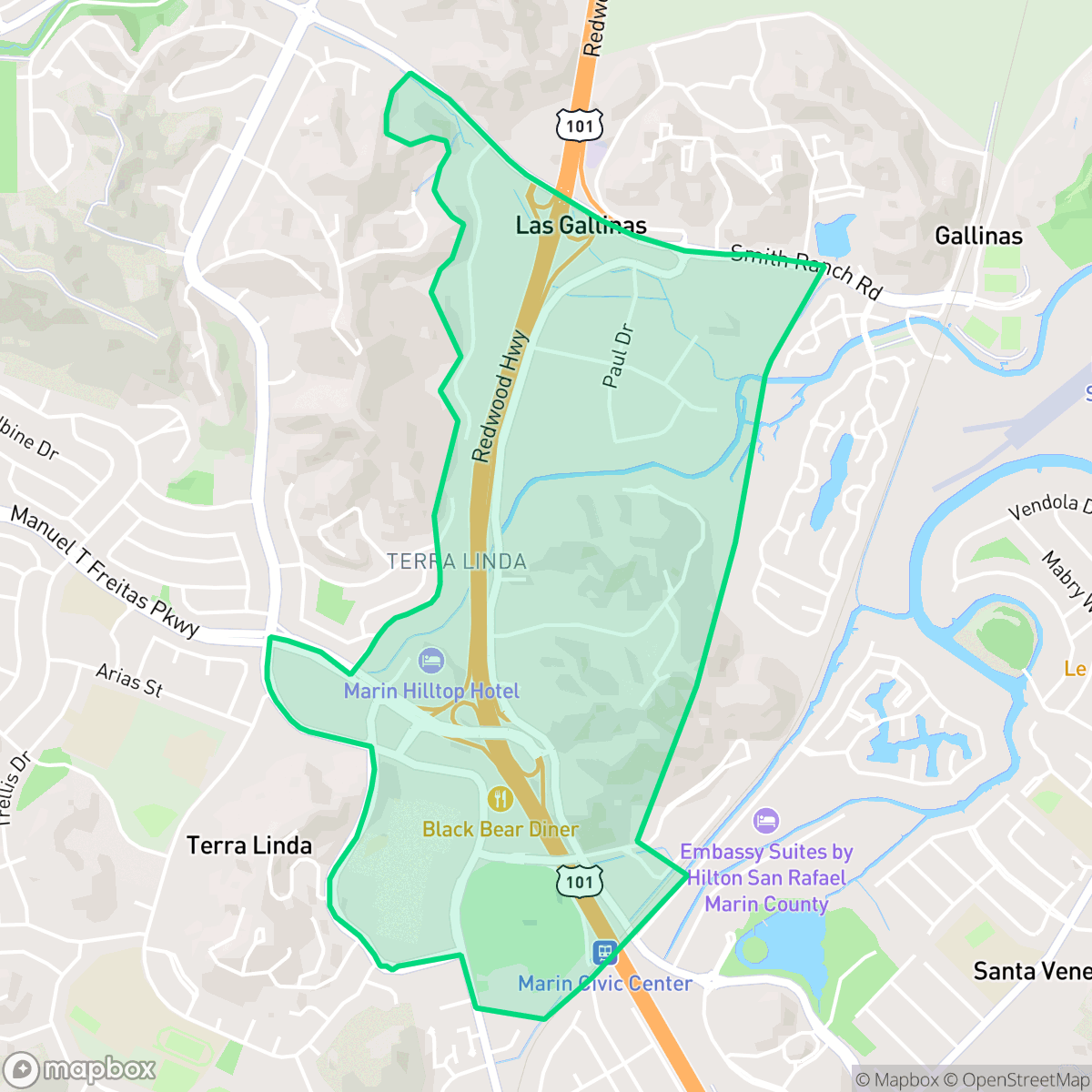
The North San Rafael Commercial Center is a busy retail and industrial hub defined by its proximity to major transit corridors and the regional shopping presence of Northgate Mall. While the area offers high air quality and strong health insurance coverage, residents should expect significant road noise and a car-dependent environment. It balances high-density residential pockets with functional commercial spaces, providing a practical living experience for those prioritizing accessibility.
Key Highlights
About North San Rafael Commercial Center
The North San Rafael Commercial Center, historically referred to as the North San Rafael Town Center, was developed on former agricultural land that was once part of the Freitas Ranch, a portion of the Mexican-era Rancho San Pedro, Santa Margarita y Las Gallinas land grant. Following World War II, the Manuel T. Freitas family's ranch land was subdivided to accommodate suburban expansion. At the heart of this commercial neighborhood is the Northgate Mall, which debuted in 1964 with the opening of The Emporium department store. Initially constructed as an open-air shopping complex, the mall was enclosed in 1987, establishing it as the only enclosed regional shopping center in Marin County. Today, the neighborhood serves as a primary retail and commercial hub for the northern San Rafael area.
The neighborhood functions as a primary commercial and logistics node, characterized by a dense mix of office complexes, light industrial warehouses, and residential clusters. This area maintains a functional, suburban atmosphere where daily life revolves around convenient access to retail centers and major highway arteries. While it offers excellent air quality and high rates of health insurance coverage, the environment is notably loud due to constant road traffic. The visual landscape is a blend of utilitarian commercial infrastructure and maintained green spaces, creating a distinct, pragmatic urban environment.
Prospective residents should weigh the convenience of the location against environmental factors. The area faces significant challenges regarding acoustic comfort and elevated risks for flood and fire events. Educational options vary, with some residents served by the high-performing Dixie Elementary School District, while others fall under the San Rafael City school districts which are currently navigating budgetary and performance transitions. This neighborhood is best suited for individuals who prioritize central access to regional employment and shopping over a quiet, secluded residential setting.
Neighborhood Scores Across 15 Qualities
Residential spacing provides a moderate level of separation between neighbors, sitting slightly above the San Rafael average. According to iHuus data, the area features mixed density with some established buffers between adjacent properties.
Pedestrian access is well-supported by sidewalks on one side of the street and safe crossings. According to iHuus data, this area offers slightly better walkability than the San Rafael average.
Large residences and frequent upscale amenities define the area, though the overall visual landscape is slightly below the San Rafael average. According to iHuus data, the neighborhood features spacious driveways and well-maintained property features.
Extensive trails and large open spaces provide significant opportunities for pet owners. According to iHuus data, the availability of nearby parks and recreation areas is notably higher than the San Rafael average.
Frequent open land and scattered woodland intersect with pockets of light industrial parks and high-density residential clusters. This area feels less developed than the San Rafael average according to iHuus data.
A mix of dining establishments and local amenities creates a more active environment than much of San Rafael. While some areas near the highway remain quiet and industrial, other pockets offer a lively suburban atmosphere with accessible social hubs.
A consistent hum from nearby busy streets defines the acoustic environment. This level of noise is slightly higher than the typical experience found elsewhere in San Rafael.
Air quality remains consistently high with minimal health concerns, appearing slightly better than the San Rafael average according to iHuus data.
Residents can enjoy a predominantly residential atmosphere with no significant industrial activity or hazards nearby. While some light commercial elements are present, the area has slightly more industrial-adjacent features than the San Rafael average according to iHuus data.
Health insurance accessibility is notably higher here than in the rest of San Rafael, according to iHuus data. This indicates a well-covered population with greater access to medical resources.
Voting patterns and census indicators reflect a deeply liberal political landscape that is consistent with the broader San Rafael area, according to iHuus data.
Residents live alongside a varied demographic of young professionals, families, and seniors. This age distribution is more balanced than the typical profile found across San Rafael, according to iHuus data.
Flood risk in this area is higher than the San Rafael average, though official FEMA studies for this specific location remain incomplete. Residents should note that the area is categorized with an undetermined risk level according to iHuus data.
Wildfire hazards are exceptionally high in this area, representing a significantly greater danger than the San Rafael average. Residents should prioritize maximum fire protection measures according to iHuus data.
Address-Level Insights for North San Rafael Commercial Center


iHuus Neighborhood Intelligence Insights
Get address-level neighborhood insights for North San Rafael Commercial Center
- Street-level scores — see how individual blocks compare, not just neighborhood averages
- Micro-zone boundaries — identify quiet pockets, flood boundaries, and walkable clusters before you visit
- 15 dimensions in full — walkability, noise, air quality, school quality, insurance coverage, population age profile, urban/rural index, and more
- Boundary risk alerts — know if your address sits near a block boundary where scores drop, the kind of detail no listing will ever mention
- School insights — individual school ratings and insights, not just district-level data
- Compare before you commit — side-by-side data across neighborhoods, down to block precision
No credit card required
Compare with Any Neighborhood
| Dimension | North San Rafael Commercial Center | Bay Islands |
|---|---|---|
| 🚶 Walkabilityavg 7.77 | ||
| 🔊 Acoustic Comfortavg 4.28 | ||
| 🤫 Privacy Indexavg 5.75 | ||
| 🎨 Visual Appealavg 7.83 | ||
| 🐕 Dog Friendlinessavg 8.65 | ||
| 🗺️ Urban-Rural Indexavg 7.61 | ||
| ✨ Neighborhood Vibeavg 4 | ||
| 🏥 Health Insurance Coverageavg 7.38 | ||
| 🌿 Air Qualityavg 9.29 | ||
| 🏭 Industrial Proximityavg 9.06 | ||
| 🌊 Flood Safetyavg 3.6 | ||
| 🗳️ Ideological Leanavg 9.8 | ||
| 👥 Population Age Profileavg 5.25 | ||
| 🔥 Fire Safetyavg 1.32 | ||
| 🏫 School Quality |
North San Rafael Commercial Center Rankings
School Districts Serving North San Rafael Commercial Center
School Insights for North San Rafael Commercial Center
Below average outcomes; significant attendance and academic challenges.
School Insights
See what's really behind every school rating near North San Rafael Commercial Center
- Individual school ratings — each school's own score with outcome context, not just a district average
- Enrollment & class size data — student-to-teacher ratio and how it compares to the state average
- Full demographics breakdown — ethnicity and gender composition for every school in the enrollment zone
- Every school in the district — all schools within the enrollment boundary ranked by rating, not just the closest one
- Grade levels & benchmarks — elementary through high school, with below/above state-average flags
No credit card required