Montecito/Happy Valley, San Rafael
Updated · 1,178 residents
Montecito/Happy Valley offers a blend of historic residential character and high-energy commercial corridors near major transit routes. While the area is exceptionally walkable and features diverse local dining, residents should be aware of significant road noise and environmental risks.
Key Highlights
About Montecito/Happy Valley
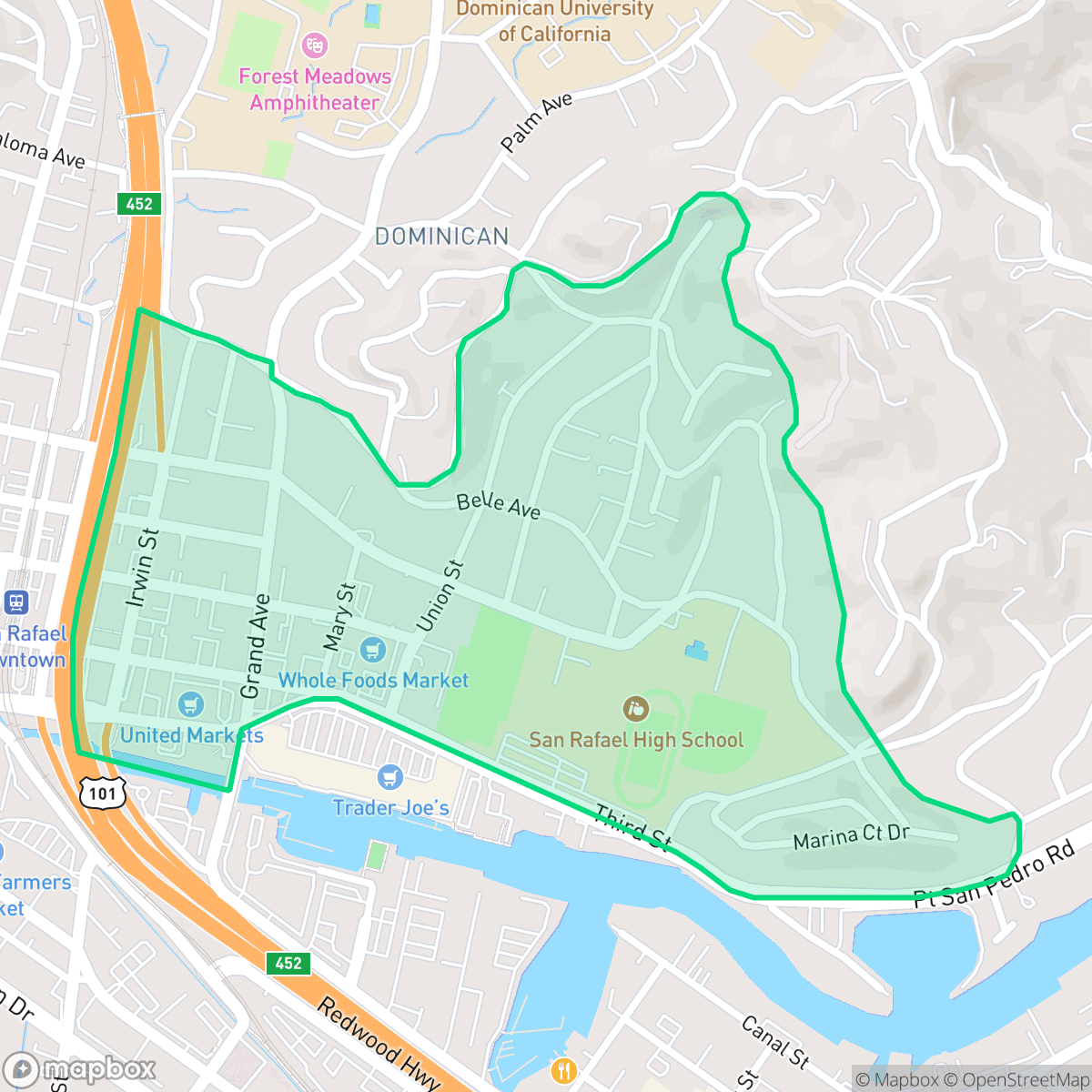
Nestled in two valleys north of the San Rafael Canal, the Montecito/Happy Valley neighborhood is recognized as the second-oldest neighborhood in San Rafael. Historically, the area was characterized by agricultural operations, most notably Roberts Dairy. Founded in 1898 by pioneer Rachel Armstrong Roberts with just two Jersey cows, the dairy grew into a prominent Marin County institution with over a thousand head of cattle by the 1940s. Its creamery plant operated at Mary and 4th Streets until closing in 1958. Today, Montecito/Happy Valley is a quiet residential enclave defined by its scenic natural setting, tree-lined streets, and diverse architectural stock that includes large, elegant historic homes.
The neighborhood functions as a multifaceted district where quiet, tree-lined residential streets transition into active commercial zones. Proximity to major highways facilitates access to local dining staples, contributing to a lively atmosphere in industrial-adjacent blocks. According to data, the air quality remains excellent, providing a clean environment despite the proximity to busy transit corridors that define much of the area's daily activity.
Potential residents should weigh the benefits of walkability and central access against notable livability trade-offs. The area experiences high levels of ambient road noise, and data indicates significant concerns regarding flood and fire safety. While the local school district provides modern facilities and stable infrastructure, families should consider the performance gaps and budget challenges facing area schools. This location is best suited for those who prioritize convenience and urban accessibility over absolute acoustic privacy or rural tranquility.
Neighborhood Scores Across 15 Qualities
Residential density varies throughout the area, ranging from tightly clustered lots to large hillside estates with significant vegetation buffers. This provides a slightly higher level of privacy between neighbors than is typically found in the San Rafael average, according to iHuus data.
Pedestrian access is well-supported by a grid system, sidewalks, and multiple bridges over the highway. This level of connectivity is largely consistent with the rest of San Rafael.
Large custom estates and private amenities like pools and tennis courts provide a highly polished landscape. This level of visual quality and architectural variety sits well above the San Rafael average.
Wooded trails and nearby sports fields offer ample space for pet exercise, though overall dog friendliness sits slightly below the San Rafael average. Many residential fringes provide easy access to large, connected green spaces away from street traffic.
Wooded hillsides and open landscapes provide a sense of seclusion, though the area is slightly less rural than the San Rafael average. Residential pockets transition from dense suburban canopies to spaces adjacent to wildland park areas.
Social hubs and diverse dining options provide a noticeable energy that is significantly higher than the San Rafael average. While various local eateries and cafes create a lively atmosphere, the car-dependent layout means most destinations require driving.
Frequent noise from nearby freeway and railroad activity defines the area. According to iHuus data, acoustic comfort levels are notably lower than the San Rafael average.
Air quality remains consistently high with minimal pollutants, performing even better than the San Rafael average according to iHuus data.
Industrial presence is virtually non-existent here, as the area consists of residential streets and open green spaces without warehouses or heavy manufacturing. This lack of industrial proximity is even more pronounced than in the rest of San Rafael, according to iHuus data.
Health insurance coverage is widespread among residents, though it remains slightly below the San Rafael average according to iHuus data.
Voting patterns and census indicators align closely with the city average, reflecting a highly liberal political landscape.
Residents live alongside a diverse mix of young adults, families, and older populations. This age distribution is largely consistent with the broader San Rafael area.
Flood risk is elevated in this area as parts of the neighborhood fall within the 100-year floodplain, meaning flood insurance is typically required. This risk level is slightly higher than the average for San Rafael, according to iHuus data.
Address-Level Insights for Montecito/Happy Valley


iHuus Neighborhood Intelligence Insights
Get address-level neighborhood insights for Montecito/Happy Valley
- Street-level scores — see how individual blocks compare, not just neighborhood averages
- Micro-zone boundaries — identify quiet pockets, flood boundaries, and walkable clusters before you visit
- 15 dimensions in full — walkability, noise, air quality, school quality, insurance coverage, population age profile, urban/rural index, and more
- Boundary risk alerts — know if your address sits near a block boundary where scores drop, the kind of detail no listing will ever mention
- School insights — individual school ratings and insights, not just district-level data
- Compare before you commit — side-by-side data across neighborhoods, down to block precision
No credit card required
Compare with Any Neighborhood
| Dimension | Montecito/Happy Valley | Bay Islands |
|---|---|---|
| 🚶 Walkabilityavg 7.77 | ||
| 🔊 Acoustic Comfortavg 4.28 | ||
| 🤫 Privacy Indexavg 5.75 | ||
| 🎨 Visual Appealavg 7.83 | ||
| 🐕 Dog Friendlinessavg 8.65 | ||
| 🗺️ Urban-Rural Indexavg 7.61 | ||
| ✨ Neighborhood Vibeavg 4 | ||
| 🏥 Health Insurance Coverageavg 7.38 | ||
| 🌿 Air Qualityavg 9.29 | ||
| 🏭 Industrial Proximityavg 9.06 | ||
| 🌊 Flood Safetyavg 3.6 | ||
| 🗳️ Ideological Leanavg 9.8 | ||
| 👥 Population Age Profileavg 5.25 | ||
| 🔥 Fire Safetyavg 1.32 | ||
| 🏫 School Quality |
Montecito/Happy Valley Rankings
School Districts Serving Montecito/Happy Valley
School Insights for Montecito/Happy Valley
Below average outcomes; significant attendance and academic challenges.
School Insights
See what's really behind every school rating near Montecito/Happy Valley
- Individual school ratings — each school's own score with outcome context, not just a district average
- Enrollment & class size data — student-to-teacher ratio and how it compares to the state average
- Full demographics breakdown — ethnicity and gender composition for every school in the enrollment zone
- Every school in the district — all schools within the enrollment boundary ranked by rating, not just the closest one
- Grade levels & benchmarks — elementary through high school, with below/above state-average flags
No credit card required