Fairhills, San Rafael
Updated · 1,173 residents
Fairhills is a serene, hillside enclave in San Rafael known for its exceptional visual appeal and quiet atmosphere. While the area requires a vehicle for most errands, it offers residents pristine air quality and a secure, tranquil residential environment.
Key Highlights
About Fairhills
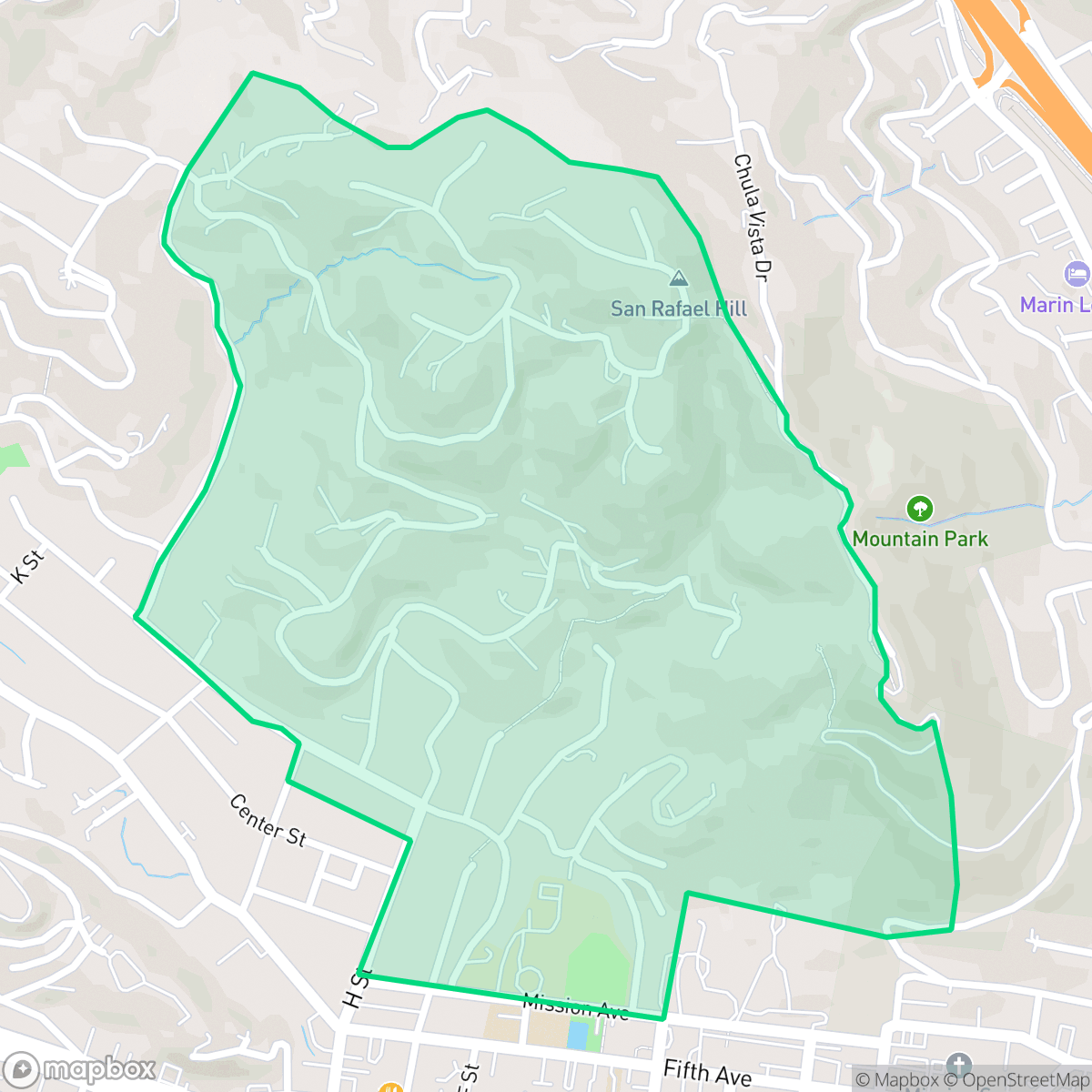
The Fairhills neighborhood in San Rafael, California, traces its origins to a 133-acre tract purchased in 1868 by San Geronimo landowner Adolph Mailliard. On this land, Mailliard built a grand three-story mansion, which was considered the largest house in town at the time. The estate was later acquired by prominent Marin County businessman Arthur William (A.W.) Foster, who officially named the property "Fairhills". Today, the neighborhood is highly regarded for its hillside setting and diverse architectural character. Its lower southern borders near downtown San Rafael retain historic charm with Victorian-era homes and Craftsman bungalows, while the winding hillside streets feature custom mid-century modern and contemporary residences that offer sweeping views of the surrounding landscape.
The neighborhood is characterized by a low-density, rural-like atmosphere that provides a sense of seclusion within the broader city. Its hillside topography contributes to high visual appeal, while the lack of dense development fosters a peaceful acoustic environment. According to iHuus data, the area maintains excellent air quality and minimal industrial proximity, making it a sanctuary for those prioritizing privacy and natural beauty over immediate access to urban amenities.
This area is best suited for residents who prefer a car-dependent lifestyle, as it lacks a walkable commercial center. While the neighborhood offers a high quality of life and strong health insurance coverage, prospective residents should consider the trade-offs of limited walkability and the necessity of using a vehicle for daily services. It remains a stable, community-focused choice for those seeking a quiet retreat from the bustle of central San Rafael.
Neighborhood Scores Across 15 Qualities
Residential density varies between compact downtown apartments and spacious hillside estates. This layout provides more buffer between neighbors than the typical San Rafael streetscape, according to iHuus data.
A grid-based sidewalk network and pedestrian bridges over the highway provide excellent connectivity to downtown amenities. This level of accessibility is slightly above the San Rafael average, according to iHuus data.
Large hillside homes, private pools, and well-manicured properties contribute to an aesthetic that is more polished than the San Rafael average. According to iHuus data, the presence of high-quality recreational facilities and spacious estates defines the local landscape.
Wooded trails and nearby sports fields provide ample space for pets. According to iHuus data, the availability of connected green spaces and wide paths is slightly below the San Rafael average.
Open land and woodland areas are common throughout the neighborhood, though it feels slightly less rural than the typical San Rafael landscape. Residents will find a mix of scattered homes and adjacent wildland parks alongside more dense, suburban commercial cores.
A mix of energetic blocks and quiet residential pockets provides a social atmosphere that is more active than the San Rafael average. Residents have access to various local dining options and cafes, though some areas remain more secluded and car-dependent.
Frequent noise from nearby major highways and railroad tracks characterizes this area. According to iHuus data, acoustic comfort levels are notably lower than the San Rafael average.
Air quality in this area is consistently excellent, providing a cleaner environment than the San Rafael average according to iHuus data.
Residential tranquility is maintained by a complete absence of warehouses, heavy industrial facilities, or hazard sites. According to iHuus data, this area is even more insulated from industrial activity than the San Rafael average.
Health insurance coverage among residents is notably higher than the San Rafael average, according to iHuus data.
Voting patterns and census indicators show a predominantly liberal community, which is slightly more pronounced than the average for San Rafael. According to iHuus data, the area maintains very consistent progressive political alignments.
Residents live alongside a balanced mix of young adults, families, and older individuals. This demographic spread is consistent with the city average according to iHuus data.
Flood risk in this area is notably higher than the San Rafael average, though official FEMA studies for this specific location remain incomplete.
Wildfire hazards are severe in this area, presenting a much higher risk than the typical San Rafael neighborhood. According to iHuus data, residents should prioritize maximum protection and emergency preparedness measures.
Address-Level Insights for Fairhills


iHuus Neighborhood Intelligence Insights
Get address-level neighborhood insights for Fairhills
- Street-level scores — see how individual blocks compare, not just neighborhood averages
- Micro-zone boundaries — identify quiet pockets, flood boundaries, and walkable clusters before you visit
- 15 dimensions in full — walkability, noise, air quality, school quality, insurance coverage, population age profile, urban/rural index, and more
- Boundary risk alerts — know if your address sits near a block boundary where scores drop, the kind of detail no listing will ever mention
- School insights — individual school ratings and insights, not just district-level data
- Compare before you commit — side-by-side data across neighborhoods, down to block precision
No credit card required
Compare with Any Neighborhood
| Dimension | Fairhills | Bay Islands |
|---|---|---|
| 🚶 Walkabilityavg 7.77 | ||
| 🔊 Acoustic Comfortavg 4.28 | ||
| 🤫 Privacy Indexavg 5.75 | ||
| 🎨 Visual Appealavg 7.83 | ||
| 🐕 Dog Friendlinessavg 8.65 | ||
| 🗺️ Urban-Rural Indexavg 7.61 | ||
| ✨ Neighborhood Vibeavg 4 | ||
| 🏥 Health Insurance Coverageavg 7.38 | ||
| 🌿 Air Qualityavg 9.29 | ||
| 🏭 Industrial Proximityavg 9.06 | ||
| 🌊 Flood Safetyavg 3.6 | ||
| 🗳️ Ideological Leanavg 9.8 | ||
| 👥 Population Age Profileavg 5.25 | ||
| 🔥 Fire Safetyavg 1.32 | ||
| 🏫 School Quality |
Fairhills Rankings
School Districts Serving Fairhills
School Insights for Fairhills
Below average outcomes; significant attendance and academic challenges.
School Insights
See what's really behind every school rating near Fairhills
- Individual school ratings — each school's own score with outcome context, not just a district average
- Enrollment & class size data — student-to-teacher ratio and how it compares to the state average
- Full demographics breakdown — ethnicity and gender composition for every school in the enrollment zone
- Every school in the district — all schools within the enrollment boundary ranked by rating, not just the closest one
- Grade levels & benchmarks — elementary through high school, with below/above state-average flags
No credit card required