Twenty-Fifth Ave, San Mateo
Updated · 2,786 residents
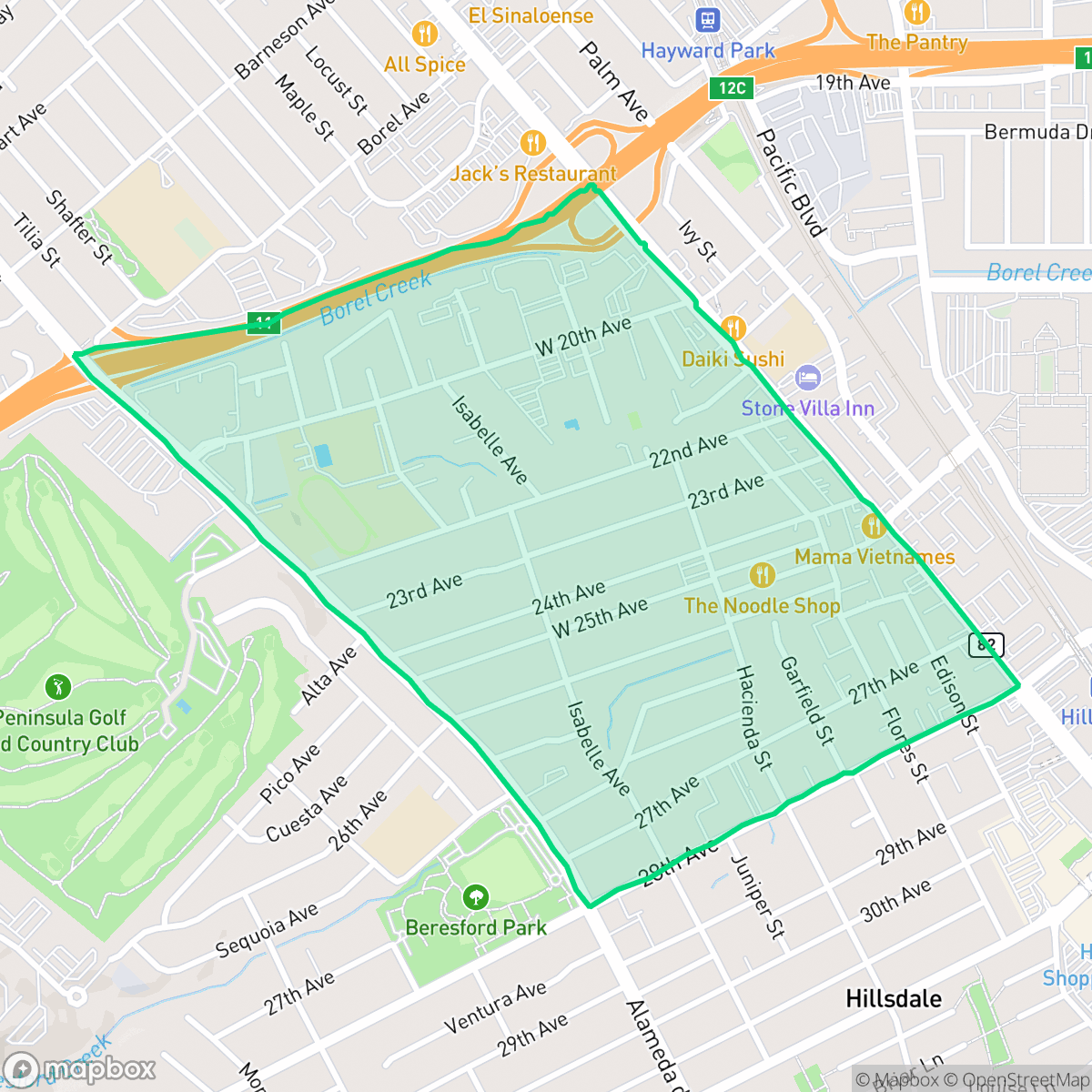
Twenty-Fifth Ave is a highly walkable San Mateo neighborhood defined by its vibrant commercial corridor and tight-knit residential grid. Residents enjoy easy access to local dining and public green spaces, though the area experiences moderate noise levels from nearby road traffic.
Key Highlights
About Twenty-Fifth Ave
The Twenty-Fifth Avenue neighborhood in San Mateo, centered around its historic commercial strip, developed as part of the Beresford Manor tract annexed by the city in 1929. In 1937, developer Axel Johnson of the San Mateo Investment Company established the 25th Avenue commercial district west of El Camino Real. This two-block retail corridor, often called San Mateo’s "second downtown," retains a distinct 1950s and 1960s character. The area's architectural footprint features pre-war Tudor, Mediterranean, and bungalow-style homes, alongside a prominent 1930 Art Deco building at the corner of El Camino Real. Longtime local businesses, such as Vinyl Solution Records—which has operated for over four decades—and classic Italian restaurants, define the neighborhood's authentic community character.
The neighborhood functions as a dense suburban enclave where daily errands are easily managed on foot. It maintains a consistent sidewalk network and proximity to community parks, making it a preferred choice for those who prioritize pedestrian access to local services. While it lacks heavy industrial activity, the environment is characterized by a steady hum of suburban life and a diverse array of dining options that contribute to an active, local atmosphere.
Prospective residents should be aware that the high walkability comes with a trade-off in acoustic comfort due to road traffic. The housing stock consists of closely spaced single-family homes, offering limited privacy compared to more sprawling developments. This area is well-suited for individuals or families who value a central location within San Mateo, access to top-tier high school education, and a social neighborhood environment over complete seclusion.
Neighborhood Scores Across 15 Qualities
Residential spacing varies throughout the area, with some homes situated closely together and others offering standard suburban buffers. According to iHuus data, privacy levels are slightly lower than the San Mateo average due to pockets of higher density housing.
Pedestrian-friendly street layouts and consistent sidewalks on both sides of the road make navigating the area on foot easy. This neighborhood offers superior connectivity for walkers compared to the San Mateo average according to iHuus data.
Manicured yards and large homes with private pools characterize the area, though the overall visual variety is slightly below the San Mateo average. According to iHuus data, the neighborhood features a consistent suburban aesthetic with spacious driveways and upscale amenities.
Proximity to a central park and various sports fields provides reliable access to green space for pets. According to iHuus data, the level of dog friendliness in this area is roughly comparable to the rest of San Mateo.
Residential pockets feature single-family homes and large commercial centers, though the area feels slightly more developed than the typical San Mateo landscape. According to iHuus data, the environment maintains a balance of suburban density and accessible open space.
Diverse dining options and local social spots provide a more active atmosphere than the San Mateo average. According to iHuus data, many suburban blocks feature a noticeable concentration of coffee shops and restaurants near accessible green spaces.
A steady hum from nearby busy streets characterizes the area, though noise levels are only slightly higher than the San Mateo average according to iHuus data.
Air quality levels fluctuate between acceptable and unhealthy, presenting occasional concerns for sensitive groups. This consistency aligns with the city average, according to iHuus data.
Industrial activity and heavy warehouses are absent from this area. According to iHuus data, the neighborhood consists of residential, school, and light commercial land uses, which is slightly lower than the city average for industrial-free zones.
Health insurance access among residents is slightly lower than the San Mateo average, according to iHuus data.
Voting patterns and census indicators in this area align closely with the broader political landscape of San Mateo. Residents will find that the local political climate is consistent with the city average.
Residents live alongside a balanced demographic of young professionals, families, and seniors. This age distribution is largely consistent with the broader San Mateo area, according to iHuus data.
Residual flood risk exists due to the area's location within a 500-year floodplain; however, safety levels are notably higher than the San Mateo city average according to iHuus data.
Address-Level Insights for Twenty-Fifth Ave


iHuus Neighborhood Intelligence Insights
Get address-level neighborhood insights for Twenty-Fifth Ave
- Street-level scores — see how individual blocks compare, not just neighborhood averages
- Micro-zone boundaries — identify quiet pockets, flood boundaries, and walkable clusters before you visit
- 15 dimensions in full — walkability, noise, air quality, school quality, insurance coverage, population age profile, urban/rural index, and more
- Boundary risk alerts — know if your address sits near a block boundary where scores drop, the kind of detail no listing will ever mention
- School insights — individual school ratings and insights, not just district-level data
- Compare before you commit — side-by-side data across neighborhoods, down to block precision
No credit card required
Compare with Any Neighborhood
| Dimension | Twenty-Fifth Ave | Aragon |
|---|---|---|
| 🚶 Walkabilityavg 8.95 | ||
| 🔊 Acoustic Comfortavg 3.72 | ||
| 🤫 Privacy Indexavg 5.13 | ||
| 🎨 Visual Appealavg 7.16 | ||
| 🐕 Dog Friendlinessavg 6.92 | ||
| 🗺️ Urban-Rural Indexavg 6.73 | ||
| ✨ Neighborhood Vibeavg 5.61 | ||
| 🏥 Health Insurance Coverageavg 8.75 | ||
| 🌿 Air Qualityavg 6 | ||
| 🏭 Industrial Proximityavg 9.34 | ||
| 🌊 Flood Safetyavg 5.24 | ||
| 🗳️ Ideological Leanavg 9.68 | ||
| 👥 Population Age Profileavg 4.99 | ||
| 🔥 Fire Safetyavg 0.28 | ||
| 🏫 School Quality |
Twenty-Fifth Ave Rankings
School Districts Serving Twenty-Fifth Ave
School Insights for Twenty-Fifth Ave
Below average outcomes; significant attendance and academic challenges.
School Insights
See what's really behind every school rating near Twenty-Fifth Ave
- Individual school ratings — each school's own score with outcome context, not just a district average
- Enrollment & class size data — student-to-teacher ratio and how it compares to the state average
- Full demographics breakdown — ethnicity and gender composition for every school in the enrollment zone
- Every school in the district — all schools within the enrollment boundary ranked by rating, not just the closest one
- Grade levels & benchmarks — elementary through high school, with below/above state-average flags
No credit card required