Sunnybrae, San Mateo
Updated · 2,176 residents
Sunnybrae is a historically significant neighborhood in San Mateo known for its innovative mid-century architectural roots and dense, planned suburban layout. While the area offers a walkable design with a comprehensive sidewalk network, residents experience a high-density environment with limited privacy and notable ambient noise from nearby major highways and industrial corridors.
Key Highlights
About Sunnybrae
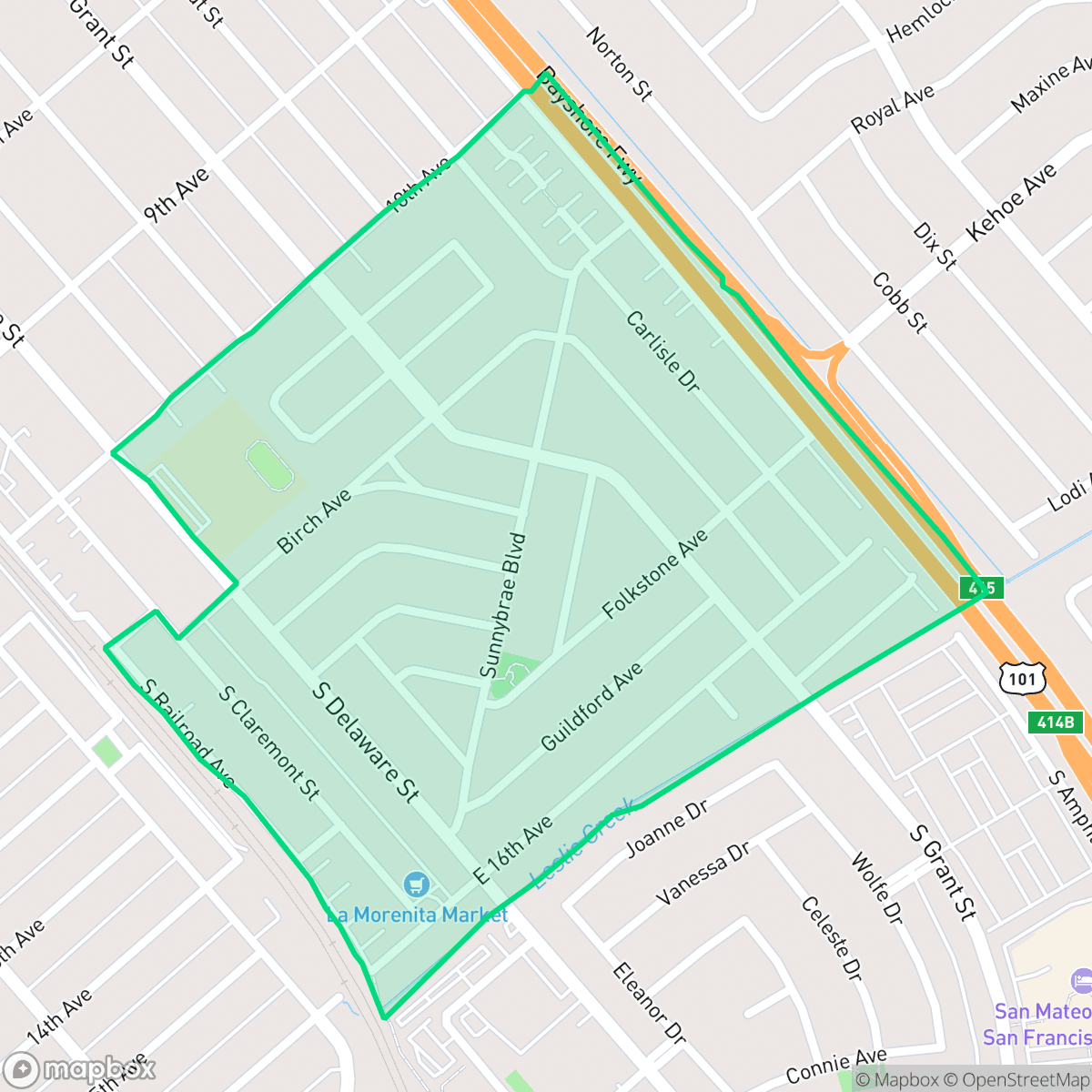
Established in 1939, Sunnybrae was developed by American Homes, Inc. (a subsidiary of G. W. Williams Co.) as San Mateo's largest low-cost tract housing development. Spanning 145 acres, the planned community was designed by FHA Land Planning Consultants with winding streets and long blocks to slow traffic, anchored by the diagonal Sunnybrae Boulevard. The initial phase featured homes designed by architect John Knox Ballantine, Jr., which included innovative, earthquake-resistant Soule "Unibilt" steel-frame structures. In the early 1950s, the neighborhood expanded into the adjacent 19th Avenue Park tract, built on land formerly owned by Leslie Salt. This expansion featured early, humble mid-century modern designs by renowned developer Joseph Eichler, characterized by signature wood-and-glass construction, open floor plans, and central atria, cementing Sunnybrae's legacy as a pioneer of post-war suburban design.
The neighborhood functions as a dense suburban enclave characterized by its mix of single-family homes and multi-family units. Its layout prioritizes connectivity through a well-developed sidewalk system, though the proximity to major thoroughfares creates significant physical barriers for pedestrians. According to iHuus data, the area maintains a balanced urban-rural index, reflecting its position as a transition zone between residential living and nearby industrial and commercial warehouses. Prospective residents should weigh the architectural legacy and school district access against the realities of a high-density setting. While the San Mateo Union High School District provides top-tier educational opportunities, the local elementary school faces challenges. The neighborhood is best suited for those who prioritize proximity to regional transit arteries and established housing styles over absolute acoustic serenity or expansive private outdoor space.
Neighborhood Scores Across 15 Qualities
Residential structures are tightly packed with minimal separation between property lines. According to iHuus data, this level of density is higher than the San Mateo average.
Residential streets feature consistent sidewalks and safe crosswalks, though the nearby major highway serves as a significant barrier for pedestrians. This level of walkability is nearly comparable to the San Mateo average, according to iHuus data.
Residential scenery varies from well-maintained affluent pockets with private pools to more uniform tract housing with smaller lots. This variety in housing density and architectural style results in a visual appeal that sits slightly below the San Mateo average.
Private backyards and a small central sports field are the primary outdoor areas for pets. According to iHuus data, this lack of large public parks or extensive green trails makes the area less dog friendly than the rest of San Mateo.
A mix of single-family homes and multi-story apartment blocks creates a dense suburban landscape. This level of development is largely consistent with the San Mateo average.
Suburban streets and green spaces provide a calm atmosphere, though local activity levels are slightly below the San Mateo average. Residents have access to a modest selection of dining options and parks, interspersed with light industrial areas and highway-adjacent blocks.
Frequent noise from nearby freeway and railroad corridors makes this area louder than the San Mateo average. According to iHuus data, residents may experience significant acoustic disturbances due to proximity to major transit routes.
Air quality fluctuates between acceptable and unhealthy levels, presenting occasional concerns for sensitive groups. This condition is consistent with the average experienced across San Mateo.
Industrial presence is minimal within the neighborhood, consisting mostly of residential areas and light commercial zones. While some warehouses exist near the edges, the area remains very similar to the San Mateo average for industrial proximity.
Health insurance coverage is widespread among residents, matching the average seen across San Mateo. According to iHuus data, nearly all inhabitants have access to medical coverage.
Voting patterns and census indicators reflect a predominantly liberal community, which is very similar to the political leaning found across the rest of San Mateo.
Residents live alongside a balanced mix of young professionals, families, and seniors. This demographic variety is roughly in line with the broader San Mateo area, according to iHuus data.
Residual flood risk exists as parts of the area fall within a 500-year floodplain; however, safety levels are notably higher than the San Mateo city average according to iHuus data.
Address-Level Insights for Sunnybrae


iHuus Neighborhood Intelligence Insights
Get address-level neighborhood insights for Sunnybrae
- Street-level scores — see how individual blocks compare, not just neighborhood averages
- Micro-zone boundaries — identify quiet pockets, flood boundaries, and walkable clusters before you visit
- 15 dimensions in full — walkability, noise, air quality, school quality, insurance coverage, population age profile, urban/rural index, and more
- Boundary risk alerts — know if your address sits near a block boundary where scores drop, the kind of detail no listing will ever mention
- School insights — individual school ratings and insights, not just district-level data
- Compare before you commit — side-by-side data across neighborhoods, down to block precision
No credit card required
Compare with Any Neighborhood
| Dimension | Sunnybrae | Aragon |
|---|---|---|
| 🚶 Walkabilityavg 8.95 | ||
| 🔊 Acoustic Comfortavg 3.72 | ||
| 🤫 Privacy Indexavg 5.13 | ||
| 🎨 Visual Appealavg 7.16 | ||
| 🐕 Dog Friendlinessavg 6.92 | ||
| 🗺️ Urban-Rural Indexavg 6.73 | ||
| ✨ Neighborhood Vibeavg 5.61 | ||
| 🏥 Health Insurance Coverageavg 8.75 | ||
| 🌿 Air Qualityavg 6 | ||
| 🏭 Industrial Proximityavg 9.34 | ||
| 🌊 Flood Safetyavg 5.24 | ||
| 🗳️ Ideological Leanavg 9.68 | ||
| 👥 Population Age Profileavg 4.99 | ||
| 🔥 Fire Safetyavg 0.28 | ||
| 🏫 School Quality |
Sunnybrae Rankings
School Districts Serving Sunnybrae
School Insights for Sunnybrae
Below average outcomes; significant attendance and academic challenges.
School Insights
See what's really behind every school rating near Sunnybrae
- Individual school ratings — each school's own score with outcome context, not just a district average
- Enrollment & class size data — student-to-teacher ratio and how it compares to the state average
- Full demographics breakdown — ethnicity and gender composition for every school in the enrollment zone
- Every school in the district — all schools within the enrollment boundary ranked by rating, not just the closest one
- Grade levels & benchmarks — elementary through high school, with below/above state-average flags
No credit card required