San Mateo Park, San Mateo
Updated · 3,147 residents
San Mateo Park is a serene, visually striking residential enclave characterized by its winding, tree-lined streets and historic estate architecture. While the area offers a quiet, low-density environment with high aesthetic appeal, it remains a car-dependent community with limited walkability and few local businesses.
Key Highlights
About San Mateo Park
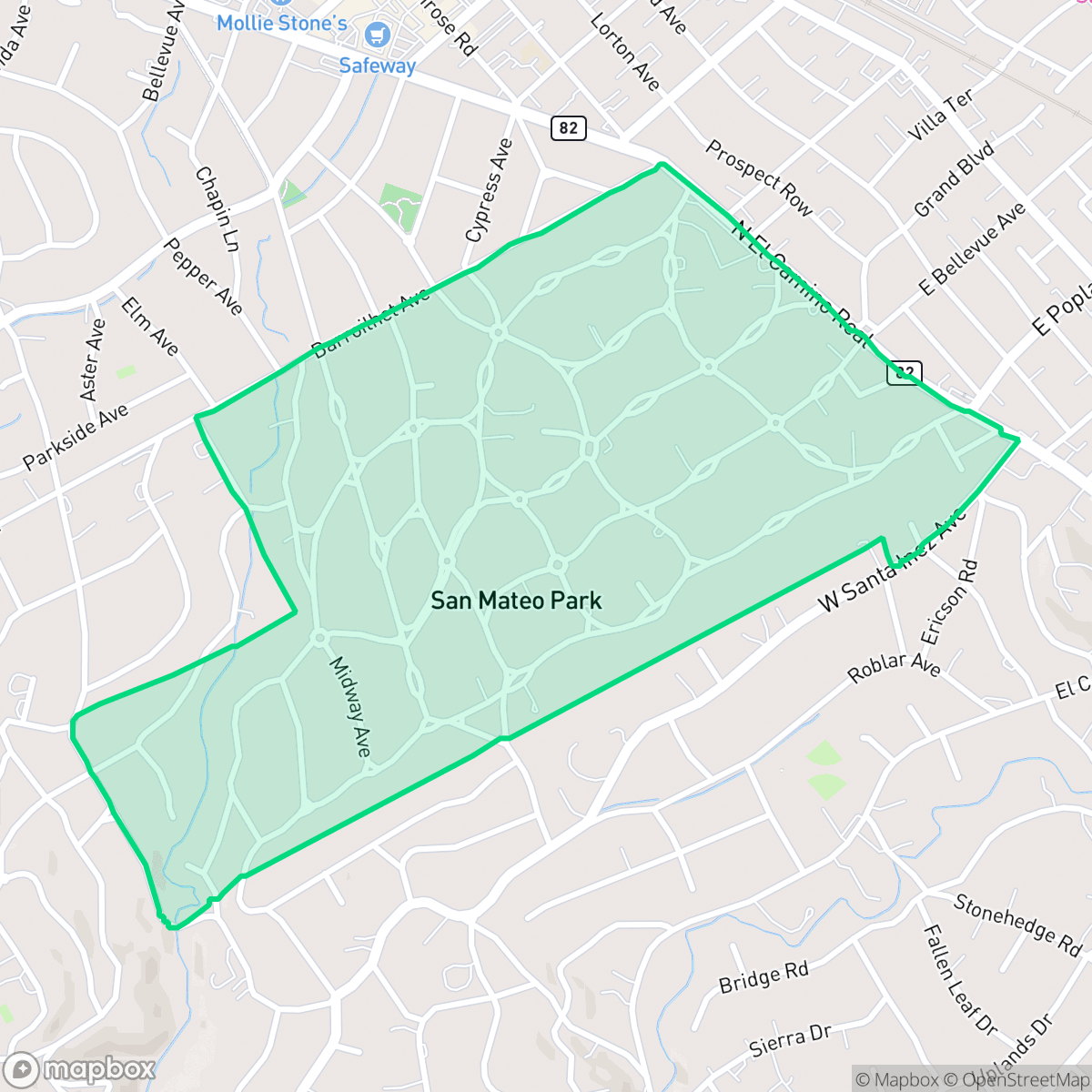
Established in the late 1890s on former dairy lands of the Howard Estate, San Mateo Park was envisioned as an exclusive, world-class residential enclave embodying the "City Beautiful" movement. The neighborhood's unique layout was designed in 1903 by city planner Davenport Bromfield, architect George Howard Jr., and legendary landscape architect John McLaren, who also designed San Francisco's Golden Gate Park. Departing from a standard grid, they mapped out narrow, winding streets centered around landscaped traffic circles, crescents, and oval islands planted with thousands of exotic and specimen trees. Following the 1906 San Francisco earthquake, affluent buyers flocked to the area. The neighborhood became renowned for its grand estate homes, featuring masterworks by celebrated architects like Julia Morgan, Bernard Maybeck, and Willis Polk in Arts and Crafts, Tudor, and Colonial Revival styles.
The neighborhood serves as a quiet, residential-focused retreat within San Mateo, offering a distinct departure from the density found in nearby commercial districts. Its layout prioritizes open space and greenery, contributing to a high level of visual appeal and a sense of seclusion for its residents. According to iHuus data, the area maintains a peaceful acoustic environment, making it a preferred location for those who prioritize privacy and a suburban atmosphere over immediate access to urban amenities. The lack of commercial infrastructure necessitates reliance on personal vehicles for daily errands, as the neighborhood is primarily composed of residential lots and landscaped public areas.
Living in this area involves a trade-off between its aesthetic charm and its lower walkability compared to the rest of the city. It is well-suited for families and individuals who value architectural character and a stable, residential environment. While the neighborhood falls within the boundaries of highly-rated school districts, prospective residents should note the variance in local school performance. The community is characterized by high health insurance coverage and a stable population profile, though residents should remain mindful of local fire safety conditions, which are a notable consideration for this part of the region.
Neighborhood Scores Across 15 Qualities
Residential spacing varies between shared-wall complexes and detached homes with vegetative screening. According to iHuus data, this neighborhood offers more separation between neighbors than the San Mateo average.
Pedestrian-friendly layouts with a complete grid of sidewalks and clear crosswalks make navigating the area easy on foot. This level of walkability is very similar to the average found throughout San Mateo.
Spacious residential lots with extensive landscaping and private pools create a highly polished aesthetic that is notably more refined than the San Mateo average. According to iHuus data, the southwest quadrant features particularly large homes and well-maintained grounds.
Green street-lining and sidewalk verges provide adequate space for walking pets; however, overall dog friendliness is below the San Mateo average according to iHuus data.
Open land and woodland areas provide a sense of space that is slightly more expansive than the typical San Mateo suburban landscape. Residents can expect a mix of scattered homes and a heavy tree canopy according to iHuus data.
Local social and leisure spots provide a moderate level of activity that is more lively than the average San Mateo neighborhood. Streets and green spaces are well balanced, creating a stable suburban atmosphere with a noticeable concentration of community hubs.
Steady sounds from nearby busy streets create a consistent level of ambient noise. According to iHuus data, this level of acoustic activity is slightly higher than the San Mateo city average.
Air quality levels in this area fluctuate between acceptable and unhealthy conditions. According to iHuus data, these conditions are consistent with the average found throughout San Mateo.
Industrial activity and heavy warehouses are entirely absent from this neighborhood. According to iHuus data, the area is more purely residential than the San Mateo average, consisting only of homes and light commercial zones.
Nearly all residents are covered by health insurance, which is notably higher than the San Mateo average according to iHuus data.
Voting patterns and census indicators show a very strong liberal lean, which is largely consistent with the broader San Mateo area according to iHuus data.
Residents live alongside a diverse mix of young professionals, families, and seniors. This demographic spread is slightly more varied than the average found across San Mateo, according to iHuus data.
Flood risk levels in this area are difficult to determine because FEMA has not yet completed a detailed study for this specific location. According to iHuus data, the level of safety from flooding is slightly lower than the San Mateo city average.
Address-Level Insights for San Mateo Park


iHuus Neighborhood Intelligence Insights
Get address-level neighborhood insights for San Mateo Park
- Street-level scores — see how individual blocks compare, not just neighborhood averages
- Micro-zone boundaries — identify quiet pockets, flood boundaries, and walkable clusters before you visit
- 15 dimensions in full — walkability, noise, air quality, school quality, insurance coverage, population age profile, urban/rural index, and more
- Boundary risk alerts — know if your address sits near a block boundary where scores drop, the kind of detail no listing will ever mention
- School insights — individual school ratings and insights, not just district-level data
- Compare before you commit — side-by-side data across neighborhoods, down to block precision
No credit card required
Compare with Any Neighborhood
| Dimension | San Mateo Park | Aragon |
|---|---|---|
| 🚶 Walkabilityavg 8.95 | ||
| 🔊 Acoustic Comfortavg 3.72 | ||
| 🤫 Privacy Indexavg 5.13 | ||
| 🎨 Visual Appealavg 7.16 | ||
| 🐕 Dog Friendlinessavg 6.92 | ||
| 🗺️ Urban-Rural Indexavg 6.73 | ||
| ✨ Neighborhood Vibeavg 5.61 | ||
| 🏥 Health Insurance Coverageavg 8.75 | ||
| 🌿 Air Qualityavg 6 | ||
| 🏭 Industrial Proximityavg 9.34 | ||
| 🌊 Flood Safetyavg 5.24 | ||
| 🗳️ Ideological Leanavg 9.68 | ||
| 👥 Population Age Profileavg 4.99 | ||
| 🔥 Fire Safetyavg 0.28 | ||
| 🏫 School Quality |
San Mateo Park Rankings
School Districts Serving San Mateo Park
School Insights for San Mateo Park
Below average outcomes; significant attendance and academic challenges.
School Insights
See what's really behind every school rating near San Mateo Park
- Individual school ratings — each school's own score with outcome context, not just a district average
- Enrollment & class size data — student-to-teacher ratio and how it compares to the state average
- Full demographics breakdown — ethnicity and gender composition for every school in the enrollment zone
- Every school in the district — all schools within the enrollment boundary ranked by rating, not just the closest one
- Grade levels & benchmarks — elementary through high school, with below/above state-average flags
No credit card required