San Mateo Heights, San Mateo
Updated · 4,150 residents
San Mateo Heights is a vibrant, highly walkable neighborhood located just east of downtown San Mateo, known for its diverse architectural heritage and lively atmosphere. Residents benefit from excellent proximity to local amenities and top-tier schools, though the area experiences significant noise from road traffic.
Key Highlights
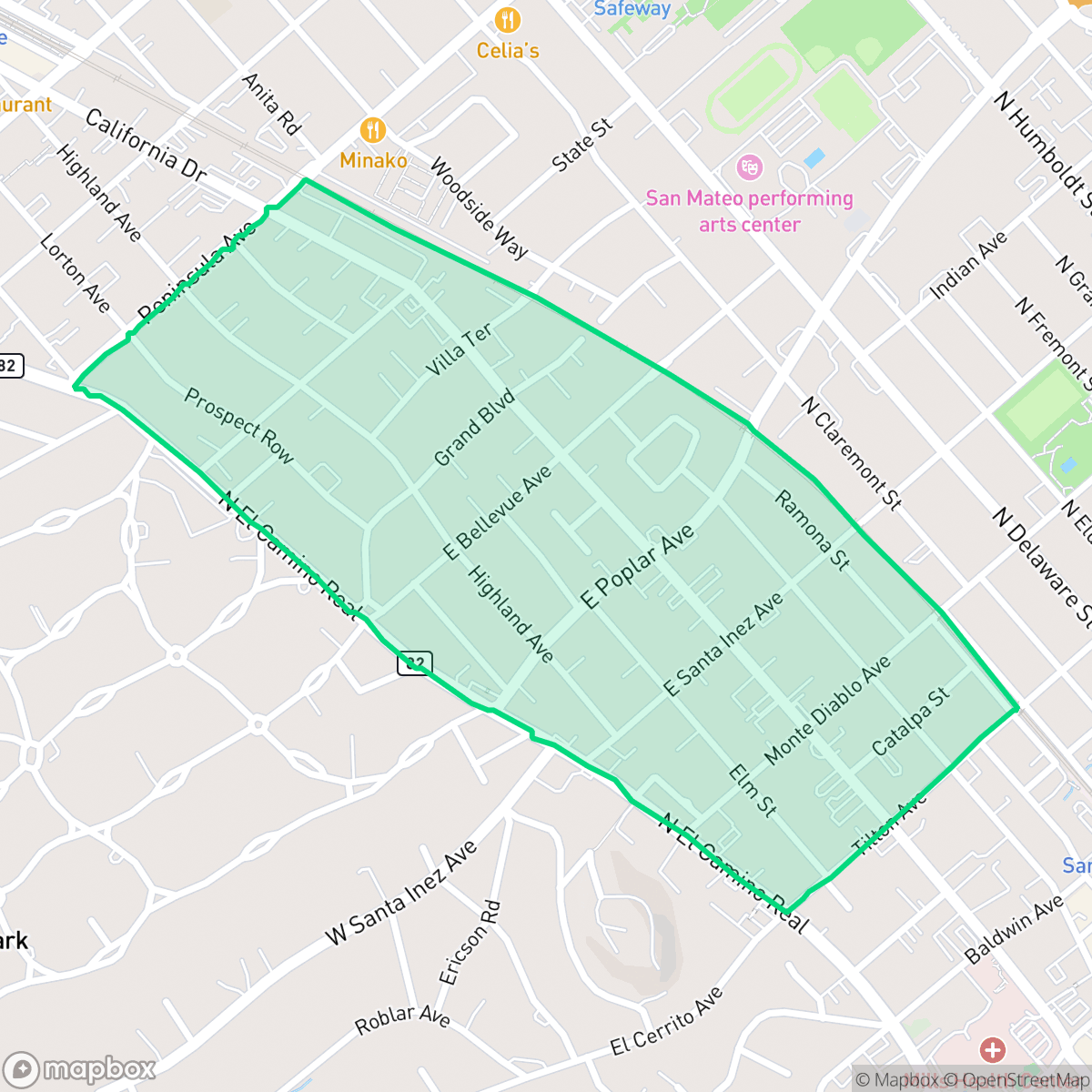
About San Mateo Heights
Established in the early 1900s, San Mateo Heights is one of San Mateo’s oldest residential neighborhoods. Located east of El Camino Real near downtown, it features distinctive turn-of-the-century architecture, including Queen Anne Victorians, Italianates, steamboat Gothics, and early American Craftsman homes. In the early 20th century, L.C. Brandt, president of the San Mateo Heights Improvement Club, led a successful campaign to exclude industrial plants from infringing on the residential tract. While the neighborhood historically preserved its residential character, later decades brought challenges. Mid-to-late 20th-century redevelopment of single-family homes into higher-density housing led to local concerns over traffic and community character, particularly along Ramona Street, Ellsworth Court, and Highland Avenue.
The neighborhood serves as a dense suburban hub characterized by a mix of historic homes and modern multi-unit developments. Its location provides immediate access to the downtown core, facilitating a lifestyle where daily errands can be completed entirely on foot. The area maintains a distinct social energy, bolstered by local dining establishments and a steady flow of foot traffic, making it a central point for those who prioritize connectivity and community presence. According to iHuus data, the neighborhood maintains a perfect score for industrial proximity, ensuring a purely residential and light commercial environment without heavy industrial hazards. Potential residents should note that the high walkability and central location come with trade-offs regarding acoustic comfort, as road traffic noise levels are notably elevated. While the area boasts excellent health insurance coverage and proximity to elite educational institutions like those in the San Mateo Union High School District, it also faces significant challenges regarding fire and flood safety. This location is best suited for professionals and families who value urban convenience and access to high-quality schools over absolute quiet or environmental safety buffers.
Neighborhood Scores Across 15 Qualities
Residential spacing is inconsistent, ranging from closely positioned houses to detached homes with some vegetative screening. According to iHuus data, the level of privacy provided by property buffers is slightly lower than the San Mateo average.
A complete grid of sidewalks and clear pedestrian crossings makes navigating the neighborhood easy on foot. According to iHuus data, the street layout and sidewalk connectivity are superior to the San Mateo average.
Large homes, extensive landscaping, and frequent private pools create a highly polished aesthetic that is consistent with the city average. According to iHuus data, the area is characterized by well-maintained residential lots and upscale amenities.
Wide, tree-lined streets and continuous sidewalk verges provide reliable walking routes for pets, though access to large public green spaces is somewhat more limited than in other parts of the city according to iHuus data.
Residential blocks feature a dense mix of single-family homes and mid-sized apartment complexes, providing a landscape similar to the city average. According to iHuus data, the area maintains a consistent suburban character with significant tree canopy interspersed among housing units.
Local dining options and social hubs create a more active atmosphere than the typical San Mateo residential area. According to iHuus data, the neighborhood features a notable concentration of diverse eateries and community spaces situated alongside quiet, green streets.
Steady traffic sounds from a nearby busy street are present, though the level of acoustic disturbance remains slightly lower than the San Mateo average according to iHuus data.
Air quality levels in this area are consistent with the city average, presenting a mix of acceptable and occasionally unhealthy days for sensitive groups.
Industrial activity and warehouses are entirely absent from this area, providing a cleaner environment than much of San Mateo. According to iHuus data, the neighborhood consists exclusively of residential, educational, and recreational zones with no detectable heavy industrial hazards.
Most residents are covered by health insurance, though coverage rates in this area are slightly lower than the San Mateo average according to iHuus data.
Voting patterns and census indicators show a predominantly liberal political leaning, which is consistent with the broader San Mateo area according to iHuus data.
Residents live alongside a diverse range of age groups, including families and older adults. This demographic spread is roughly in line with the broader San Mateo area according to iHuus data.
Significant flood risk exists here because parts of the area fall within the 100-year floodplain; according to iHuus data, this risk is considerably higher than the San Mateo average and may necessitate flood insurance.
Address-Level Insights for San Mateo Heights


iHuus Neighborhood Intelligence Insights
Get address-level neighborhood insights for San Mateo Heights
- Street-level scores — see how individual blocks compare, not just neighborhood averages
- Micro-zone boundaries — identify quiet pockets, flood boundaries, and walkable clusters before you visit
- 15 dimensions in full — walkability, noise, air quality, school quality, insurance coverage, population age profile, urban/rural index, and more
- Boundary risk alerts — know if your address sits near a block boundary where scores drop, the kind of detail no listing will ever mention
- School insights — individual school ratings and insights, not just district-level data
- Compare before you commit — side-by-side data across neighborhoods, down to block precision
No credit card required
Compare with Any Neighborhood
| Dimension | San Mateo Heights | Aragon |
|---|---|---|
| 🚶 Walkabilityavg 8.95 | ||
| 🔊 Acoustic Comfortavg 3.72 | ||
| 🤫 Privacy Indexavg 5.13 | ||
| 🎨 Visual Appealavg 7.16 | ||
| 🐕 Dog Friendlinessavg 6.92 | ||
| 🗺️ Urban-Rural Indexavg 6.73 | ||
| ✨ Neighborhood Vibeavg 5.61 | ||
| 🏥 Health Insurance Coverageavg 8.75 | ||
| 🌿 Air Qualityavg 6 | ||
| 🏭 Industrial Proximityavg 9.34 | ||
| 🌊 Flood Safetyavg 5.24 | ||
| 🗳️ Ideological Leanavg 9.68 | ||
| 👥 Population Age Profileavg 4.99 | ||
| 🔥 Fire Safetyavg 0.28 | ||
| 🏫 School Quality |
San Mateo Heights Rankings
School Districts Serving San Mateo Heights
School Insights for San Mateo Heights
Below average outcomes; significant attendance and academic challenges.
School Insights
See what's really behind every school rating near San Mateo Heights
- Individual school ratings — each school's own score with outcome context, not just a district average
- Enrollment & class size data — student-to-teacher ratio and how it compares to the state average
- Full demographics breakdown — ethnicity and gender composition for every school in the enrollment zone
- Every school in the district — all schools within the enrollment boundary ranked by rating, not just the closest one
- Grade levels & benchmarks — elementary through high school, with below/above state-average flags
No credit card required