Lauriedale, San Mateo
Updated · 2,128 residents
Lauriedale is a densely populated San Mateo neighborhood characterized by a mix of mid-century condominiums and single-family homes. It offers exceptional walkability and immediate access to local dining, though residents should be prepared for significant noise levels from nearby road traffic.
Key Highlights
About Lauriedale
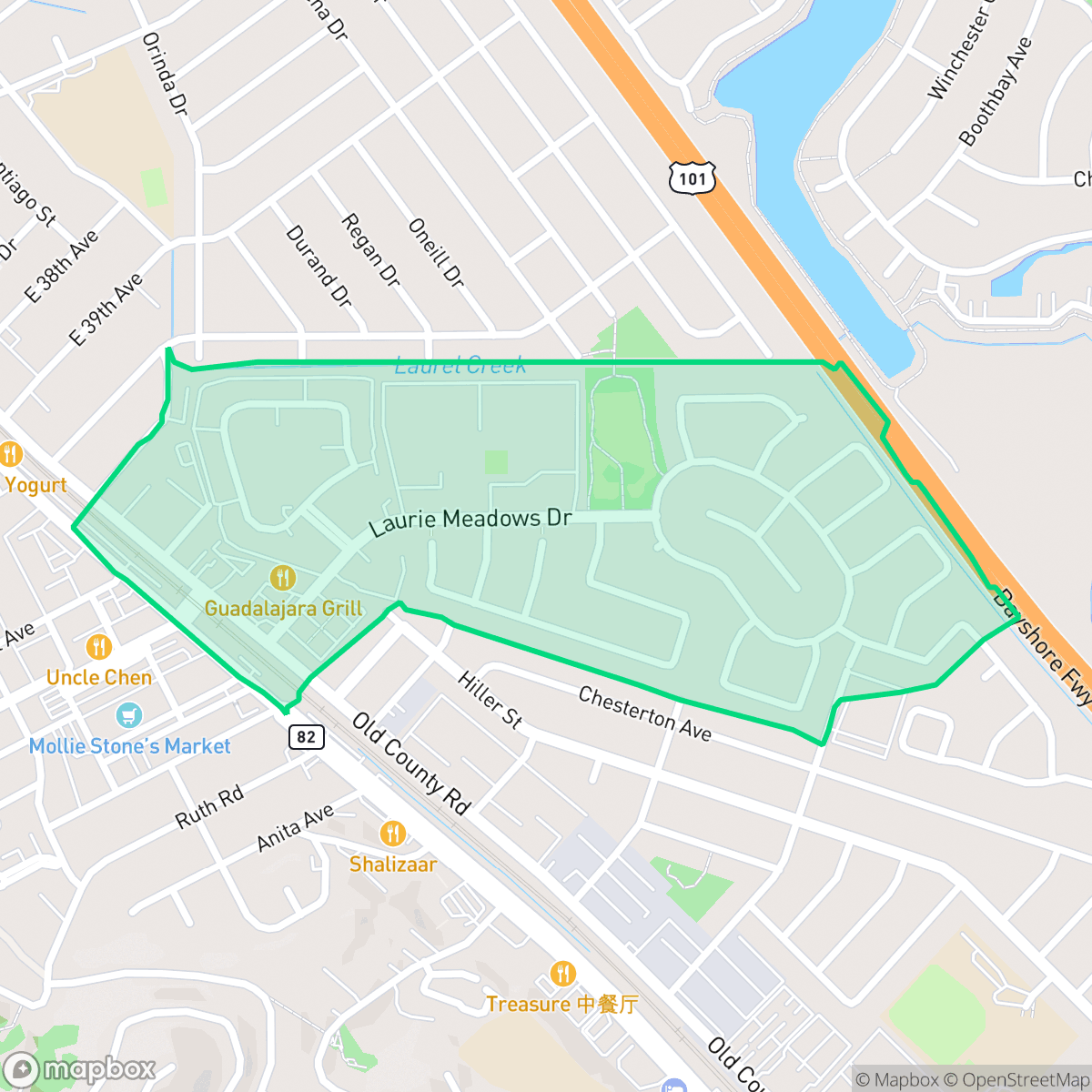
Situated at the southern end of San Mateo, the Lauriedale neighborhood is named after Laurie Meadows Park—a 7.5-acre green space separated from Casanova Park by Laurel Creek—and a 1960s condominium complex of the same name. The establishment of the Lauriedale complex along Laurie Meadows Drive initiated a wave of multi-unit developments, making apartments and condominiums a defining feature of the neighborhood’s northern section. Beginning in the mid-1970s, developers expanded the area with single-family subdivisions designed to attract white-collar commuters traveling to San Francisco or Silicon Valley. These subdivisions introduced distinctive faux-Tudor and stucco Mediterranean-style homes along signature streets such as Rosalie Street, Ramblewood Way, and Woodbridge Circle. Today, Lauriedale remains a unique, densely populated residential enclave blending suburban calm with diverse architectural styles and convenient transit access.
The area functions as a versatile residential enclave where high-density apartment living meets established suburban streets. Residents enjoy a highly walkable environment that provides convenient access to local social hubs and diverse eateries, including popular spots like Yumi Yogurt, Peking Alley, and Guadalajara Grill. The neighborhood maintains a balanced urban feel, supported by accessible green spaces that offer a reprieve from the surrounding residential density.
Prospective residents should note that the area experiences significant noise from road traffic, which is a primary consideration for those seeking a quiet environment. While the neighborhood offers high levels of privacy and a lack of heavy industrial proximity, the tightly packed nature of the housing and shared-wall structures are defining features. It remains a practical choice for commuters and families who prioritize school district access and walkability over absolute acoustic seclusion.
Neighborhood Scores Across 15 Qualities
Residential spacing fluctuates between tightly packed apartment complexes and more secluded hillside estates. This mix of shared walls and buffered yards offers more privacy than the San Mateo average, according to iHuus data.
Continuous sidewalks and clear pedestrian crossings exist on nearly all residential streets, providing a network that is slightly more pedestrian-friendly than the San Mateo average. These connected paths and dedicated pedestrian routes allow for safe movement throughout the neighborhood according to iHuus data.
Manicured lawns, private pools, and large custom homes on the hillsides contribute to a polished aesthetic that is largely consistent with the San Mateo average. According to iHuus data, the area features a mix of upscale estates and standard suburban housing.
Expansive parks, wetlands, and connected green buffers provide ample space for pets. According to iHuus data, these accessible trails and wide paths offer a higher level of dog friendliness than the San Mateo average.
Residential areas consist of a diverse blend of single-family homes, multi-story apartments, and commercial strips. This level of development is largely consistent with the broader San Mateo area according to iHuus data.
Quiet residential streets and parks sit alongside accessible local dining and small business clusters. This level of activity is largely consistent with the broader San Mateo area.
Frequent noise from nearby airport runways and heavy rail lines makes this area significantly louder than the San Mateo average. According to iHuus data, residents will experience persistent acoustic disruptions throughout the day.
Air quality levels in Lauriedale are consistent with the San Mateo average, though residents may notice occasional periods of concern for sensitive groups.
Industrial activity and large-scale warehouses are absent from this area. According to iHuus data, the neighborhood remains almost entirely residential and recreational, which is very similar to the broader San Mateo area.
Health insurance enrollment is widespread among residents, reflecting a rate that is higher than the San Mateo city average according to iHuus data.
Voting patterns and census indicators reflect a predominantly liberal political leaning, matching the broader San Mateo average according to iHuus data.
A varied demographic of young adults, families, and seniors resides here, reflecting a population age profile slightly below the San Mateo average according to iHuus data.
Flood risk in this area remains uncertain because FEMA has not yet completed a detailed study for the neighborhood. This level of risk is consistent with the average found throughout San Mateo.
Address-Level Insights for Lauriedale


iHuus Neighborhood Intelligence Insights
Get address-level neighborhood insights for Lauriedale
- Street-level scores — see how individual blocks compare, not just neighborhood averages
- Micro-zone boundaries — identify quiet pockets, flood boundaries, and walkable clusters before you visit
- 15 dimensions in full — walkability, noise, air quality, school quality, insurance coverage, population age profile, urban/rural index, and more
- Boundary risk alerts — know if your address sits near a block boundary where scores drop, the kind of detail no listing will ever mention
- School insights — individual school ratings and insights, not just district-level data
- Compare before you commit — side-by-side data across neighborhoods, down to block precision
No credit card required
Compare with Any Neighborhood
| Dimension | Lauriedale | Aragon |
|---|---|---|
| 🚶 Walkabilityavg 8.95 | ||
| 🔊 Acoustic Comfortavg 3.72 | ||
| 🤫 Privacy Indexavg 5.13 | ||
| 🎨 Visual Appealavg 7.16 | ||
| 🐕 Dog Friendlinessavg 6.92 | ||
| 🗺️ Urban-Rural Indexavg 6.73 | ||
| ✨ Neighborhood Vibeavg 5.61 | ||
| 🏥 Health Insurance Coverageavg 8.75 | ||
| 🌿 Air Qualityavg 6 | ||
| 🏭 Industrial Proximityavg 9.34 | ||
| 🌊 Flood Safetyavg 5.24 | ||
| 🗳️ Ideological Leanavg 9.68 | ||
| 👥 Population Age Profileavg 4.99 | ||
| 🔥 Fire Safetyavg 0.28 | ||
| 🏫 School Quality |
Lauriedale Rankings
School Districts Serving Lauriedale
School Insights for Lauriedale
Below average outcomes; significant attendance and academic challenges.
School Insights
See what's really behind every school rating near Lauriedale
- Individual school ratings — each school's own score with outcome context, not just a district average
- Enrollment & class size data — student-to-teacher ratio and how it compares to the state average
- Full demographics breakdown — ethnicity and gender composition for every school in the enrollment zone
- Every school in the district — all schools within the enrollment boundary ranked by rating, not just the closest one
- Grade levels & benchmarks — elementary through high school, with below/above state-average flags
No credit card required