Central Business District, San Mateo
Updated · 3,550 residents
The Central Business District of San Mateo is a highly walkable urban hub defined by its dense commercial activity and vibrant dining scene. Residents enjoy immediate access to diverse culinary options and public transit, though the area is characterized by high-density living and moderate noise levels from nearby rail and road traffic.
Key Highlights
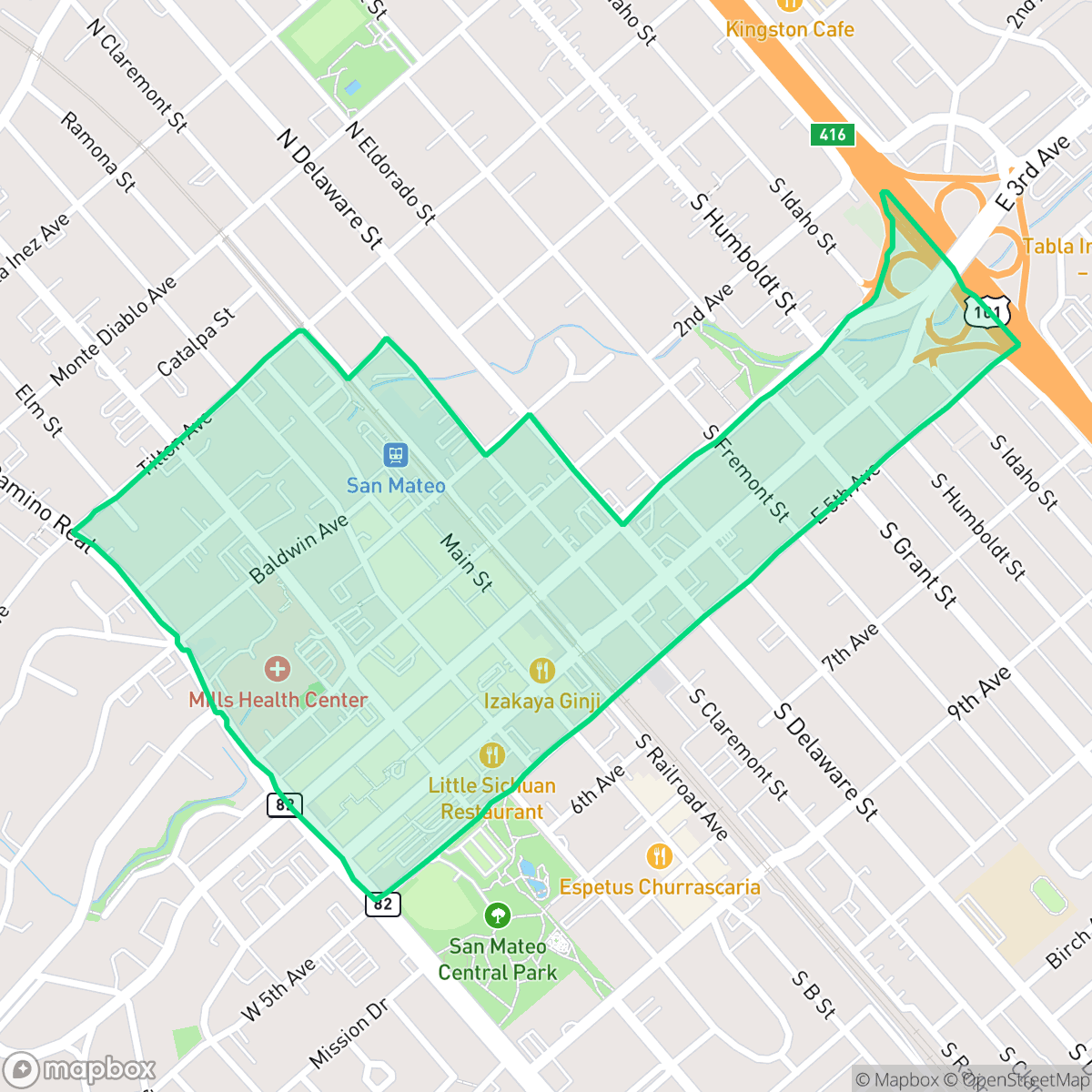
About Central Business District
San Mateo’s Central Business District (Downtown) originated from a 1793 Spanish mission outpost and an 1849 stagecoach stop, but was formally established with the arrival of the San Francisco-San Jose railroad in 1863. Following the city's 1894 incorporation, the district evolved into a bustling commercial hub. Its architectural landscape features a mixture of Spanish Colonial Revival, Art Deco, and Mission Revival styles. Notable landmarks include the 1935 Mission Revival-style Saint Matthew’s Station Post Office, the 1900 St. Matthew's Hotel, and the 9.5-story Spanish Colonial Revival Benjamin Franklin Hotel (now Draper University). The neighborhood is also historically significant to the local Japanese-American community and is bordered by Central Park, home to a traditional 1960s Japanese Tea Garden.
This neighborhood serves as the core of San Mateo, offering a dense grid of streets that prioritize pedestrian movement and local commerce. The area maintains a lively atmosphere, supported by a mix of multi-story apartments and commercial blocks that house popular eateries and cultural landmarks. With exceptional walkability, residents can easily access daily necessities and leisure spaces like the nearby Central Park, which provides a quiet contrast to the bustling street-level energy.
Prospective residents should anticipate a high-density environment where private outdoor space is limited and housing is tightly clustered. While the central location offers significant convenience, the proximity to active rail lines and major thoroughfares contributes to moderate ambient noise levels. This area is well-suited for those who prioritize a car-free lifestyle and proximity to a diverse array of businesses over absolute acoustic privacy or expansive residential yards.
Neighborhood Scores Across 15 Qualities
Residential spacing varies between shared-wall apartment complexes and detached homes with some greenery. This level of density is consistent with the average across San Mateo.
Pedestrian infrastructure is exceptional, featuring a complete grid of wide sidewalks and clearly marked crossings that surpass the San Mateo average. Most daily errands and park access can be completed easily on foot due to the dense, pedestrian-priority street layouts.
Visual surroundings consist of a mix of standard commercial structures and apartment complexes with modest yards. This area offers a typical urban aesthetic that is roughly in line with the city average.
Accessible sidewalks and nearby public parks provide adequate walking routes for pets, though overall features are slightly below the San Mateo city average. Tree-lined streets and local green spaces offer consistent paths for exercise, according to iHuus data.
A blend of mid-rise apartments, single-family homes, and commercial blocks creates a transition zone that is slightly less open than the San Mateo average. According to iHuus data, the area features a mix of dense residential layouts and a heavy tree canopy.
A dense concentration of diverse restaurants, parks, and local landmarks creates an energetic atmosphere that is significantly more active than the San Mateo average. According to iHuus data, the area offers a wide variety of culinary destinations and community spaces along its streets and near the railway.
Steady traffic sounds from nearby busy streets are present. This level of ambient noise is slightly higher than the average found across San Mateo.
Air quality in this area fluctuates between acceptable and unhealthy levels, presenting occasional concerns for sensitive groups. This level of air quality is consistent with the city average, according to iHuus data.
Land use is limited to residential and commercial zones with no detectable warehouses, heavy machinery, or industrial hazards. This absence of industrial facilities is even more pronounced here than in the broader San Mateo area, according to iHuus data.
Health insurance access among residents is widespread, though slightly lower than the San Mateo city average according to iHuus data.
Voting patterns and census indicators show a predominantly liberal leaning that is consistent with the broader San Mateo area, according to iHuus data.
A diverse mix of young professionals, families, and older adults resides here, representing a demographic spread that is very similar to the San Mateo city average.
Flood risk in this area is slightly higher than the San Mateo average due to the lack of a detailed FEMA study. Residents should note that the area is currently classified under an undetermined risk category.
Address-Level Insights for Central Business District


iHuus Neighborhood Intelligence Insights
Get address-level neighborhood insights for Central Business District
- Street-level scores — see how individual blocks compare, not just neighborhood averages
- Micro-zone boundaries — identify quiet pockets, flood boundaries, and walkable clusters before you visit
- 15 dimensions in full — walkability, noise, air quality, school quality, insurance coverage, population age profile, urban/rural index, and more
- Boundary risk alerts — know if your address sits near a block boundary where scores drop, the kind of detail no listing will ever mention
- School insights — individual school ratings and insights, not just district-level data
- Compare before you commit — side-by-side data across neighborhoods, down to block precision
No credit card required
Compare with Any Neighborhood
| Dimension | Central Business District | Aragon |
|---|---|---|
| 🚶 Walkabilityavg 8.95 | ||
| 🔊 Acoustic Comfortavg 3.72 | ||
| 🤫 Privacy Indexavg 5.13 | ||
| 🎨 Visual Appealavg 7.16 | ||
| 🐕 Dog Friendlinessavg 6.92 | ||
| 🗺️ Urban-Rural Indexavg 6.73 | ||
| ✨ Neighborhood Vibeavg 5.61 | ||
| 🏥 Health Insurance Coverageavg 8.75 | ||
| 🌿 Air Qualityavg 6 | ||
| 🏭 Industrial Proximityavg 9.34 | ||
| 🌊 Flood Safetyavg 5.24 | ||
| 🗳️ Ideological Leanavg 9.68 | ||
| 👥 Population Age Profileavg 4.99 | ||
| 🔥 Fire Safetyavg 0.28 | ||
| 🏫 School Quality |
Central Business District Rankings
School Districts Serving Central Business District
School Insights for Central Business District
Below average outcomes; significant attendance and academic challenges.
School Insights
See what's really behind every school rating near Central Business District
- Individual school ratings — each school's own score with outcome context, not just a district average
- Enrollment & class size data — student-to-teacher ratio and how it compares to the state average
- Full demographics breakdown — ethnicity and gender composition for every school in the enrollment zone
- Every school in the district — all schools within the enrollment boundary ranked by rating, not just the closest one
- Grade levels & benchmarks — elementary through high school, with below/above state-average flags
No credit card required