Baywood, San Mateo
Updated · 2,475 residents
Baywood is a highly walkable San Mateo neighborhood characterized by its dense tree canopy and well-preserved period revival architecture. It offers a suburban residential atmosphere with excellent access to local amenities and top-rated schools, though residents should expect moderate noise levels from nearby road traffic.
Key Highlights
About Baywood
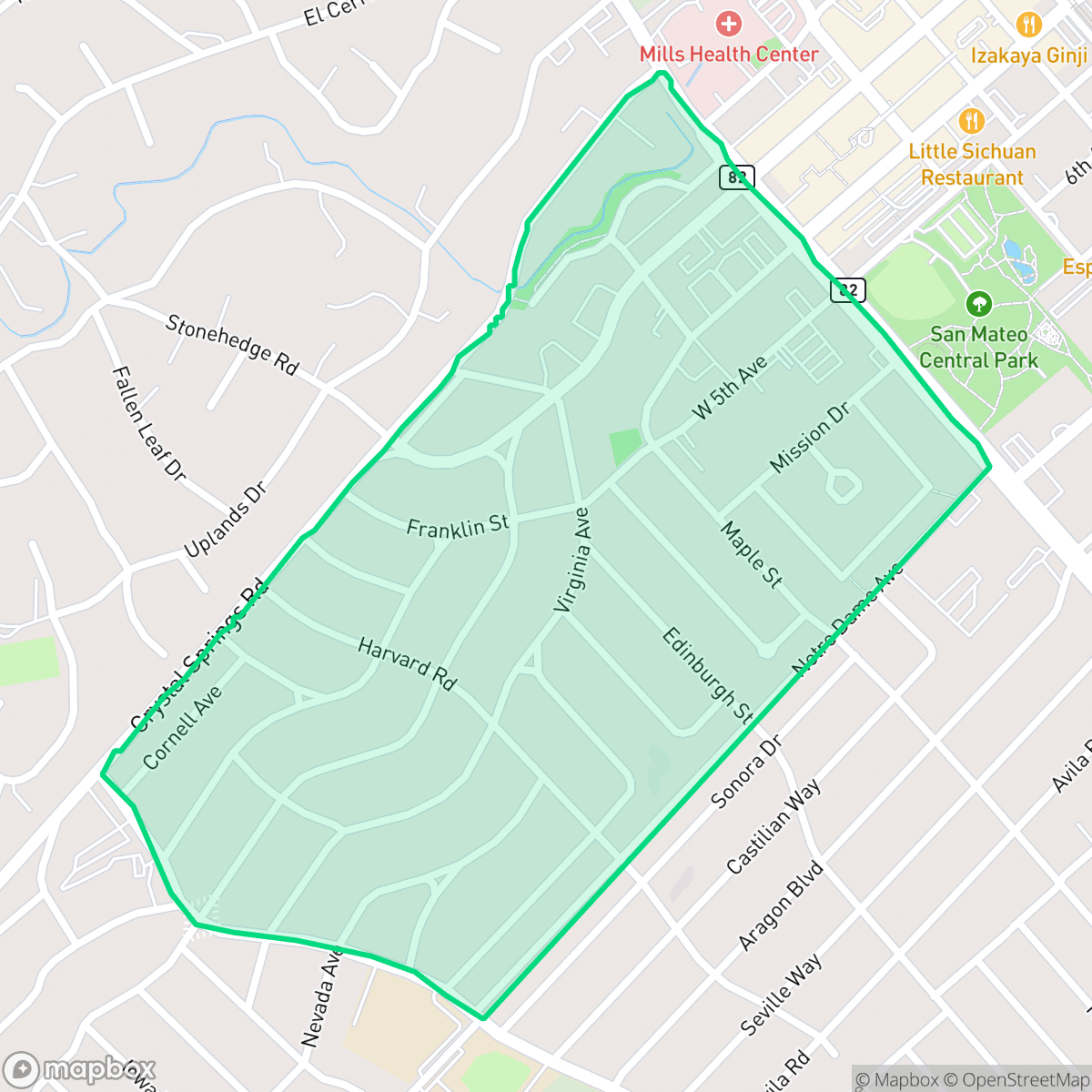
The Baywood neighborhood of San Mateo originated as part of the 377-acre country estate of John Parrott, a prominent banker who built his "Baywood" mansion there in 1868. Named after the property's ancient bay trees, the estate was ceded from Hillsborough and annexed to San Mateo in 1927. It was then subdivided by the Dunn Williams Company into an upscale, pre-war commuter suburb. Developed primarily in the 1920s and 1930s, Baywood is characterized by its winding, tree-canopied streets and intact period revival architecture, including Tudor, Spanish, Moorish, and Colonial Revival homes. A local landmark is the 35,000-square-foot mini-park at Fifth and Dartmouth Avenues, dedicated in 1979 to protect a historic, 300-year-old California bay tree measuring 20 feet in circumference.
The area serves as a transition zone between dense mid-rise apartment complexes and lower-density residential blocks. It maintains a high level of visual appeal through manicured lots and significant vegetative screening. Residents benefit from strong health insurance coverage and proximity to light commercial amenities, contributing to a stable and active suburban environment. According to iHuus, the neighborhood is particularly notable for its complete sidewalk grid, which supports a high level of daily pedestrian activity and connects residents to local landmarks like the Congregational Church of San Mateo.
Prospective residents should note that while the area is highly desirable for its academic access and aesthetic quality, acoustic comfort is limited by road traffic noise. The neighborhood requires careful consideration regarding fire safety, as indicated by local risk assessments. It is best suited for individuals or families who prioritize walkability and proximity to high-performing schools over complete silence or low-density seclusion.
Neighborhood Scores Across 15 Qualities
Spacious lots with significant separation between homes offer a greater sense of seclusion than most of San Mateo. According to iHuus data, privacy levels here are notably higher than the city average, though density varies between single-family residences and apartment complexes.
Pedestrian access is excellent due to a dense sidewalk network on both sides of most streets and easy connectivity to local parks. This area offers a more walkable environment than much of San Mateo, according to iHuus data.
Manicured properties and large homes with private amenities characterize this area. According to iHuus data, the visual landscape is notably more upscale than the San Mateo average.
Expansive central parklands and tree-lined streets provide ample space for pets. According to iHuus data, the availability of connected green spaces and wide, low-traffic paths is higher than the San Mateo average.
Open land and scattered greenery provide a more semi-rural atmosphere than most of San Mateo. This characteristic is reflected in the prevalence of fields and woodland areas interspersed with residential pockets, according to iHuus data.
Local dining and green spaces provide a more vibrant social atmosphere than the San Mateo average. While some pockets remain quiet and low-density, various blocks feature a noticeable concentration of restaurants and community landmarks.
Steady hums from local traffic are present near major streets, though levels are notably quieter than the San Mateo average according to iHuus data.
Air quality in Baywood fluctuates between acceptable and unhealthy levels, matching the city average. Sensitive individuals may experience occasional concerns during periods of poor air quality, according to iHuus data.
Industrial activity is non-existent within the neighborhood, providing a landscape free of warehouses or heavy manufacturing. This area offers a cleaner residential profile than the San Mateo average, according to iHuus data.
Health insurance access is nearly universal among residents, appearing slightly higher than the San Mateo average according to iHuus data.
Voting patterns and census indicators in Baywood show a predominantly liberal orientation that is very similar to the broader San Mateo area, according to iHuus data.
Residents live alongside a balanced mix of young professionals, families, and seniors. According to iHuus data, this demographic distribution is slightly more varied than the San Mateo city average.
Located in a coastal high-hazard zone with potential wave action, this area faces significantly greater flood vulnerability than the San Mateo average. According to iHuus data, residents should prepare for elevated or potentially prohibitive flood insurance costs.
Extreme fire hazards are present in this area, representing a significantly higher risk level than the San Mateo average according to iHuus data. Residents should prioritize maximum fire protection measures and emergency preparedness.
Address-Level Insights for Baywood


iHuus Neighborhood Intelligence Insights
Get address-level neighborhood insights for Baywood
- Street-level scores — see how individual blocks compare, not just neighborhood averages
- Micro-zone boundaries — identify quiet pockets, flood boundaries, and walkable clusters before you visit
- 15 dimensions in full — walkability, noise, air quality, school quality, insurance coverage, population age profile, urban/rural index, and more
- Boundary risk alerts — know if your address sits near a block boundary where scores drop, the kind of detail no listing will ever mention
- School insights — individual school ratings and insights, not just district-level data
- Compare before you commit — side-by-side data across neighborhoods, down to block precision
No credit card required
Compare with Any Neighborhood
| Dimension | Baywood | Aragon |
|---|---|---|
| 🚶 Walkabilityavg 8.95 | ||
| 🔊 Acoustic Comfortavg 3.72 | ||
| 🤫 Privacy Indexavg 5.13 | ||
| 🎨 Visual Appealavg 7.16 | ||
| 🐕 Dog Friendlinessavg 6.92 | ||
| 🗺️ Urban-Rural Indexavg 6.73 | ||
| ✨ Neighborhood Vibeavg 5.61 | ||
| 🏥 Health Insurance Coverageavg 8.75 | ||
| 🌿 Air Qualityavg 6 | ||
| 🏭 Industrial Proximityavg 9.34 | ||
| 🌊 Flood Safetyavg 5.24 | ||
| 🗳️ Ideological Leanavg 9.68 | ||
| 👥 Population Age Profileavg 4.99 | ||
| 🔥 Fire Safetyavg 0.28 | ||
| 🏫 School Quality |
Baywood Rankings
School Districts Serving Baywood
School Insights for Baywood
Below average outcomes; significant attendance and academic challenges.
School Insights
See what's really behind every school rating near Baywood
- Individual school ratings — each school's own score with outcome context, not just a district average
- Enrollment & class size data — student-to-teacher ratio and how it compares to the state average
- Full demographics breakdown — ethnicity and gender composition for every school in the enrollment zone
- Every school in the district — all schools within the enrollment boundary ranked by rating, not just the closest one
- Grade levels & benchmarks — elementary through high school, with below/above state-average flags
No credit card required