Aragon, San Mateo
Updated · 3,374 residents
Aragon is a highly walkable San Mateo neighborhood characterized by its charming collection of pre-war, European-inspired homes. Residents benefit from excellent access to local dining and top-tier schools, though the area features a denser residential layout with limited private outdoor space.
Key Highlights
About Aragon
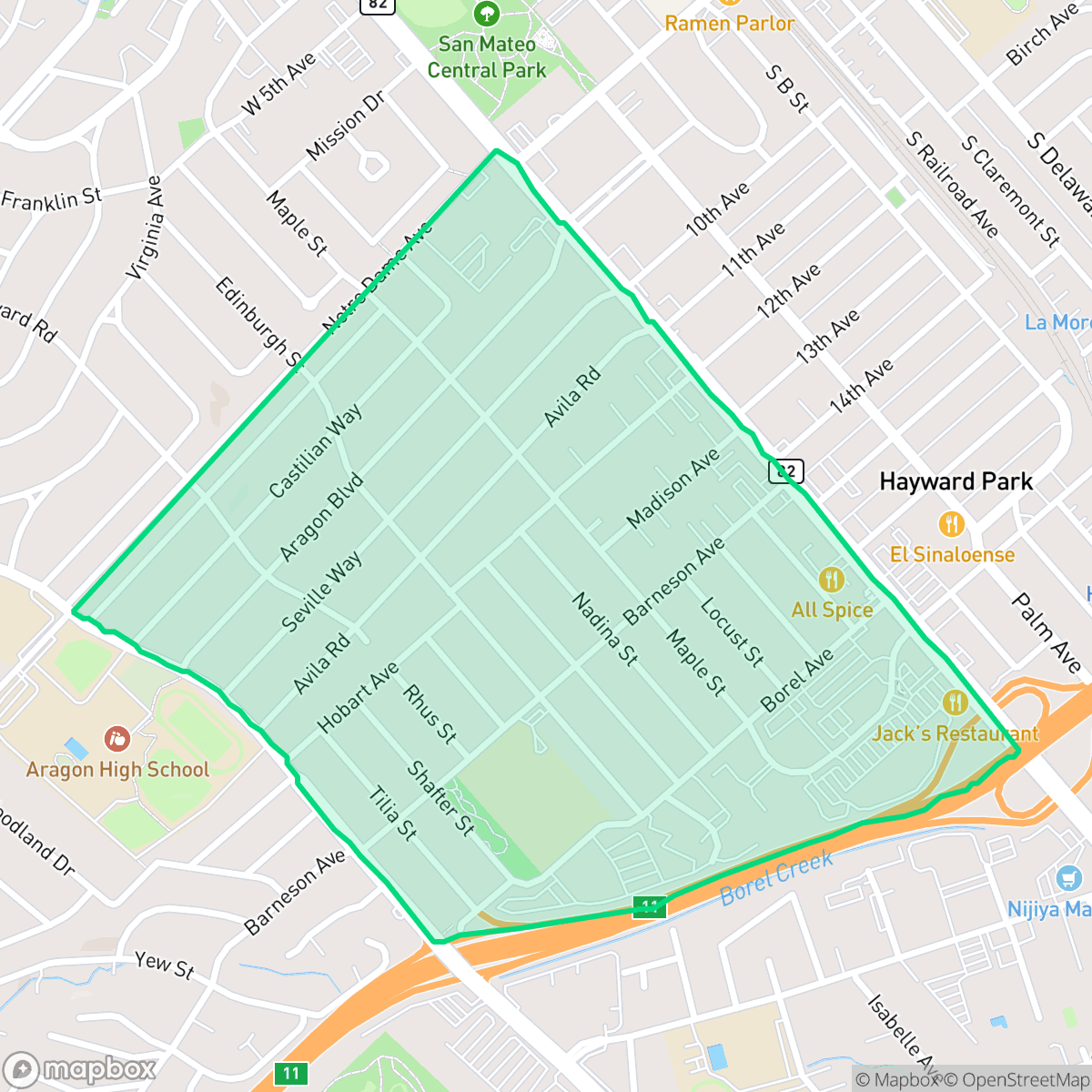
The Aragon neighborhood in San Mateo, California, was originally part of the expansive Tobin Clark estate. Laid out as a subdivision, the area was annexed by the city of San Mateo in 1929. Bound by Hobart Avenue, Notre Dame Avenue, Alameda de las Pulgas, and El Camino Real, the neighborhood experienced its primary development boom between 1930 and 1940. Aragon is highly regarded for its picturesque, tree-lined streets and its rich collection of pre-war, "storybook" architecture. The neighborhood’s distinctive visual character is defined by whimsical, well-preserved homes built in diverse European-inspired styles, including Spanish Colonial Revival, Tudor Revival, French Normandy, and English Cottage.
The area serves as a vibrant residential hub, offering exceptional walkability that allows residents to easily reach a diverse range of local restaurants and lifestyle businesses. It is served by the San Mateo Union High School District, which provides high-quality educational opportunities for local families. The neighborhood maintains a lively atmosphere, with a mix of residential streets and light commercial zones that contribute to a convenient, urban-suburban lifestyle.
Prospective residents should consider the trade-offs associated with this high-density environment. While the complete sidewalk network and grid layout make it easy to navigate on foot, the close proximity of homes results in reduced privacy and limited space for pets. Additionally, while the area is free from heavy industrial activity, road traffic contributes to moderate noise levels that are typical for this part of the city.
Neighborhood Scores Across 15 Qualities
Residential spacing varies between detached single-family homes and denser apartment complexes, resulting in a privacy level slightly below the San Mateo average. According to iHuus data, some areas feature homes in close proximity with minimal buffering between neighbors.
Extensive sidewalk networks and frequent pedestrian crossings make navigating the area on foot exceptionally easy. According to iHuus data, the street design is significantly more pedestrian-friendly than the average for San Mateo.
Manicured properties and large homes with private pools characterize much of the western area, though some sections feature more standard, uniform suburban housing. This level of visual quality is roughly in line with the San Mateo city average, according to iHuus data.
Large central public parks and tree-lined verges provide good walking options, though some densely packed residential areas lack significant green space. According to iHuus data, overall dog friendliness is slightly below the San Mateo average.
Open land and scattered greenery provide a semi-rural atmosphere that is slightly less dense than the San Mateo average. According to iHuus data, the area features a mix of woodland pockets and residential clusters.
Local dining hubs and social centers provide a noticeably higher level of activity than the San Mateo average. Residents can access a diverse range of restaurants and wellness businesses within a suburban landscape characterized by accessible green space.
Frequent noise from nearby freeway and railroad corridors is a notable characteristic of this area. According to iHuus data, acoustic comfort levels are roughly consistent with the broader San Mateo average.
Air quality levels in Aragon are typical for the area, featuring a mix of acceptable and unhealthy days. Sensitive groups should remain aware of occasional periods of concern as noted by iHuus data.
Industrial activity and heavy warehouses are absent from this area. According to iHuus data, the neighborhood is composed entirely of residential and light commercial zones, making it slightly cleaner of industrial presence than the San Mateo average.
Health insurance coverage among residents is high and remains very similar to the broader San Mateo area, according to iHuus data.
Voting patterns and census indicators reflect a highly liberal political leaning that is consistent with the rest of San Mateo.
Residents experience a balanced demographic spread of young adults, families, and older individuals. This age distribution is consistent with the broader San Mateo area according to iHuus data.
Flood risk in this area remains undetermined because FEMA has not yet completed a detailed study. According to iHuus data, the level of risk in Aragon is slightly higher than the San Mateo city average.
Address-Level Insights for Aragon


iHuus Neighborhood Intelligence Insights
Get address-level neighborhood insights for Aragon
- Street-level scores — see how individual blocks compare, not just neighborhood averages
- Micro-zone boundaries — identify quiet pockets, flood boundaries, and walkable clusters before you visit
- 15 dimensions in full — walkability, noise, air quality, school quality, insurance coverage, population age profile, urban/rural index, and more
- Boundary risk alerts — know if your address sits near a block boundary where scores drop, the kind of detail no listing will ever mention
- School insights — individual school ratings and insights, not just district-level data
- Compare before you commit — side-by-side data across neighborhoods, down to block precision
No credit card required
Compare with Any Neighborhood
| Dimension | Aragon | B-Delaware Strip |
|---|---|---|
| 🚶 Walkabilityavg 8.95 | ||
| 🔊 Acoustic Comfortavg 3.72 | ||
| 🤫 Privacy Indexavg 5.13 | ||
| 🎨 Visual Appealavg 7.16 | ||
| 🐕 Dog Friendlinessavg 6.92 | ||
| 🗺️ Urban-Rural Indexavg 6.73 | ||
| ✨ Neighborhood Vibeavg 5.61 | ||
| 🏥 Health Insurance Coverageavg 8.75 | ||
| 🌿 Air Qualityavg 6 | ||
| 🏭 Industrial Proximityavg 9.34 | ||
| 🌊 Flood Safetyavg 5.24 | ||
| 🗳️ Ideological Leanavg 9.68 | ||
| 👥 Population Age Profileavg 4.99 | ||
| 🔥 Fire Safetyavg 0.28 | ||
| 🏫 School Quality |
Aragon Rankings
School Districts Serving Aragon
School Insights for Aragon
Below average outcomes; significant attendance and academic challenges.
School Insights
See what's really behind every school rating near Aragon
- Individual school ratings — each school's own score with outcome context, not just a district average
- Enrollment & class size data — student-to-teacher ratio and how it compares to the state average
- Full demographics breakdown — ethnicity and gender composition for every school in the enrollment zone
- Every school in the district — all schools within the enrollment boundary ranked by rating, not just the closest one
- Grade levels & benchmarks — elementary through high school, with below/above state-average flags
No credit card required