Mission District, San Marino
Updated · 2,178 residents
The Mission District is a highly walkable and visually appealing enclave in San Marino defined by its historic commercial charm and tree-lined streets. While the area offers excellent access to local shops and dining, residents should be aware of elevated road noise levels and specific environmental risk factors.
Key Highlights
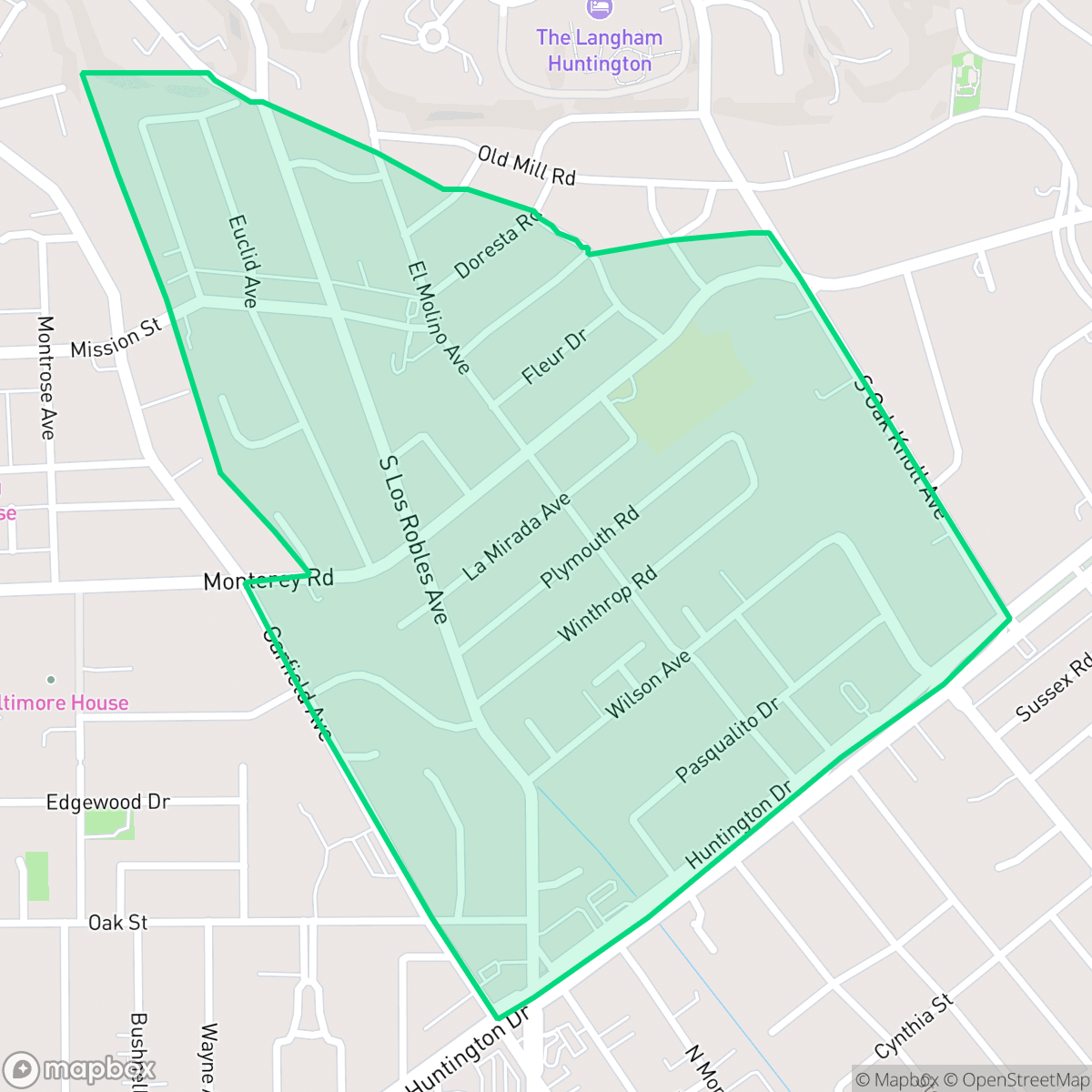
About Mission District
The Mission District of San Marino, centered along historic Mission Street, developed as one of the city's few designated commercial zones. Historically separated from South Pasadena by the San Pasqual Wash, the neighborhood became more integrated in 1926 when the San Marino Civic Improvement Association constructed the first bridge across the wash. By 1929, Sanborn maps recorded a small, emerging commercial footprint here, including a drugstore and local shops. Over the decades, this area evolved into the 'Shops at Mission Village,' a distinctive, tree-lined shopping and dining district characterized by its upscale, small-town atmosphere. The neighborhood's character is defined by its historic low-rise storefronts and long-standing local institutions, such as Julienne Fine Foods & Celebrations, alongside a curated collection of independent boutiques, antique shops, and salons.
The Mission District serves as a primary commercial and social anchor for San Marino, offering a dense, pedestrian-friendly environment that stands out for its exceptional visual appeal. The neighborhood provides immediate access to boutique retail and dining, creating a distinct small-town atmosphere that encourages foot traffic and local engagement. According to iHuus data, the area maintains high standards for air quality and visual aesthetics, making it a desirable location for those who prioritize daily convenience and a curated streetscape.
Living in this part of the city requires balancing the benefits of extreme walkability against specific environmental trade-offs. Prospective residents should note that the neighborhood experiences higher levels of ambient road traffic noise compared to other parts of the city. Additionally, while the area is served by the top-rated San Marino Unified School District, it faces significant challenges regarding flood and fire safety. This makes the neighborhood best suited for individuals who value a central, active lifestyle and are comfortable navigating the specific infrastructure realities of this historic district.
Neighborhood Scores Across 15 Qualities
Residential spacing is relatively tight with some properties sharing close property lines. This level of seclusion is slightly lower than the San Marino average according to iHuus data.
Wide sidewalks and clear crosswalks facilitate easy movement on foot throughout the area. This level of walkability is nearly identical to the city average, providing reliable access to both residential and commercial streets.
Standard suburban housing features dense plots with occasional private pools and modest roof geometries. This level of visual character is consistent with the average for San Marino.
Private yards and narrow parkways dominate the landscape, offering fewer public green spaces or trails than the San Marino average. According to iHuus data, the area lacks significant public park access for pet owners.
A mix of single-family homes, apartments, and commercial corridors provides an even balance of street density and green space. This environment is slightly less suburban than the San Marino average, according to iHuus data.
Low-density residential blocks and serene green spaces provide a steady but subdued atmosphere. This area offers a slightly more active mix of services and leisure spots compared to the city average, according to iHuus data.
Frequent noise from nearby major freeways and railroad tracks characterizes this area. This level of acoustic disturbance is noticeably higher than the average found across San Marino.
Air quality remains consistently good with rare instances of elevated readings. This level of cleanliness is in line with the San Marino city average according to iHuus data.
Industrial presence is non-existent here, as the area contains no warehouses or heavy manufacturing facilities. This lack of industrial proximity is even more pronounced than the San Marino average, ensuring an environment free from industrial hazards.
Health insurance accessibility is exceptionally high, matching the city average for the area. According to iHuus data, nearly all residents in this neighborhood are covered by a health insurance plan.
Voting patterns and census indicators show a predominantly liberal leaning that is more pronounced than the San Marino city average. This political profile is reflected in the local community engagement and demographic trends according to iHuus data.
A diverse mix of young adults, families, and older residents characterizes this area. According to iHuus data, the age distribution is largely in line with the broader San Marino average.
Significant flood risk exists here due to being situated within a 100-year floodplain; this area is notably more vulnerable to flooding than the San Marino city average. Residents should anticipate that flood insurance will likely be a requirement for properties in this neighborhood.
Address-Level Insights for Mission District


iHuus Neighborhood Intelligence Insights
Get address-level neighborhood insights for Mission District
- Street-level scores — see how individual blocks compare, not just neighborhood averages
- Micro-zone boundaries — identify quiet pockets, flood boundaries, and walkable clusters before you visit
- 15 dimensions in full — walkability, noise, air quality, school quality, insurance coverage, population age profile, urban/rural index, and more
- Boundary risk alerts — know if your address sits near a block boundary where scores drop, the kind of detail no listing will ever mention
- School insights — individual school ratings and insights, not just district-level data
- Compare before you commit — side-by-side data across neighborhoods, down to block precision
No credit card required
Compare with Any Neighborhood
| Dimension | Mission District | East Village |
|---|---|---|
| 🚶 Walkabilityavg 9.76 | ||
| 🔊 Acoustic Comfortavg 4.64 | ||
| 🤫 Privacy Indexavg 5.86 | ||
| 🎨 Visual Appealavg 8.35 | ||
| 🐕 Dog Friendlinessavg 6.49 | ||
| 🗺️ Urban-Rural Indexavg 6.38 | ||
| ✨ Neighborhood Vibeavg 3.31 | ||
| 🏥 Health Insurance Coverageavg 8.8 | ||
| 🌿 Air Qualityavg 8 | ||
| 🏭 Industrial Proximityavg 9.02 | ||
| 🌊 Flood Safetyavg 3.45 | ||
| 🗳️ Ideological Leanavg 8.03 | ||
| 👥 Population Age Profileavg 5.39 | ||
| 🔥 Fire Safety | ||
| 🏫 School Quality |
Mission District Rankings
School Districts Serving Mission District
School Insights for Mission District
Below average outcomes; significant attendance and academic challenges.
School Insights
See what's really behind every school rating near Mission District
- Individual school ratings — each school's own score with outcome context, not just a district average
- Enrollment & class size data — student-to-teacher ratio and how it compares to the state average
- Full demographics breakdown — ethnicity and gender composition for every school in the enrollment zone
- Every school in the district — all schools within the enrollment boundary ranked by rating, not just the closest one
- Grade levels & benchmarks — elementary through high school, with below/above state-average flags
No credit card required