Washington Manor, San Leandro
Updated · 14,882 residents
Washington Manor is a diverse, mid-century residential community in San Leandro defined by its high walkability and dense suburban layout. Residents benefit from a consistent grid of sidewalks and proximity to neighborhood parks, though the area experiences significant road traffic noise and limited privacy due to closely spaced homes.
Key Highlights
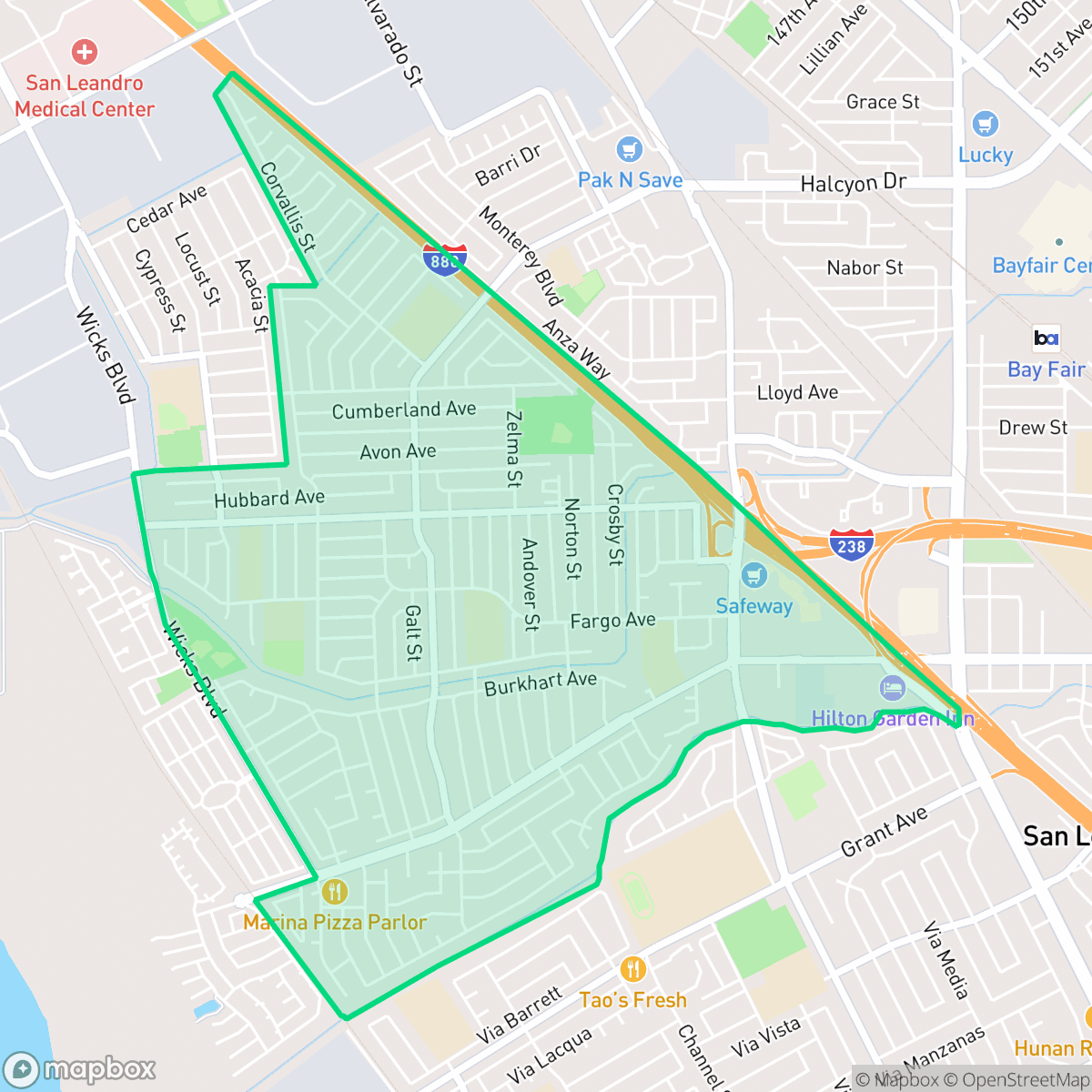
About Washington Manor
Established in 1950 as a planned community within San Lorenzo, Washington Manor originally featured affordable two- and three-bedroom tract homes built by McEntyre. Seeking self-determination, the neighborhood purchased an old nursery in the late 1950s to build Washington Manor Park. Shortly after, in 1957, the area was annexed by the city of San Leandro. A central neighborhood landmark is the mid-century Manor Shopping Center neon sign, originally erected in the early 1950s. While historically subject to the exclusionary housing practices that shaped mid-century San Leandro, Washington Manor has evolved into a highly diverse enclave, today recognized for its prominent Portuguese-American and Asian-American communities.
The area functions as a classic mid-density suburban enclave characterized by its uniform tract housing and established neighborhood institutions. It maintains a strong sense of community, supported by various local dining spots like Mama Lupe's Cocina and Tapsilog Express. According to iHuus data, the neighborhood provides a highly accessible pedestrian environment with a comprehensive network of sidewalks and well-marked crosswalks, facilitating easy movement for residents throughout the residential grid.
Prospective residents should note that the neighborhood features a high-density layout where homes are typically less than 10 meters apart, resulting in limited private outdoor space. While the area is generally quiet, acoustic comfort is impacted by nearby road traffic. Families should also be aware that the local school districts, while inclusive and diverse, are currently navigating academic challenges and varying performance metrics across their elementary and secondary campuses.
Neighborhood Scores Across 15 Qualities
Homes are positioned closely together with shared property lines and minimal buffer between neighbors. This density is slightly higher than the San Leandro average, particularly in areas where structures are separated by very small gaps.
Comprehensive sidewalk networks and well-marked crosswalks make navigating the residential grid easy on foot. This level of pedestrian accessibility is consistent with the rest of San Leandro.
Standard tract housing defines the area, featuring consistent rooflines and small yards that are typical for the city. Most lots are closely spaced and offer minimal private luxury amenities, according to iHuus data.
Large school fields and Washington Park provide ample area for pet exercise. This level of access to public parks and walking paths is higher than the San Leandro average, according to iHuus data.
Residential layouts here consist mainly of single-family homes and dense suburban tracts. This environment is very similar to the broader San Leandro area in its mix of housing and proximity to industrial zones.
Suburban streets and green spaces provide a calm atmosphere, though the low density of local businesses makes the area slightly less lively than the San Leandro average. While various dining and social spots are available, most essential services require a vehicle to reach.
Frequent noise from nearby freeway and railroad proximity impacts acoustic comfort. This level of disturbance is slightly higher than the San Leandro average, according to iHuus data.
Air quality fluctuates between acceptable and unhealthy levels, presenting occasional concerns for sensitive groups. This level of-air quality is consistent with the average found throughout San Leandro, according to iHuus data.
Largely residential and light commercial, this area features fewer industrial warehouses than the San Leandro average. While heavy logistics hubs are visible on the periphery, the neighborhood lacks significant heavy industry or hazardous facilities.
Health insurance access remains consistent with the broader San Leandro area, according to iHuus data. Residents can expect a level of coverage stability that aligns with the city average.
Voting patterns and census indicators reflect a deeply liberal political landscape, appearing very similar to the broader San Leandro area according to iHuus data.
A balanced mix of young adults, families, and older residents defines the local demographic. According to iHuus data, this age distribution is largely in line with the broader San Leandro area.
Properties in this area are located within a designated floodplain, which may necessitate flood insurance. According to iHuus data, the risk level here is slightly higher than the San Leandro average.
Address-Level Insights for Washington Manor


iHuus Neighborhood Intelligence Insights
Get address-level neighborhood insights for Washington Manor
- Street-level scores — see how individual blocks compare, not just neighborhood averages
- Micro-zone boundaries — identify quiet pockets, flood boundaries, and walkable clusters before you visit
- 15 dimensions in full — walkability, noise, air quality, school quality, insurance coverage, population age profile, urban/rural index, and more
- Boundary risk alerts — know if your address sits near a block boundary where scores drop, the kind of detail no listing will ever mention
- School insights — individual school ratings and insights, not just district-level data
- Compare before you commit — side-by-side data across neighborhoods, down to block precision
No credit card required
Compare with Any Neighborhood
| Dimension | Washington Manor | Bay-O-Vista |
|---|---|---|
| 🚶 Walkabilityavg 9 | ||
| 🔊 Acoustic Comfortavg 2.73 | ||
| 🤫 Privacy Indexavg 4.08 | ||
| 🎨 Visual Appealavg 6.06 | ||
| 🐕 Dog Friendlinessavg 5.61 | ||
| 🗺️ Urban-Rural Indexavg 6.39 | ||
| ✨ Neighborhood Vibeavg 4.8 | ||
| 🏥 Health Insurance Coverageavg 7.81 | ||
| 🌿 Air Qualityavg 6 | ||
| 🏭 Industrial Proximityavg 7.2 | ||
| 🌊 Flood Safetyavg 2.59 | ||
| 🗳️ Ideological Leanavg 9.78 | ||
| 👥 Population Age Profileavg 4.97 | ||
| 🔥 Fire Safetyavg 0.04 | ||
| 🏫 School Quality |
Washington Manor Rankings
School Districts Serving Washington Manor
School Insights for Washington Manor
Below average outcomes; significant attendance and academic challenges.
School Insights
See what's really behind every school rating near Washington Manor
- Individual school ratings — each school's own score with outcome context, not just a district average
- Enrollment & class size data — student-to-teacher ratio and how it compares to the state average
- Full demographics breakdown — ethnicity and gender composition for every school in the enrollment zone
- Every school in the district — all schools within the enrollment boundary ranked by rating, not just the closest one
- Grade levels & benchmarks — elementary through high school, with below/above state-average flags
No credit card required