Heron Bay-Marina Vista, San Leandro
Updated · 1,103 residents
Heron Bay-Marina Vista is a residential enclave defined by its proximity to the San Leandro Shoreline and the Monarch Bay Golf Club. While the area offers high walkability and exceptional dog-friendliness, residents should be aware of its quiet, low-energy atmosphere and the presence of nearby industrial logistics hubs.
Key Highlights
About Heron Bay-Marina Vista
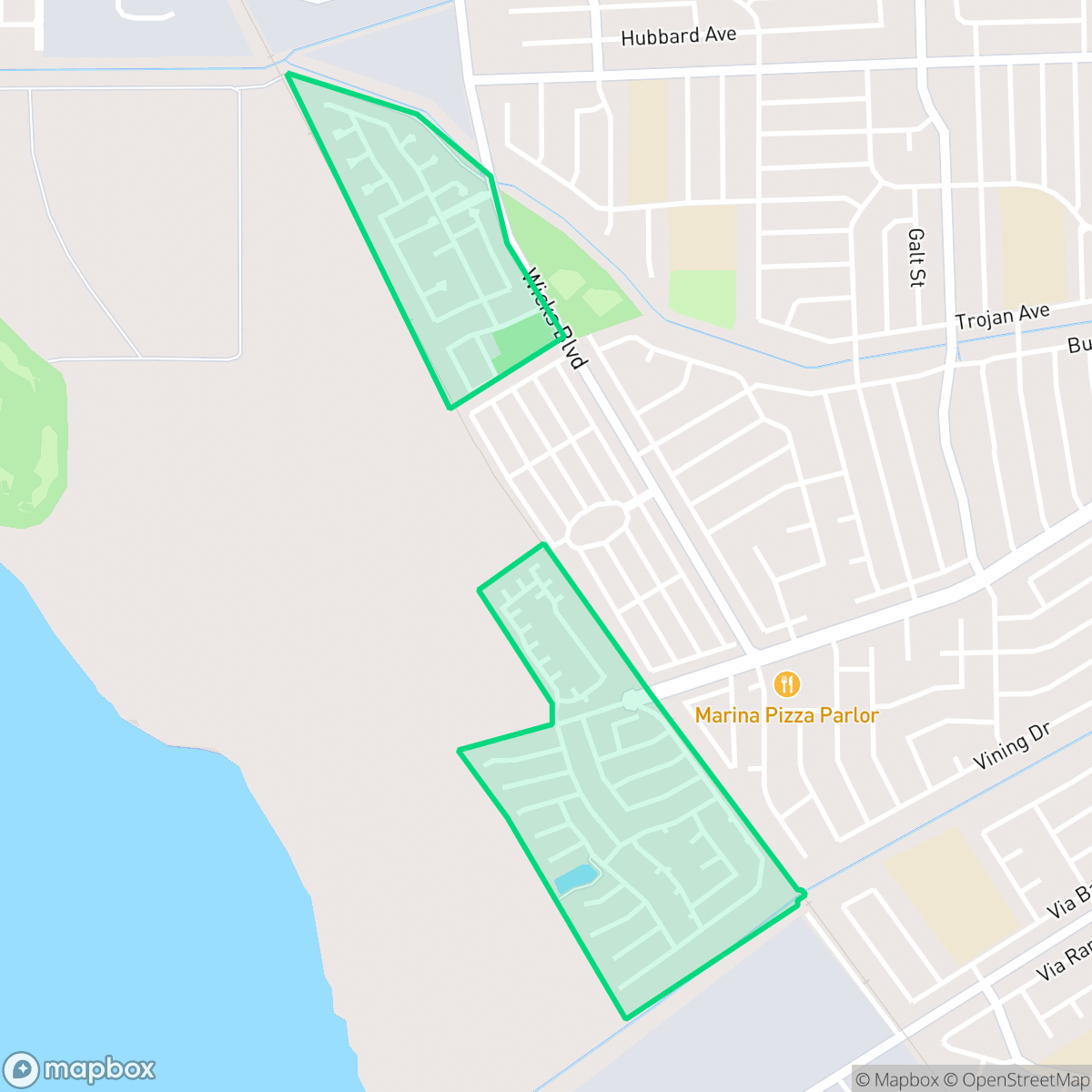
Situated in southwestern San Leandro, the Heron Bay-Marina Vista neighborhood is built on the historic site of Roberts Landing. Established in 1851 by Captain William Roberts, the landing served as a major 19th-century shipping port before hosting a Trojan Powder Company explosives plant from 1906 to 1964. Following decontamination, the area was master-planned and developed between 1996 and 2001. Today, the residential enclave features late-20th-century contemporary homes characterized by pastel stucco and red-tiled roofs. It is bordered by the Monarch Bay Golf Club and the San Leandro Shoreline Marshlands, a restored 400-acre wetland habitat. The neighborhood serves as a key gateway to the San Francisco Bay Trail, which winds through the local marshes and connects residents directly to the waterfront.
The area features a collection of contemporary homes characterized by pastel stucco facades and red-tiled roofs, creating a distinct visual identity near the waterfront. It serves as a tranquil base for those who prioritize outdoor access, as the neighborhood provides direct entry to the San Francisco Bay Trail and expansive marshland views. The environment is notably quiet, with a lack of dense commercial activity or local business hubs, making it a secluded pocket within the broader San Leandro landscape.
Prospective residents should consider the trade-offs associated with the neighborhood's industrial surroundings, as logistics warehouses and nearby rail lines contribute to ambient noise levels. While the area boasts high dog-friendliness and strong health insurance coverage, it is situated within school districts that face varying levels of academic challenges. This neighborhood is best suited for individuals or families who value a suburban residential lifestyle with immediate access to nature and are comfortable with the proximity of regional industrial infrastructure.
Neighborhood Scores Across 15 Qualities
Residential spacing varies throughout the area, with some sections featuring closely situated structures and mobile home parks that lack significant buffer between neighbors. This level of density is roughly in line with the average for San Leandro, according to iHuus data.
Low-traffic residential streets and consistent sidewalks provide safe pedestrian paths, though connectivity is slightly lower than the San Leandro average. Some visibility along these routes is occasionally limited by dense tree canopy.
Standard tract housing and mobile home communities define the landscape, featuring modest yards and consistent architectural styles. According to iHuus data, the visual variety in this area is roughly in line with the San Leandro average.
Connected green spaces and wide paths provide safer walking routes for pets than the San Leandro average. While large parks are located just outside the immediate residential blocks, some streets feature narrow sidewalk verges and private fencing.
Open land and scattered greenery are interspersed with dense suburban housing and industrial zones, resulting in an environment slightly more semi-rural than the San Leandro average, according to iHuus data.
Residential life here is characterized by a calm, low-intensity rhythm with limited local commercial activity. This neighborhood offers a more tranquil atmosphere than the San Leandro average, featuring significant green space and vast open areas near the coastline.
Steady traffic sounds from a nearby busy street are present, though the acoustic environment is notably quieter than the San Leandro average according to iHuus data.
Air quality levels in this area fluctuate between acceptable and unhealthy, presenting occasional concerns for sensitive groups. This level of air quality is consistent with the average found throughout San Leandro, according to iHuus data.
Large-scale logistics hubs and warehouses are concentrated to the north and west, though the neighborhood itself remains mostly residential with quiet streets. This level of industrial proximity is slightly higher than the San Leandro average according to iHuus data.
Health insurance access is exceptionally high in this area, significantly outpacing the San Leandro average according to iHuus data.
Voting patterns and census indicators show a predominantly liberal political leaning, which is very similar to the broader San Leandro area according to iHuus data.
Residents live among a diverse mix of young professionals, families, and older adults. According to iHuus data, this demographic spread is slightly more varied than the typical profile found across San Leandro.
Flood risk in this area is higher than the San Leandro average, as FEMA has not yet finalized a detailed flood study for this specific location. Residents should remain aware of the undetermined risk levels noted in iHuus data.
Address-Level Insights for Heron Bay-Marina Vista


iHuus Neighborhood Intelligence Insights
Get address-level neighborhood insights for Heron Bay-Marina Vista
- Street-level scores — see how individual blocks compare, not just neighborhood averages
- Micro-zone boundaries — identify quiet pockets, flood boundaries, and walkable clusters before you visit
- 15 dimensions in full — walkability, noise, air quality, school quality, insurance coverage, population age profile, urban/rural index, and more
- Boundary risk alerts — know if your address sits near a block boundary where scores drop, the kind of detail no listing will ever mention
- School insights — individual school ratings and insights, not just district-level data
- Compare before you commit — side-by-side data across neighborhoods, down to block precision
No credit card required
Compare with Any Neighborhood
| Dimension | Heron Bay-Marina Vista | Bay-O-Vista |
|---|---|---|
| 🚶 Walkabilityavg 9 | ||
| 🔊 Acoustic Comfortavg 2.73 | ||
| 🤫 Privacy Indexavg 4.08 | ||
| 🎨 Visual Appealavg 6.06 | ||
| 🐕 Dog Friendlinessavg 5.61 | ||
| 🗺️ Urban-Rural Indexavg 6.39 | ||
| ✨ Neighborhood Vibeavg 4.8 | ||
| 🏥 Health Insurance Coverageavg 7.81 | ||
| 🌿 Air Qualityavg 6 | ||
| 🏭 Industrial Proximityavg 7.2 | ||
| 🌊 Flood Safetyavg 2.59 | ||
| 🗳️ Ideological Leanavg 9.78 | ||
| 👥 Population Age Profileavg 4.97 | ||
| 🔥 Fire Safetyavg 0.04 | ||
| 🏫 School Quality |
Heron Bay-Marina Vista Rankings
School Districts Serving Heron Bay-Marina Vista
School Insights for Heron Bay-Marina Vista
Below average outcomes; significant attendance and academic challenges.
School Insights
See what's really behind every school rating near Heron Bay-Marina Vista
- Individual school ratings — each school's own score with outcome context, not just a district average
- Enrollment & class size data — student-to-teacher ratio and how it compares to the state average
- Full demographics breakdown — ethnicity and gender composition for every school in the enrollment zone
- Every school in the district — all schools within the enrollment boundary ranked by rating, not just the closest one
- Grade levels & benchmarks — elementary through high school, with below/above state-average flags
No credit card required