Floresta Gardens, San Leandro
Updated · 5,222 residents
Floresta Gardens is a highly walkable suburban neighborhood known for its grid-based street layout and diverse local dining options. Residents experience a dense residential environment with tightly packed homes and moderate noise levels due to nearby road traffic and rail lines.
Key Highlights
About Floresta Gardens
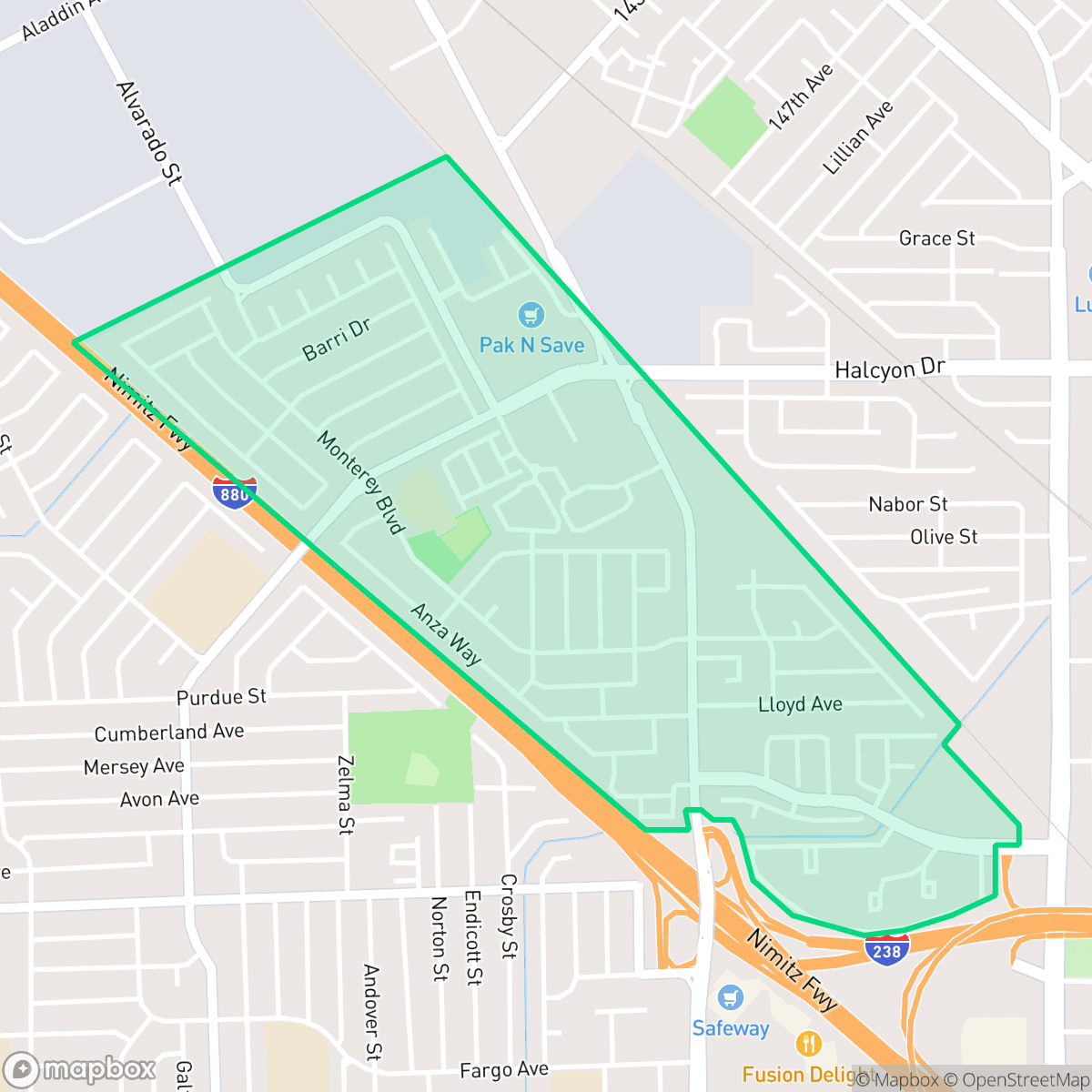
Developed primarily in the early 1950s, Floresta Gardens is a well-established residential neighborhood in southern San Leandro. The community was originally built out starting around 1952 by the development partnership of Valley, Logan & Bradrick. Architecturally, the neighborhood is characterized by its cohesive stock of mid-century, single-story ranch-style homes featuring stucco and wood siding, which are situated on level lots with well-kept lawns. Geographically bounded near the industrial corridors east of Interstate 880, Floresta Gardens transitioned from a region once closely tied to the East Bay's historic food processing industry into a quiet, commuter-friendly suburban enclave. Over the decades, it has evolved into one of the city's most culturally and linguistically diverse pockets, notably home to a prominent population of Asian and Portuguese heritage.
The area offers a blend of residential living and commercial convenience, supported by a highly accessible grid layout that makes daily errands manageable on foot. The neighborhood features a mix of suburban homes and nearby industrial zones, which contribute to a unique local character defined by active daytime commercial traffic and diverse cultural amenities like local art galleries and restaurants. According to iHuus data, the area maintains a balanced urban-rural feel that appeals to those seeking proximity to both essential services and transit corridors.
Prospective residents should note that the neighborhood presents specific trade-offs regarding privacy and acoustic comfort. Due to the high density of the housing stock, structures are situated close together, resulting in limited personal space between properties. Additionally, the proximity to road and rail infrastructure creates a consistent ambient noise environment. This setting is well-suited for commuters and individuals who prioritize walkability and access to diverse community resources over complete seclusion.
Neighborhood Scores Across 15 Qualities
Residential structures feature mixed spacing with some buffer between neighbors, providing slightly more separation than the San Leandro average. According to iHuus data, certain pockets of the area contain tightly packed housing and shared property lines.
Pedestrians benefit from a dense grid of sidewalks on both sides of residential streets and well-marked crosswalks at major intersections. This level of walkability is slightly above the San Leandro average, according to iHuus data.
Standard tract housing features uniform rooflines and modest yards, which is consistent with the typical residential landscape of San Leandro. According to iHuus data, the area presents a highly organized but dense residential pattern with few large private green spaces.
Access to large-scale dog parks and expansive trails is below the San Leandro average. Residents rely on smaller neighborhood green spaces and local school fields for pet exercise.
Residential blocks and single-family homes exist alongside large-scale industrial warehouses and commercial retail zones. This balance of housing and industry is slightly less dense than the San Leandro average, according to iHuus data.
Local life follows a consistent, mixed-use pattern where residential streets and light industrial areas coexist with scattered dining and essential services. This level of activity is slightly higher than the San Leandro average, according to iHuus data.
Frequent auditory disturbances from nearby railroad tracks and freeway traffic characterize this area. According to iHuus data, acoustic comfort is notably lower than the San Leandro average.
Air quality levels in Floresta Gardens fluctuate between acceptable and unhealthy conditions. According to iHuus data, these levels are consistent with the average seen throughout San Leandro.
Residential life here is mostly uninterrupted by heavy industry, though some areas sit near logistics hubs and warehouses. This neighborhood features less industrial presence than the San Leandro average.
Health insurance accessibility in Floresta Gardens is high and stays consistent with the San Leandro average, according to iHuus data.
Voting patterns and census indicators in Floresta Gardens reflect a highly liberal political leaning that is consistent with the broader San Leandro area.
Residents live alongside a balanced variety of young adults, families, and older individuals. According to iHuus data, this demographic spread is slightly more varied than the San Leandro average.
Significant flood risk exists here as much of the area falls within a designated floodplain. According to iHuus data, this risk is higher than the typical level found across San Leandro, which may necessitate additional flood insurance.
Address-Level Insights for Floresta Gardens


iHuus Neighborhood Intelligence Insights
Get address-level neighborhood insights for Floresta Gardens
- Street-level scores — see how individual blocks compare, not just neighborhood averages
- Micro-zone boundaries — identify quiet pockets, flood boundaries, and walkable clusters before you visit
- 15 dimensions in full — walkability, noise, air quality, school quality, insurance coverage, population age profile, urban/rural index, and more
- Boundary risk alerts — know if your address sits near a block boundary where scores drop, the kind of detail no listing will ever mention
- School insights — individual school ratings and insights, not just district-level data
- Compare before you commit — side-by-side data across neighborhoods, down to block precision
No credit card required
Compare with Any Neighborhood
| Dimension | Floresta Gardens | Bay-O-Vista |
|---|---|---|
| 🚶 Walkabilityavg 9 | ||
| 🔊 Acoustic Comfortavg 2.73 | ||
| 🤫 Privacy Indexavg 4.08 | ||
| 🎨 Visual Appealavg 6.06 | ||
| 🐕 Dog Friendlinessavg 5.61 | ||
| 🗺️ Urban-Rural Indexavg 6.39 | ||
| ✨ Neighborhood Vibeavg 4.8 | ||
| 🏥 Health Insurance Coverageavg 7.81 | ||
| 🌿 Air Qualityavg 6 | ||
| 🏭 Industrial Proximityavg 7.2 | ||
| 🌊 Flood Safetyavg 2.59 | ||
| 🗳️ Ideological Leanavg 9.78 | ||
| 👥 Population Age Profileavg 4.97 | ||
| 🔥 Fire Safetyavg 0.04 | ||
| 🏫 School Quality |
Floresta Gardens Rankings
School Districts Serving Floresta Gardens
School Insights for Floresta Gardens
Below average outcomes; significant attendance and academic challenges.
School Insights
See what's really behind every school rating near Floresta Gardens
- Individual school ratings — each school's own score with outcome context, not just a district average
- Enrollment & class size data — student-to-teacher ratio and how it compares to the state average
- Full demographics breakdown — ethnicity and gender composition for every school in the enrollment zone
- Every school in the district — all schools within the enrollment boundary ranked by rating, not just the closest one
- Grade levels & benchmarks — elementary through high school, with below/above state-average flags
No credit card required