Estudiollo Estates, San Leandro
Updated · 3,168 residents
Estudillo Estates is a highly walkable neighborhood in San Leandro characterized by its dense, pedestrian-friendly grid and tranquil residential atmosphere. Residents benefit from a vibrant local scene featuring popular spots like Zocalo Coffeehouse and Paradiso, all while remaining completely insulated from industrial activity.
Key Highlights
About Estudiollo Estates
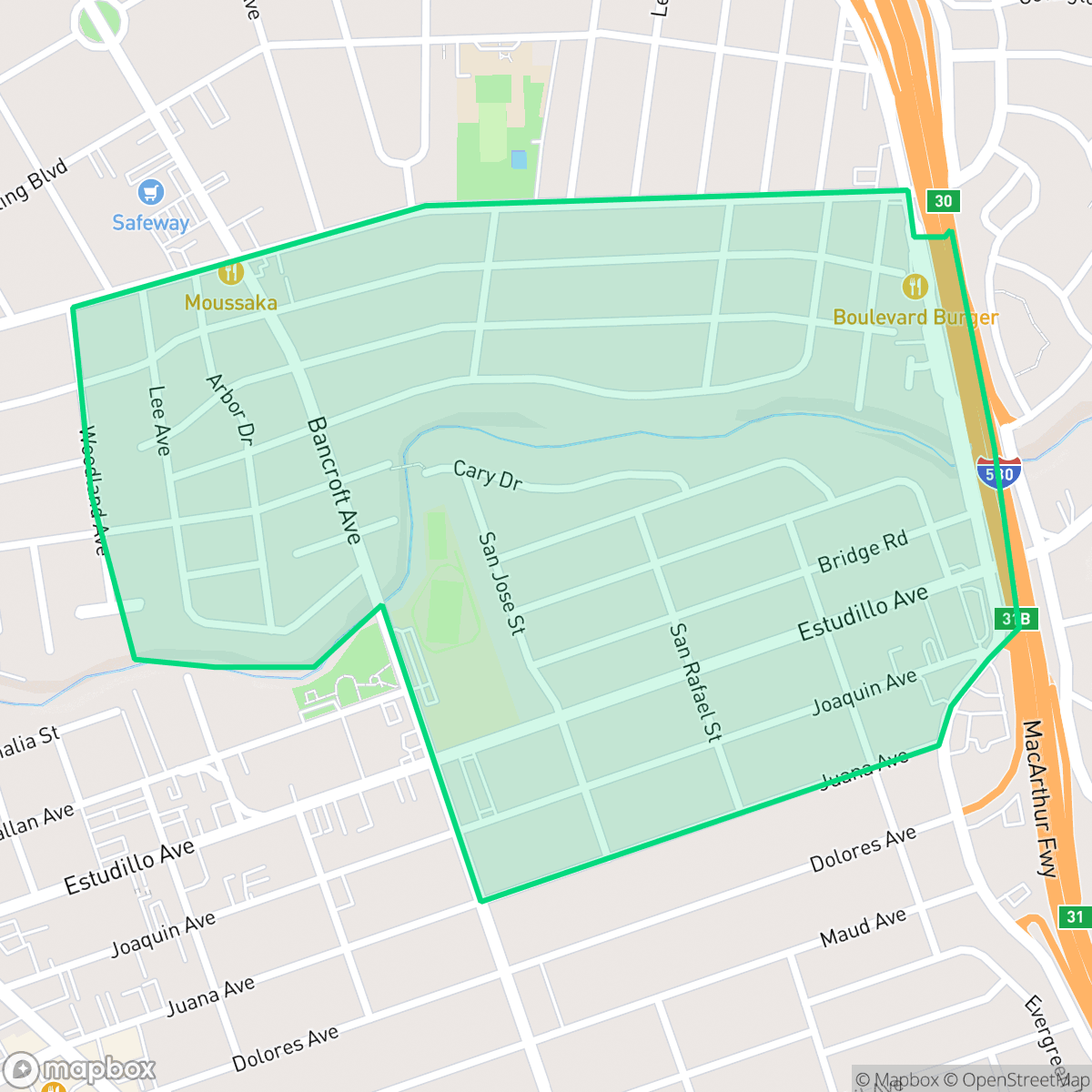
Developed starting in 1926 by the Fred T. Wood Company, Estudillo Estates was marketed as "San Leandro's Piedmont with the Better Climate". Significant residential construction began around 1930, transforming the area south of San Leandro Creek into one of the city's most desirable neighborhoods. It is highly regarded for its diverse, well-preserved architectural stock dating from the 1920s through the 1950s, featuring classic Tudor, Spanish Stucco, Mediterranean, Craftsman, and Mid-Century Ranch homes. The neighborhood's layout is characterized by mature, tree-lined streets and properties bordering the natural habitat of the San Leandro Creek watershed. Memorial Park, established along the creek in 1938, serves as a central neighborhood gathering space.
The neighborhood offers a dense, pedestrian-oriented environment where residents benefit from high walkability and a complete absence of industrial sites. Local life centers around diverse community hubs such as Zocalo Coffeehouse, the Praises of Zion Missionary Baptist Church, and local dining staples like Paradiso. The area maintains a consistent acoustic profile, providing a relatively quiet living environment despite its suburban density.
Prospective residents should note that the neighborhood features tightly packed housing with limited property buffering, which results in a lower level of private space compared to more sprawling suburbs. While the area is well-served by the San Leandro Unified School District, families should consider the academic variance within the district, including the performance metrics for Bancroft Middle School. Additionally, while the neighborhood demonstrates strong flood safety, it faces significant challenges regarding fire risk, which is a critical factor for long-term planning.
Neighborhood Scores Across 15 Qualities
Residential spacing is relatively tight with some houses positioned close to neighbors. According to iHuus data, this level of density is slightly higher than the San Leandro average.
Extensive sidewalk networks and frequent crosswalks make navigating the residential streets easy on foot. While the layout is more pedestrian-friendly than most of San Leandro, the nearby freeway serves as a significant barrier to movement in certain directions.
Standard tract housing defines the area with uniform rooflines and small yards. This neighborhood offers a consistent visual landscape that is slightly more orderly than the San Leandro average, according to iHuus data.
Access to school sports fields and a large regional park provides ample green space for exercise. Proximity to these areas and the presence of continuous sidewalks with grass verges make the neighborhood more dog friendly than the San Leandro average.
Predominantly suburban in character, this area features a mix of single-family homes and multi-family structures that is very similar to the broader San Leandro area. Residents will find a developed landscape with significant grey cover and established residential grids according to iHuus data.
Local dining and social spots like Zocalo Coffeehouse and various pizza shops provide a higher level of activity than the San Leandro average. Residents can find a noticeable concentration of neighborhood hubs, though some suburban blocks remain quiet and adjacent to major highway features.
Frequent noise from nearby freeways and railroad tracks characterizes this area. According to iHuus data, acoustic levels are notably higher than the San Leandro average.
Air quality levels here fluctuate between acceptable and unhealthy periods, matching the typical levels found throughout San Leandro. Sensitive individuals should monitor local conditions on days when pollutants may be more concentrated.
Industrial presence is virtually non-existent in this area, providing a separation from warehouses and heavy manufacturing that is much higher than the San Leandro average. According to iHuus data, the landscape consists exclusively of residential and institutional uses without visible industrial facilities or chimneys.
Health insurance access is very high among residents, which is notably above the San Leandro average according to iHuus data.
Voting patterns and census indicators show a predominantly liberal leaning that is consistent with the broader San Leandro area, according to iHuus data.
A diverse mix of young adults, families, and older residents characterizes the area. This demographic distribution is slightly more varied than the San Leandro average, according to iHuus data.
Flood risk levels are currently difficult to determine because FEMA has not completed a detailed study for this area; however, according to iHuus data, the potential for flooding appears higher than the San Leandro average.
Address-Level Insights for Estudiollo Estates


iHuus Neighborhood Intelligence Insights
Get address-level neighborhood insights for Estudiollo Estates
- Street-level scores — see how individual blocks compare, not just neighborhood averages
- Micro-zone boundaries — identify quiet pockets, flood boundaries, and walkable clusters before you visit
- 15 dimensions in full — walkability, noise, air quality, school quality, insurance coverage, population age profile, urban/rural index, and more
- Boundary risk alerts — know if your address sits near a block boundary where scores drop, the kind of detail no listing will ever mention
- School insights — individual school ratings and insights, not just district-level data
- Compare before you commit — side-by-side data across neighborhoods, down to block precision
No credit card required
Compare with Any Neighborhood
| Dimension | Estudiollo Estates | Bay-O-Vista |
|---|---|---|
| 🚶 Walkabilityavg 9 | ||
| 🔊 Acoustic Comfortavg 2.73 | ||
| 🤫 Privacy Indexavg 4.08 | ||
| 🎨 Visual Appealavg 6.06 | ||
| 🐕 Dog Friendlinessavg 5.61 | ||
| 🗺️ Urban-Rural Indexavg 6.39 | ||
| ✨ Neighborhood Vibeavg 4.8 | ||
| 🏥 Health Insurance Coverageavg 7.81 | ||
| 🌿 Air Qualityavg 6 | ||
| 🏭 Industrial Proximityavg 7.2 | ||
| 🌊 Flood Safetyavg 2.59 | ||
| 🗳️ Ideological Leanavg 9.78 | ||
| 👥 Population Age Profileavg 4.97 | ||
| 🔥 Fire Safetyavg 0.04 | ||
| 🏫 School Quality |
Estudiollo Estates Rankings
School Districts Serving Estudiollo Estates
School Insights for Estudiollo Estates
Below average outcomes; significant attendance and academic challenges.
School Insights
See what's really behind every school rating near Estudiollo Estates
- Individual school ratings — each school's own score with outcome context, not just a district average
- Enrollment & class size data — student-to-teacher ratio and how it compares to the state average
- Full demographics breakdown — ethnicity and gender composition for every school in the enrollment zone
- Every school in the district — all schools within the enrollment boundary ranked by rating, not just the closest one
- Grade levels & benchmarks — elementary through high school, with below/above state-average flags
No credit card required