Downtown, San Leandro
Updated · 9,540 residents
Downtown San Leandro serves as a vibrant civic and cultural hub, defined by its highly walkable grid and proximity to local dining and community spaces. While the area offers exceptional pedestrian access, residents should expect noticeable traffic noise and a dense residential environment with limited privacy between homes.
Key Highlights
About Downtown
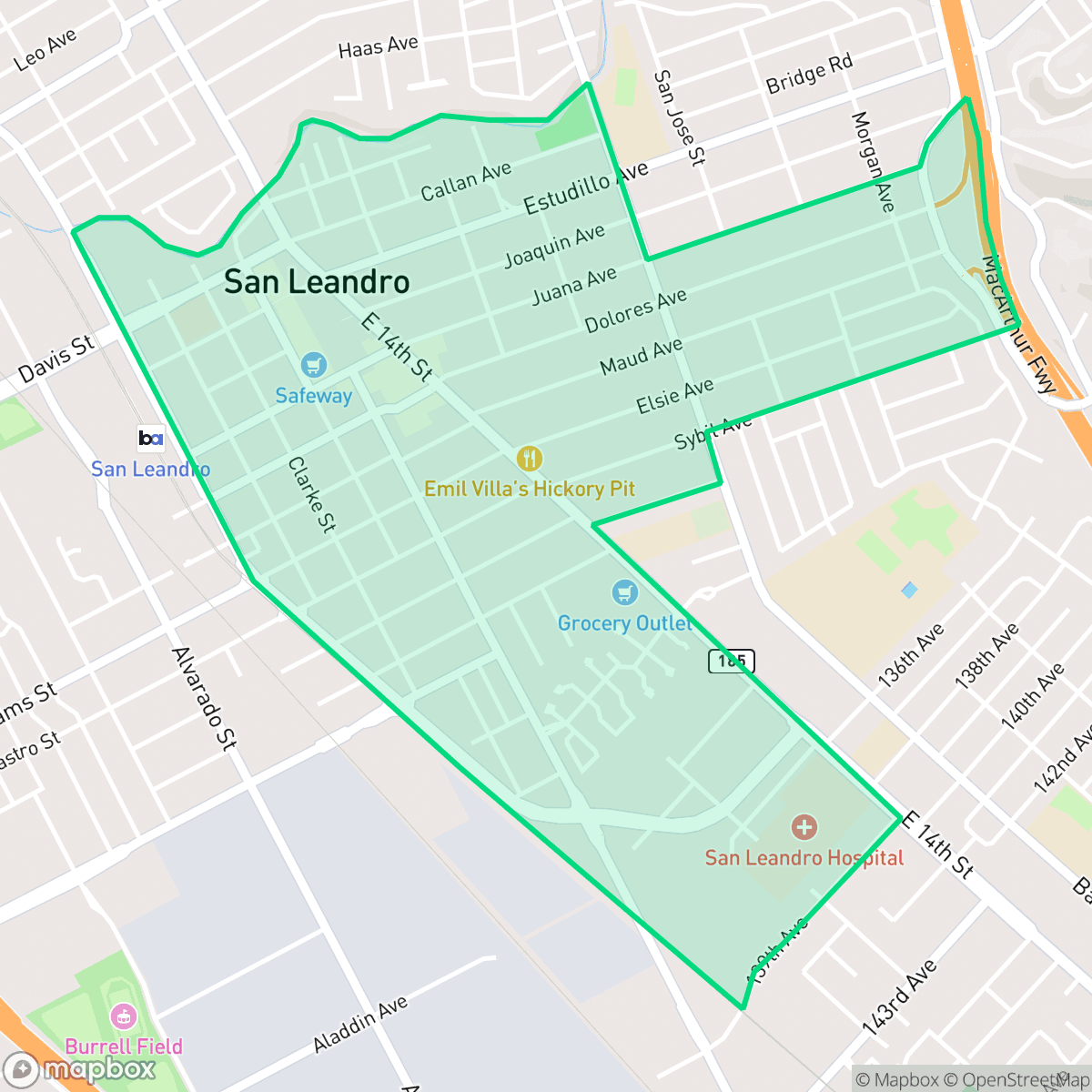
Downtown San Leandro, centered around East 14th Street and Washington Avenue, traces its origins to the 1850s townsite laid out on the former Rancho San Leandro land grant. Historically an agricultural hub known for its cherry orchards, the area served as the Alameda County seat from 1856 to 1873. The neighborhood preserves its heritage through a historic complex on West Estudillo Avenue, which includes the Spanish Colonial Revival-style Casa Peralta, the San Leandro History Museum, and the 1867 Little Brown Church. Downtown’s architectural character is further defined by early 20th-century commercial structures like the 1911 Best Building, financed by inventor Daniel Best. Once a bustling center for the agricultural and tractor industries, the downtown district has transitioned into a modern civic and cultural core while maintaining its identity through preserved landmarks and public history initiatives.
The neighborhood functions as the primary social and commercial center of the city, characterized by a dense layout that encourages exploration on foot. A lively atmosphere prevails, supported by a concentration of coffee shops and restaurants that draw residents together. The area maintains a diverse demographic profile, housing a balanced mix of young professionals, families, and long-term residents within its central grid.
Living here involves certain trade-offs, as the proximity to major transit corridors and railways results in consistent background noise. The housing stock consists largely of modest, closely spaced units, which limits privacy for those seeking secluded living. Despite these factors, the area provides strong health insurance coverage and remains an attractive option for those who prioritize walkability and access to local amenities over quiet, suburban isolation.
Neighborhood Scores Across 15 Qualities
Residential structures are often closely spaced with narrow side setbacks and minimal buffering between neighbors. According to iHuus data, privacy levels are slightly lower than the San Leandro city average.
Pedestrian connectivity is exceptional due to a dense grid system with continuous sidewalks and clearly marked crosswalks. This area offers superior walkability compared to the San Leandro average, according to iHuus data.
Residential architecture consists primarily of standard tract housing and multi-unit complexes with modest lot sizes. This area maintains a visual profile similar to the rest of San Leandro, characterized by uniform rooflines and minimal private luxury amenities.
Access to green space for walking is average for the city, featuring a mix of school sports fields and narrow grass verges alongside denser residential areas. While some corridors offer continuous sidewalks, other parts of the neighborhood lack significant public parks or wide greenery.
Residential streets and green spaces are balanced with larger industrial and commercial footprints. This area is slightly less dense than the San Leandro average, according to iHuus data.
A notable concentration of local dining, coffee shops, and community parks creates a level of activity well above the San Leandro average. While certain pockets offer high-energy urban vibes, other areas remain more subdued with a mix of light industrial and suburban elements.
Persistent sounds from nearby railroad tracks and major freeway corridors are common in this area. According to iHuus data, acoustic levels are slightly higher than the San Leandro average.
Air quality levels in this area fluctuate between acceptable and unhealthy periods. According to iHuus data, these conditions are consistent with the average found throughout San Leandro.
Low industrial presence defines this area, which features mostly residential and institutional buildings. While some warehouse structures and a railway corridor are present, the neighborhood remains slightly more insulated from industrial activity than the San Leandro average, according to iHuus data.
Health insurance accessibility is strong in this area, sitting slightly above the San Leandro average according to iHuus data.
Voting patterns and census indicators show a very high concentration of liberal leanings, which is slightly more pronounced than the San Leandro city average.
Residents live alongside a balanced mix of young adults, families, and seniors. This demographic spread is consistent with the city average, according to iHuus data.
Flood risk in this area is higher than the San Leandro average, though a definitive assessment remains unavailable due to incomplete federal studies. Residents should note that while some level of risk exists, the precise severity is currently undetermined.
Address-Level Insights for Downtown


iHuus Neighborhood Intelligence Insights
Get address-level neighborhood insights for Downtown
- Street-level scores — see how individual blocks compare, not just neighborhood averages
- Micro-zone boundaries — identify quiet pockets, flood boundaries, and walkable clusters before you visit
- 15 dimensions in full — walkability, noise, air quality, school quality, insurance coverage, population age profile, urban/rural index, and more
- Boundary risk alerts — know if your address sits near a block boundary where scores drop, the kind of detail no listing will ever mention
- School insights — individual school ratings and insights, not just district-level data
- Compare before you commit — side-by-side data across neighborhoods, down to block precision
No credit card required
Compare with Any Neighborhood
| Dimension | Downtown | Bay-O-Vista |
|---|---|---|
| 🚶 Walkabilityavg 9 | ||
| 🔊 Acoustic Comfortavg 2.73 | ||
| 🤫 Privacy Indexavg 4.08 | ||
| 🎨 Visual Appealavg 6.06 | ||
| 🐕 Dog Friendlinessavg 5.61 | ||
| 🗺️ Urban-Rural Indexavg 6.39 | ||
| ✨ Neighborhood Vibeavg 4.8 | ||
| 🏥 Health Insurance Coverageavg 7.81 | ||
| 🌿 Air Qualityavg 6 | ||
| 🏭 Industrial Proximityavg 7.2 | ||
| 🌊 Flood Safetyavg 2.59 | ||
| 🗳️ Ideological Leanavg 9.78 | ||
| 👥 Population Age Profileavg 4.97 | ||
| 🔥 Fire Safetyavg 0.04 | ||
| 🏫 School Quality |
Downtown Rankings
School Districts Serving Downtown
School Insights for Downtown
Below average outcomes; significant attendance and academic challenges.
School Insights
See what's really behind every school rating near Downtown
- Individual school ratings — each school's own score with outcome context, not just a district average
- Enrollment & class size data — student-to-teacher ratio and how it compares to the state average
- Full demographics breakdown — ethnicity and gender composition for every school in the enrollment zone
- Every school in the district — all schools within the enrollment boundary ranked by rating, not just the closest one
- Grade levels & benchmarks — elementary through high school, with below/above state-average flags
No credit card required