Bay-O-Vista, San Leandro
Updated · 2,640 residents
Bay-O-Vista is a hilly, scenic neighborhood in San Leandro known for its exceptional walkability and dog-friendly environment. Residents enjoy a lively suburban atmosphere with abundant green space and impressive panoramic views of the San Francisco Bay.
Key Highlights
About Bay-O-Vista
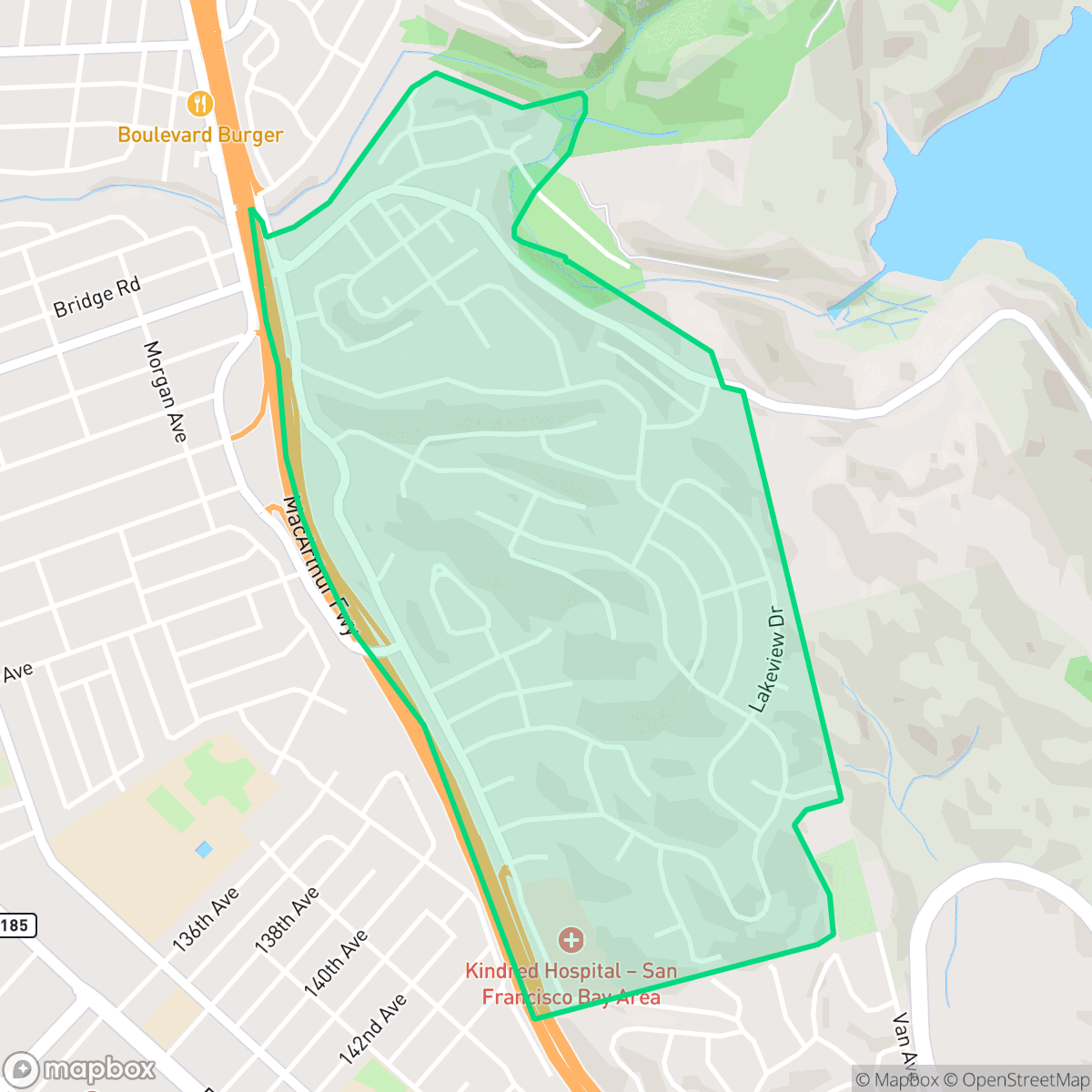
Nestled in the hills east of Interstate 580 near Lake Chabot, San Leandro’s Bay-O-Vista neighborhood developed primarily during the 1950s and 1960s. Known for its winding streets, hilly topography, and panoramic views of the San Francisco Bay, the area is characterized by spacious mid-century modern, contemporary, and ranch-style homes on large lots. Community life has long centered around the Bay-O-Vista Improvement Association (BOVIA), established in the 1950s, and the private Bay-O-Vista Swim & Tennis Club. In the 1990s, the neighborhood became a focal point for grassroots civil rights efforts when local residents successfully organized to strike out historic, racially restrictive covenants (CC&Rs) from the deeds of several housing tracts, marking a significant step in confronting the area's legacy of housing discrimination.
The neighborhood maintains a balanced urban-rural feel, offering quiet residential streets and proximity to various local services and entertainment options. With high levels of health insurance coverage and a consistent ideological lean, the area provides a stable environment for its diverse population. The visual appeal is high, reflecting the well-maintained nature of the properties and the surrounding landscape, while the lack of nearby industrial activity contributes to a peaceful residential experience.
While the area excels in walkability and dog friendliness, prospective residents should be aware of the fire safety risks associated with its hillside location. The neighborhood offers good acoustic comfort, as it is largely free from industrial noise, though road traffic remains the primary factor in local sound levels. It is well-suited for those who prioritize outdoor access and a vibrant, walkable lifestyle within a suburban setting, supported by a school district that is actively pursuing facility modernizations.
Neighborhood Scores Across 15 Qualities
Housing density is moderate, providing more separation between neighbors than the typical San Leandro residential area. According to iHuus data, many homes feature visible buffers, though some high-density sections feature closer proximity between structures.
Continuous sidewalks and clear crosswalks facilitate safe pedestrian movement, though walkability is slightly below the San Leandro average. Residential streets feature a grid layout with accessible paths, even near major highway crossings.
Larger homes and upscale amenities contribute to a visual quality that is higher than the San Leandro average. According to iHuus data, the area features well-maintained properties with spacious driveways and uniform residential architecture.
Abundant open hillsides and large school sports fields provide ample space for pets. According to iHuus data, this area offers significantly more access to safe, connected green spaces and wide paths than the San Leandro average.
Open land and scattered greenery provide a slightly more rural atmosphere than the typical San Leandro suburb. Residents will find a mix of small single-family lots and multi-family structures integrated within a dense suburban fabric, according to iHuus data.
Local amenities and dining options provide a slightly more active atmosphere than much of San Leandro. While some blocks offer a quiet suburban feel, other pockets feature a diverse mix of social spots and walkable services.
Frequent aircraft noise from the nearby airport runway and proximity to heavy rail lines create significant acoustic disruption. According to iHuus data, this level of noise is substantially higher than the San Leandro average.
Air quality in this area is typical for San Leandro, presenting a mix of acceptable and unhealthy days that may occasionally affect sensitive groups. According to iHuus data, the atmospheric conditions are consistent with the city average.
Industrial presence is nonexistent in this area, offering a landscape of quiet streets and green spaces that is significantly lower than the San Leandro average. According to iHuus data, the neighborhood contains no detected warehouses, heavy industrial facilities, or hazardous sites.
Most residents have access to health insurance, although coverage levels are slightly lower than the San Leandro average. According to iHuus data, the majority of the population maintains active health benefits.
Voting patterns and census indicators show a deeply liberal political leaning, which is consistent with the broader San Leandro area according to iHuus data.
Residents live alongside a balanced spread of young adults, families, and older individuals. This demographic distribution is largely in line with the overall San Leandro average, according to iHuus data.
Flood risk in this area is notably higher than the San Leandro average, though precise assessments are currently limited due to incomplete local studies. Residents should remain aware of moderate potential for flooding as indicated by iHuus data.
Fire hazards in this area are significantly higher than the San Leandro average. According to iHuus data, this neighborhood requires maximum protection measures due to the severe level of risk present.
Address-Level Insights for Bay-O-Vista


iHuus Neighborhood Intelligence Insights
Get address-level neighborhood insights for Bay-O-Vista
- Street-level scores — see how individual blocks compare, not just neighborhood averages
- Micro-zone boundaries — identify quiet pockets, flood boundaries, and walkable clusters before you visit
- 15 dimensions in full — walkability, noise, air quality, school quality, insurance coverage, population age profile, urban/rural index, and more
- Boundary risk alerts — know if your address sits near a block boundary where scores drop, the kind of detail no listing will ever mention
- School insights — individual school ratings and insights, not just district-level data
- Compare before you commit — side-by-side data across neighborhoods, down to block precision
No credit card required
Compare with Any Neighborhood
| Dimension | Bay-O-Vista | Bonaire |
|---|---|---|
| 🚶 Walkabilityavg 9 | ||
| 🔊 Acoustic Comfortavg 2.73 | ||
| 🤫 Privacy Indexavg 4.08 | ||
| 🎨 Visual Appealavg 6.06 | ||
| 🐕 Dog Friendlinessavg 5.61 | ||
| 🗺️ Urban-Rural Indexavg 6.39 | ||
| ✨ Neighborhood Vibeavg 4.8 | ||
| 🏥 Health Insurance Coverageavg 7.81 | ||
| 🌿 Air Qualityavg 6 | ||
| 🏭 Industrial Proximityavg 7.2 | ||
| 🌊 Flood Safetyavg 2.59 | ||
| 🗳️ Ideological Leanavg 9.78 | ||
| 👥 Population Age Profileavg 4.97 | ||
| 🔥 Fire Safetyavg 0.04 | ||
| 🏫 School Quality |
Bay-O-Vista Rankings
School Districts Serving Bay-O-Vista
School Insights for Bay-O-Vista
Below average outcomes; significant attendance and academic challenges.
School Insights
See what's really behind every school rating near Bay-O-Vista
- Individual school ratings — each school's own score with outcome context, not just a district average
- Enrollment & class size data — student-to-teacher ratio and how it compares to the state average
- Full demographics breakdown — ethnicity and gender composition for every school in the enrollment zone
- Every school in the district — all schools within the enrollment boundary ranked by rating, not just the closest one
- Grade levels & benchmarks — elementary through high school, with below/above state-average flags
No credit card required