West San Jose, San Jose
Updated · 93,663 residents
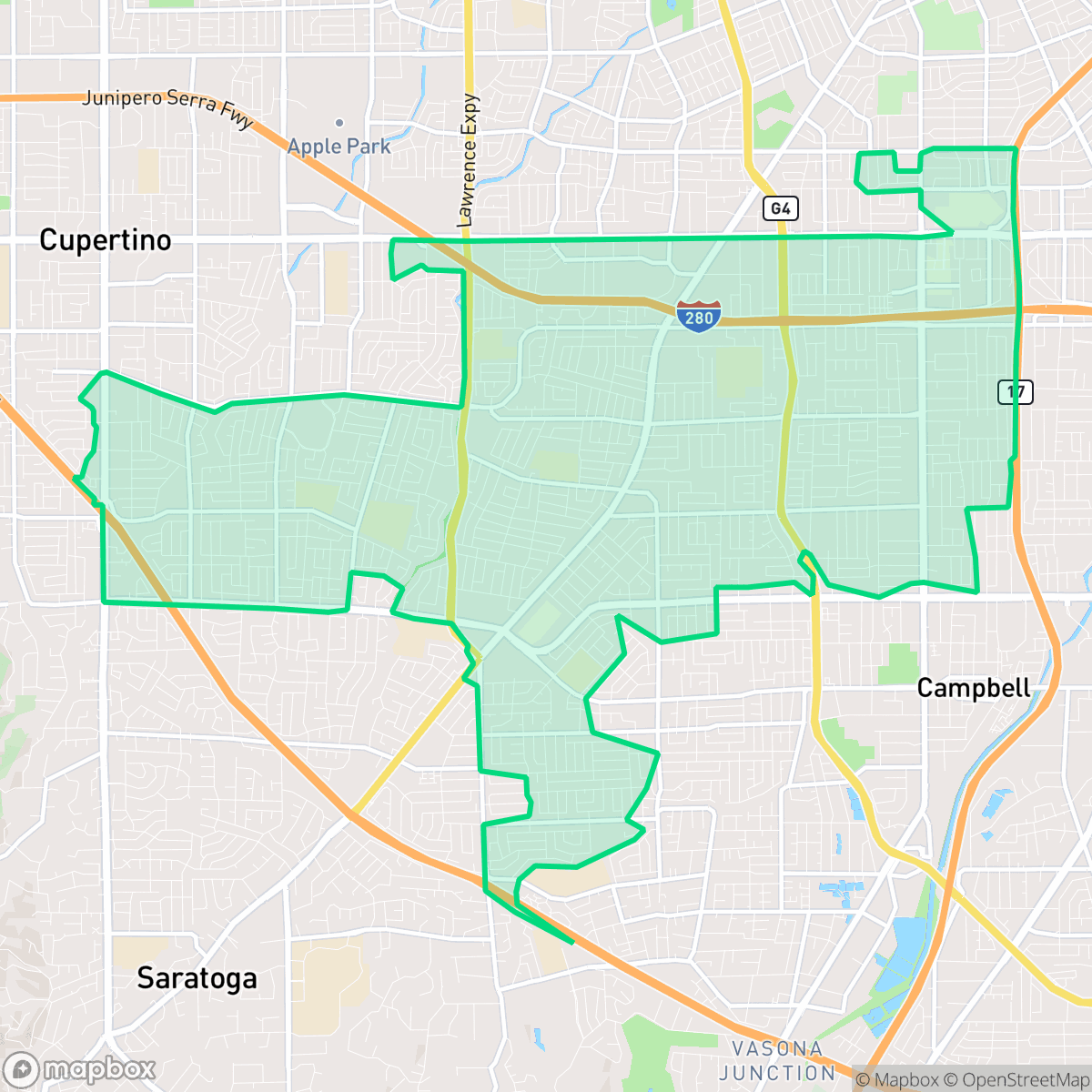
West San Jose is defined by iconic landmarks like the Winchester Mystery House and the vibrant, mixed-use atmosphere of Santana Row. The area features a highly walkable environment with a dense network of suburban residential streets, though residents often experience significant noise from nearby highway traffic.
Key Highlights
About West San Jose
West San Jose evolved from the expansive prune and apricot orchards that once defined the Santa Clara Valley. Following World War II, the area underwent rapid suburbanization, transforming agricultural land into residential subdivisions and commercial corridors. A defining landmark is the Winchester Mystery House, a sprawling, eccentric Victorian mansion built by Sarah Winchester, which remains a significant cultural site. The neighborhood's character was further reshaped by the redevelopment of the former Town & Country Village into Santana Row, a major mixed-use urban village that redefined the area's commercial landscape. Today, West San Jose serves as a hub of suburban residential life, marked by its transition from the agricultural roots of the 'Valley of Heart's Delight' to a modern, densely developed urban environment.
This neighborhood functions as a central hub of suburban activity, blending established residential tracts with major commercial corridors. While the area offers high walkability and excellent access to public amenities, the layout is characterized by relatively high-density housing where homes are frequently spaced within 10 to 15 meters of one another. The presence of significant retail and dining clusters provides a lively atmosphere, though the proximity to major thoroughfares contributes to elevated noise levels throughout many residential blocks.
For prospective residents, the area is best suited for those who prioritize proximity to Silicon Valley employment centers and access to high-performing school districts such as the Fremont Union High School District. While the neighborhood lacks large-scale industrial hazards, the trade-off for its central location is a noticeable acoustic footprint from road traffic. According to iHuus data, the area maintains a strong sense of community through its well-connected sidewalk network and numerous local parks, making it a functional choice for families and professionals seeking a balance between suburban comfort and urban convenience.
Neighborhood Scores Across 15 Qualities
Residential spacing varies between detached homes with private yards and denser apartment clusters with shared walls. This level of density is slightly higher than the San Jose average, offering a mix of suburban setbacks and closely packed multi-family units.
Continuous sidewalks and clear crosswalks are available on both sides of most streets, including major arterials and residential areas. This dense pedestrian network offers superior connectivity for walkers compared to the San Jose average.
Manicured landscapes, large residential lots, and frequent private pools create an upscale visual environment that is slightly above the San Jose average. Many properties feature well-maintained grounds and spacious driveways, though some areas transition into denser, more uniform tract housing.
Abundant public parks, school athletic fields, and wide grassy sidewalk verges provide plenty of space for exercise. This level of access to green space is consistent with the city average.
Established suburban development characterizes this area, featuring a consistent mix of single-family homes, apartment complexes, and commercial centers. This landscape is very similar to the broader San Jose urban fabric, offering a standard suburban density.
Diverse dining and local amenities provide more activity than the city average, though much of the area remains quiet and car-dependent. While some pockets feature lively social hubs and walkable paths, other blocks are primarily composed of calm, residential streets with sparse business access.
Frequent noise from nearby freeways and railroad tracks characterizes this area. According to iHuus data, acoustic comfort in West San Jose is slightly below the San Jose average.
Air quality fluctuates between acceptable and unhealthy levels, presenting occasional concerns for sensitive groups. This condition is roughly in line with the average seen across San Jose.
Residential and retail spaces dominate this area with no detectable warehouses or heavy manufacturing facilities. This lack of industrial activity provides a cleaner environment than the city average, according to iHuus data.
Health insurance access is widespread among residents, performing slightly above the San Jose average according to iHuus data.
Voting patterns and census indicators show a predominantly liberal leaning that is slightly higher than the San Jose average, according to iHuus data.
A balanced mix of young professionals, families, and older residents characterizes this area, mirroring the overall demographic spread found across San Jose.
Properties in this area are situated within a designated floodplain, which may necessitate the purchase of flood insurance. According to iHuus data, this level of flood risk is higher than the average for San Jose.
Address-Level Insights for West San Jose


iHuus Neighborhood Intelligence Insights
Get address-level neighborhood insights for West San Jose
- Street-level scores — see how individual blocks compare, not just neighborhood averages
- Micro-zone boundaries — identify quiet pockets, flood boundaries, and walkable clusters before you visit
- 15 dimensions in full — walkability, noise, air quality, school quality, insurance coverage, population age profile, urban/rural index, and more
- Boundary risk alerts — know if your address sits near a block boundary where scores drop, the kind of detail no listing will ever mention
- School insights — individual school ratings and insights, not just district-level data
- Compare before you commit — side-by-side data across neighborhoods, down to block precision
No credit card required
Compare with Any Neighborhood
| Dimension | West San Jose | Almaden Valley |
|---|---|---|
| 🚶 Walkabilityavg 9.17 | ||
| 🔊 Acoustic Comfortavg 3.12 | ||
| 🤫 Privacy Indexavg 4.96 | ||
| 🎨 Visual Appealavg 6.7 | ||
| 🐕 Dog Friendlinessavg 6.94 | ||
| 🗺️ Urban-Rural Indexavg 6.64 | ||
| ✨ Neighborhood Vibeavg 4.74 | ||
| 🏥 Health Insurance Coverageavg 8.07 | ||
| 🌿 Air Qualityavg 6.07 | ||
| 🏭 Industrial Proximityavg 8.85 | ||
| 🌊 Flood Safetyavg 1.56 | ||
| 🗳️ Ideological Leanavg 9.4 | ||
| 👥 Population Age Profileavg 4.88 | ||
| 🔥 Fire Safetyavg 0.17 | ||
| 🏫 School Quality |
West San Jose Rankings
School Districts Serving West San Jose
School Insights for West San Jose
Below average outcomes; significant attendance and academic challenges.
School Insights
See what's really behind every school rating near West San Jose
- Individual school ratings — each school's own score with outcome context, not just a district average
- Enrollment & class size data — student-to-teacher ratio and how it compares to the state average
- Full demographics breakdown — ethnicity and gender composition for every school in the enrollment zone
- Every school in the district — all schools within the enrollment boundary ranked by rating, not just the closest one
- Grade levels & benchmarks — elementary through high school, with below/above state-average flags
No credit card required