Washington, San Jose
Updated · 3,037 residents
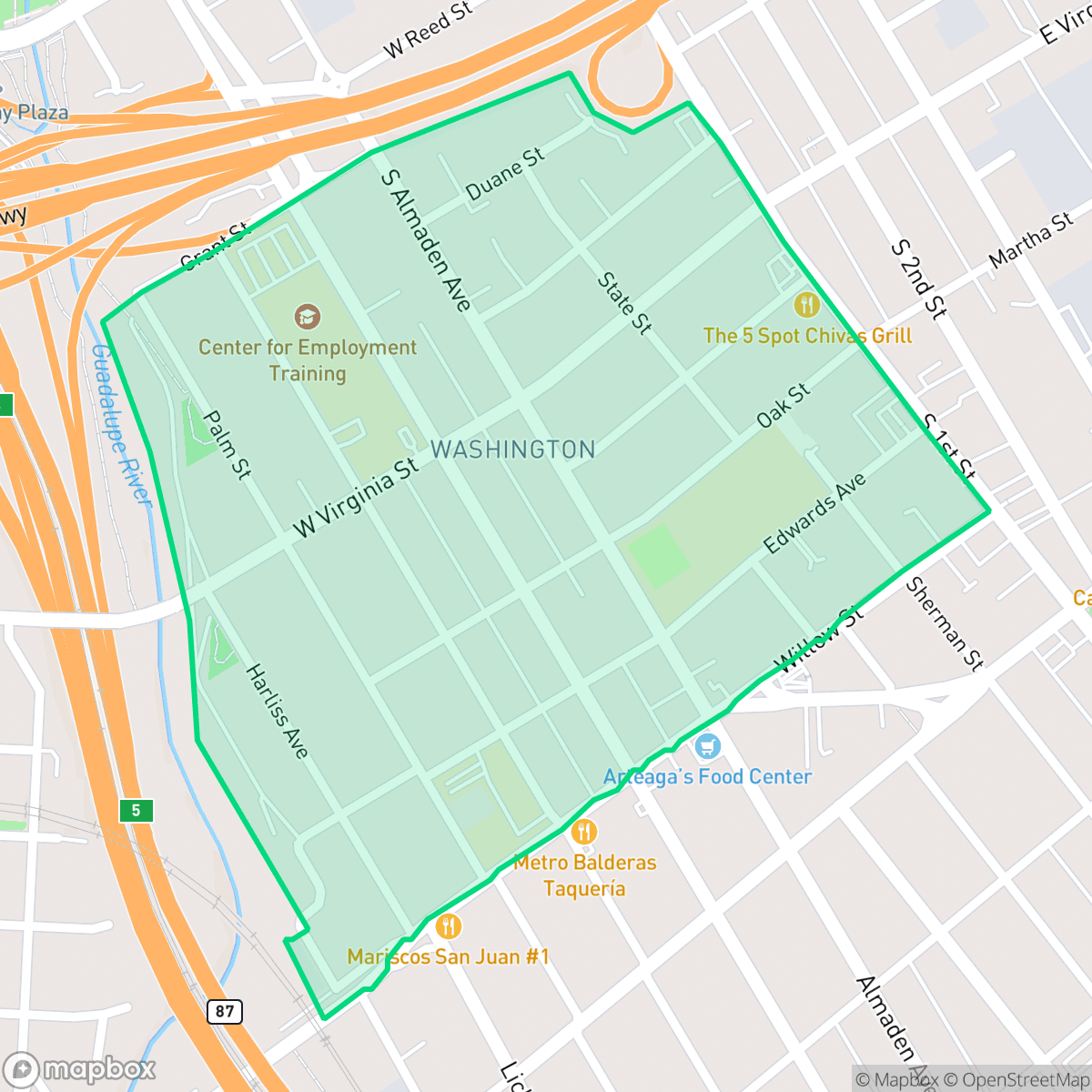
Washington is a highly walkable, dense urban neighborhood located just south of downtown San Jose. Residents benefit from a high-energy atmosphere and diverse local dining options, though the area features tightly packed housing and elevated noise levels from nearby traffic.
Key Highlights
About Washington
The Washington-Guadalupe neighborhood, located just south of downtown San Jose, is one of the city's most significant historic Chicano and Mexican-American districts. Designated as a historic conservation area, the neighborhood is noted for its collection of 19th and early 20th-century architecture, including the 1920 Spanish Revival-style Sacred Heart of Jesus Parish Church. Historically, the area has served as a central hub for the local Latino community, with the Calle Willow business district remaining a focal point for Spanish-speaking businesses. The neighborhood's character is defined by its long-standing immigrant roots, dating back to at least the 1940s, and a strong tradition of community advocacy and grassroots organization, often centered around local schools and neighborhood networks that have shaped the community's identity and resilience.
The neighborhood is defined by a dense grid of streets that offers exceptional walkability, allowing residents to easily access local businesses and essential services on foot. This high-energy environment is bolstered by a variety of dining establishments, including local bakeries and grills, which contribute to the area's active and diverse character. The proximity to major transit routes and the downtown core makes it a convenient location for those who prioritize accessibility and an urban lifestyle over quiet, suburban surroundings.
Living in this area involves specific trade-offs, particularly regarding privacy and acoustic comfort. The residential fabric consists of closely packed homes with minimal separation, and the proximity to industrial zones and major roads results in consistent ambient noise. Furthermore, the neighborhood lacks significant public green spaces, making it better suited for individuals who value urban connectivity and cultural heritage rather than those seeking expansive private yards or a quiet, secluded environment.
Neighborhood Scores Across 15 Qualities
Structures are closely packed with minimal separation between homes, resulting in less privacy than the San Jose average. Many residential clusters feature shared walls or very small gaps between buildings, according to iHuus data.
Continuous sidewalks and an interconnected grid make navigating the neighborhood on foot easy. According to iHuus data, this area offers superior connectivity and pedestrian infrastructure compared to the San Jose average.
Uniform rooflines and small, crowded yards characterize the area's visual landscape. This lack of greenery and architectural variety is notably lower than the San Jose average, according to iHuus data.
Public parks and green verges are relatively scarce in this area, making it less dog friendly than the San Jose average. Most residential greenery is contained within private yards, with very few accessible public spaces within the immediate residential grid.
Residential streets and green spaces are balanced, though the area feels less urban than much of San Jose. According to iHuus data, the landscape features a blend of single-family homes and commercial strips with a lower density than the city average.
Social hubs and diverse dining options create a noticeably more energetic atmosphere than the San Jose average. According to iHuus data, the area features a mix of urban cores near major transit corridors and quieter suburban blocks with accessible parks.
Frequent noise from nearby heavy transit corridors, including major freeways and railroad tracks, makes this area significantly louder than the San Jose average. According to iHuus data, residents can expect persistent acoustic disturbances throughout the day.
Air quality levels fluctuate between acceptable and unhealthy, posing occasional concerns for sensitive groups. According to iHuus data, this neighborhood experiences air quality similar to the San Jose average.
Residential areas predominate here, though proximity to a major freeway interchange and rail lines introduces notable noise and air quality considerations. Large warehouses are concentrated primarily on the eastern edge of the neighborhood, making the area less industrial than the San Jose average.
Health insurance coverage among residents is notably lower than the San Jose average, according to iHuus data. This suggests a higher proportion of the population may be uninsured compared to other parts of the city.
Voting patterns and census indicators show a predominantly liberal political leaning, which is more pronounced here than in the San Jose average according to iHuus data.
A varied mix of young adults, families, and older residents defines the area. According to iHuus data, the age distribution leans slightly more towards a younger demographic than the San Jose average.
Significant flood and wave action risks exist in this area, which is notably higher than the San Jose average. According to iHuus data, residents should anticipate elevated or potentially prohibitive flood insurance costs.
Address-Level Insights for Washington


iHuus Neighborhood Intelligence Insights
Get address-level neighborhood insights for Washington
- Street-level scores — see how individual blocks compare, not just neighborhood averages
- Micro-zone boundaries — identify quiet pockets, flood boundaries, and walkable clusters before you visit
- 15 dimensions in full — walkability, noise, air quality, school quality, insurance coverage, population age profile, urban/rural index, and more
- Boundary risk alerts — know if your address sits near a block boundary where scores drop, the kind of detail no listing will ever mention
- School insights — individual school ratings and insights, not just district-level data
- Compare before you commit — side-by-side data across neighborhoods, down to block precision
No credit card required
Compare with Any Neighborhood
| Dimension | Washington | Almaden Valley |
|---|---|---|
| 🚶 Walkabilityavg 9.17 | ||
| 🔊 Acoustic Comfortavg 3.12 | ||
| 🤫 Privacy Indexavg 4.96 | ||
| 🎨 Visual Appealavg 6.7 | ||
| 🐕 Dog Friendlinessavg 6.94 | ||
| 🗺️ Urban-Rural Indexavg 6.64 | ||
| ✨ Neighborhood Vibeavg 4.74 | ||
| 🏥 Health Insurance Coverageavg 8.07 | ||
| 🌿 Air Qualityavg 6.07 | ||
| 🏭 Industrial Proximityavg 8.85 | ||
| 🌊 Flood Safetyavg 1.56 | ||
| 🗳️ Ideological Leanavg 9.4 | ||
| 👥 Population Age Profileavg 4.88 | ||
| 🔥 Fire Safetyavg 0.17 | ||
| 🏫 School Quality |
Washington Rankings
School Districts Serving Washington
School Insights for Washington
Below average outcomes; significant attendance and academic challenges.
School Insights
See what's really behind every school rating near Washington
- Individual school ratings — each school's own score with outcome context, not just a district average
- Enrollment & class size data — student-to-teacher ratio and how it compares to the state average
- Full demographics breakdown — ethnicity and gender composition for every school in the enrollment zone
- Every school in the district — all schools within the enrollment boundary ranked by rating, not just the closest one
- Grade levels & benchmarks — elementary through high school, with below/above state-average flags
No credit card required