Santa Teresa, San Jose
Updated · 49,239 residents
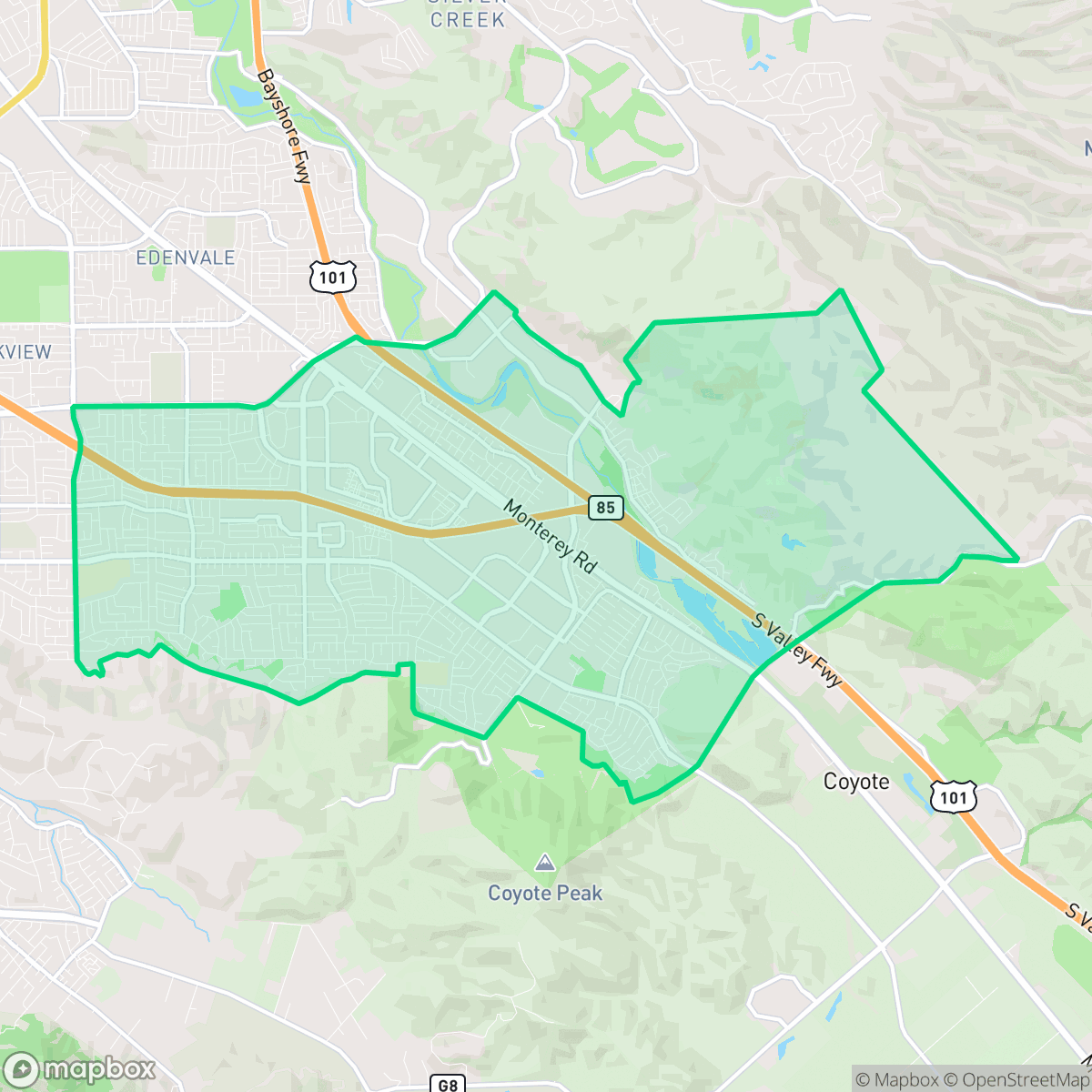
Santa Teresa is a dense suburban community in San Jose defined by its proximity to the Santa Teresa Hills and a consistent network of pedestrian-friendly streets. While the area offers residents strong access to public parks and schools, it is characterized by closely packed housing and significant road noise from nearby transit corridors.
Key Highlights
About Santa Teresa
The Santa Teresa neighborhood in San Jose derives its name from the Rancho Santa Teresa, a Mexican land grant awarded to José Joaquín Bernal in 1834. The area’s historical core is anchored by the Bernal-Gulnac-Joice Ranch, which preserves the legacy of the Bernal family and early California ranching life. This site, now part of Santa Teresa County Park, features restored structures that offer a glimpse into the region’s pastoral origins before the area’s mid-20th-century suburban transformation. The neighborhood is defined by its proximity to the Santa Teresa Hills, which serve as a prominent natural landmark, and the Santa Teresa Light Rail station, which facilitated its integration into the broader San Jose transit network during the late 1980s. These elements collectively reflect the neighborhood’s transition from an agricultural landscape to a residential community.
Santa Teresa functions as a classic suburban enclave where uniform housing tracts meet expansive natural green spaces. According to iHuus data, the area is marked by a high density of single-family homes that often feature private pools, creating a well-manicured aesthetic. Residents benefit from consistent sidewalk infrastructure and proximity to multiple public parks, which provide ample room for outdoor activities and pet exercise. The neighborhood maintains a quiet, steady rhythm of life, though it remains primarily car-oriented despite its walkable street layout. Prospective residents should note that the neighborhood experiences elevated noise levels primarily due to road traffic. Privacy is relatively limited, as many homes are situated on small lots with minimal separation between neighbors. While the area hosts several top-rated elementary and high schools, the broader school district landscape is marked by significant performance gaps and fiscal challenges. The area is best suited for families seeking established suburban infrastructure and access to regional recreation, provided they are comfortable with the noise profiles and density typical of this part of San Jose.
Neighborhood Scores Across 15 Qualities
Residential spacing varies significantly throughout the area, ranging from closely packed mobile home parks and townhomes to detached single-family homes with private yards. This level of separation is roughly in line with the San Jose average, according to iHuus data.
Wide sidewalks and well-marked crosswalks facilitate easy movement throughout residential streets and near commercial zones. While very high, this level of walkability is slightly below the San Jose average due to certain areas being separated by major highway infrastructure.
Manicured properties and a high density of private backyard pools contribute to a visual landscape that is slightly more polished than the San Jose average. According to iHuus data, the area features a mix of large, well-maintained homes and standard suburban tract housing.
Abundant public parks, trail systems along the central creek corridor, and wide sidewalk verges provide ample space for pets. According to iHuus data, the availability of connected green spaces and walking paths in this area is above the San Jose average.
Rolling hills and pockets of undeveloped land provide a more open landscape than most of San Jose. This area features a mix of suburban housing and significant natural vegetation, according to iHuus data.
Local activity remains consistent with a balanced mix of residential streets, green spaces, and various dining options. This level of liveliness is typical for the city, offering a predictable atmosphere that fluctuates between quiet suburban pockets and more active commercial corridors.
Frequent noise from nearby freeways and railroad tracks defines the acoustic environment here. According to iHuus data, these disturbances are more prevalent than in most other parts of San Jose.
Air quality in this area fluctuates between acceptable and unhealthy levels, which may cause occasional concern for sensitive groups. According to iHuus data, these conditions are roughly in line with the average seen across San Jose.
Industrial presence is minimal and largely limited to light commercial use, though some areas near the neighborhood periphery are situated close to an EPA Superfund site. Overall, the area lacks the heavy warehouses and large-scale manufacturing found more frequently in other parts of San Jose.
Health insurance access is widespread among residents, appearing slightly higher than the San Jose average according to iHuus data.
Voting patterns and census indicators reflect a predominantly liberal political leaning, matching the overall trend seen across San Jose.
Residents live alongside a balanced mix of young adults, families, and seniors. This age distribution is largely in line with the broader San Jose area, according to iHuus data.
Significant flood hazards exist within this area, which is slightly higher than the typical risk level found across San Jose. According to iHuus data, residents should prepare for elevated or potentially prohibitive flood insurance costs.
Extreme fire hazards are present in this area, which represents a significantly higher danger level than the San Jose average according to iHuus data.
Address-Level Insights for Santa Teresa


iHuus Neighborhood Intelligence Insights
Get address-level neighborhood insights for Santa Teresa
- Street-level scores — see how individual blocks compare, not just neighborhood averages
- Micro-zone boundaries — identify quiet pockets, flood boundaries, and walkable clusters before you visit
- 15 dimensions in full — walkability, noise, air quality, school quality, insurance coverage, population age profile, urban/rural index, and more
- Boundary risk alerts — know if your address sits near a block boundary where scores drop, the kind of detail no listing will ever mention
- School insights — individual school ratings and insights, not just district-level data
- Compare before you commit — side-by-side data across neighborhoods, down to block precision
No credit card required
Compare with Any Neighborhood
| Dimension | Santa Teresa | Almaden Valley |
|---|---|---|
| 🚶 Walkabilityavg 9.17 | ||
| 🔊 Acoustic Comfortavg 3.12 | ||
| 🤫 Privacy Indexavg 4.96 | ||
| 🎨 Visual Appealavg 6.7 | ||
| 🐕 Dog Friendlinessavg 6.94 | ||
| 🗺️ Urban-Rural Indexavg 6.64 | ||
| ✨ Neighborhood Vibeavg 4.74 | ||
| 🏥 Health Insurance Coverageavg 8.07 | ||
| 🌿 Air Qualityavg 6.07 | ||
| 🏭 Industrial Proximityavg 8.85 | ||
| 🌊 Flood Safetyavg 1.56 | ||
| 🗳️ Ideological Leanavg 9.4 | ||
| 👥 Population Age Profileavg 4.88 | ||
| 🔥 Fire Safetyavg 0.17 | ||
| 🏫 School Quality |
Santa Teresa Rankings
School Districts Serving Santa Teresa
School Insights for Santa Teresa
Below average outcomes; significant attendance and academic challenges.
School Insights
See what's really behind every school rating near Santa Teresa
- Individual school ratings — each school's own score with outcome context, not just a district average
- Enrollment & class size data — student-to-teacher ratio and how it compares to the state average
- Full demographics breakdown — ethnicity and gender composition for every school in the enrollment zone
- Every school in the district — all schools within the enrollment boundary ranked by rating, not just the closest one
- Grade levels & benchmarks — elementary through high school, with below/above state-average flags
No credit card required