North San Jose, San Jose
Updated · 25,484 residents
North San Jose serves as a primary hub for Silicon Valley technology firms, characterized by a mix of modern corporate campuses and high-density residential developments. While the area offers a robust network of sidewalks and pedestrian infrastructure, residents often experience significant noise from nearby freeways and a car-dependent environment with limited local retail options.
Key Highlights
About North San Jose
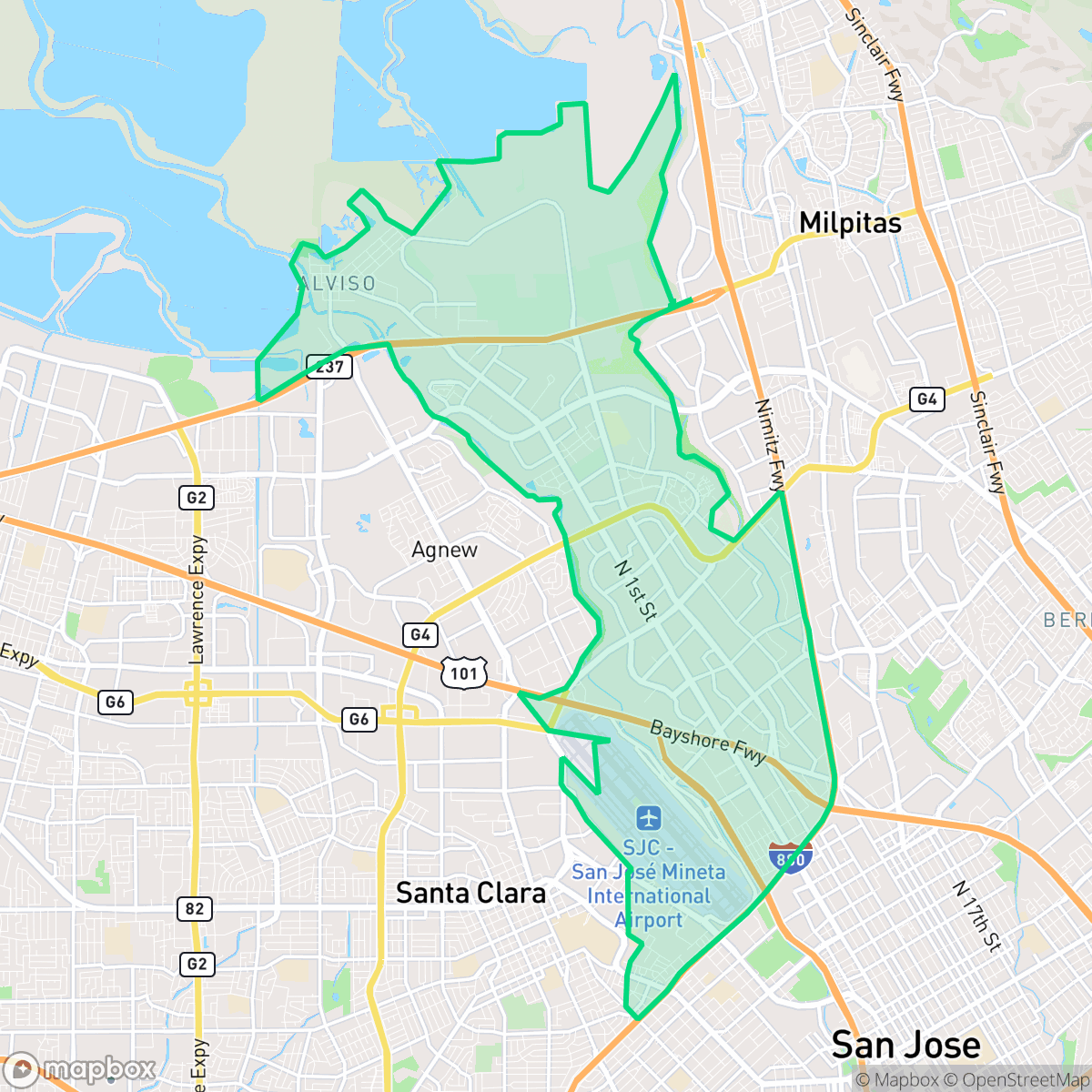
North San Jose is a diverse region encompassing the Alviso, Berryessa, and Rincon/Golden Triangle districts. Historically, the area was defined by its agricultural roots, characterized by extensive apricot orchards that dominated the landscape until the 1970s. The hamlet of Alviso, annexed by San Jose in 1968, serves as a distinct historical anchor; it originated as a vital 19th-century port for steamboat transport and later became a major industrial hub, notably hosting the Bayside Canning Company, which was once the third-largest cannery in the United States. While Alviso retains vestiges of its maritime and industrial past, the broader North San Jose region has transformed into a primary center for Silicon Valley’s high-tech industry, now housing corporate campuses and high-density residential developments that reflect the city's modern economic evolution.
The neighborhood functions as a dense, industrial-adjacent corridor that bridges the gap between major Silicon Valley employment centers and residential living. The landscape is dominated by large-scale office parks, logistics warehouses, and multi-family housing complexes that prioritize proximity to tech employers over traditional neighborhood charm. According to iHuus data, the area maintains a high degree of pedestrian connectivity, featuring comprehensive sidewalk networks and crosswalks that link residential clusters to transit and workspace hubs.
Living in this area involves distinct trade-offs, particularly regarding acoustic comfort and privacy. The high density of apartment complexes and mobile home parks creates a close-quarters living environment, while the proximity to major highways and logistics operations results in elevated ambient noise levels. Prospective residents should note that while the neighborhood provides easy access to major thoroughfares, the lack of a centralized commercial district makes it a car-dependent environment. It is best suited for professionals seeking proximity to tech campuses who prioritize commute efficiency over a quiet or highly walkable social scene.
Neighborhood Scores Across 15 Qualities
Residential structures often feature shared walls or narrow gaps between buildings, resulting in slightly less privacy than the San Jose average. Many residents live in high-density apartment complexes or townhomes where minimal setbacks between neighbors are common.
Pedestrian infrastructure is extensive, featuring continuous sidewalks, marked crosswalks, and dedicated paths along green corridors and waterways. While the area remains slightly below the San Jose average for overall walkability, the presence of pedestrian bridges and well-defined campus paths ensures safe movement through residential and office clusters.
Visual variety ranges from modern corporate campuses and high-density apartment blocks to established tract housing. This landscape is slightly less visually diverse than the San Jose average, characterized largely by standard middle-class residential layouts and large commercial office parks.
Extensive trail networks along the western canal and large central park areas provide ample space for pets. According to iHuus data, the availability of connected green spaces and wide walking paths is slightly above the San Jose average.
A complex landscape of large-scale office campuses, industrial warehouses, and significant airport infrastructure exists alongside pockets of residential clusters and vast wetlands. This mix of developed grey infrastructure and open natural space is largely consistent with the broader San Jose area.
A tranquil, industrial-leaning landscape dominates this area, with most essential services and dining options requiring a car. The local atmosphere is significantly more subdued than the San Jose average, characterized by warehouse corridors and limited commercial density.
Constant noise from nearby airport runways and heavy rail lines makes this area significantly louder than the San Jose average. Residents should expect persistent acoustic disruptions throughout the day and night.
Air quality levels fluctuate between acceptable and unhealthy, presenting occasional concerns for sensitive groups. According to iHuus data, conditions in this area are slightly lower than the San Jose average.
Residents can enjoy a predominantly residential environment with only occasional light commercial activity. This area features significantly fewer industrial hazards and heavy warehouses than the San Jose average.
Health insurance access is widespread among residents, performing slightly above the San Jose average according to iHuus data.
Voting patterns and census indicators in North San Jose reflect a predominantly liberal political leaning, consistent with the broader San Jose area.
Residents encounter a balanced variety of age groups, ranging from young professionals to older adults. This demographic spread is slightly more even than the broader San Jose area, according to iHuus data.
Properties in this area are situated within a known floodplain, which represents a significantly higher risk level than the San Jose average. Residents should anticipate the potential necessity of flood insurance for their homes according to iHuus data.
Address-Level Insights for North San Jose


iHuus Neighborhood Intelligence Insights
Get address-level neighborhood insights for North San Jose
- Street-level scores — see how individual blocks compare, not just neighborhood averages
- Micro-zone boundaries — identify quiet pockets, flood boundaries, and walkable clusters before you visit
- 15 dimensions in full — walkability, noise, air quality, school quality, insurance coverage, population age profile, urban/rural index, and more
- Boundary risk alerts — know if your address sits near a block boundary where scores drop, the kind of detail no listing will ever mention
- School insights — individual school ratings and insights, not just district-level data
- Compare before you commit — side-by-side data across neighborhoods, down to block precision
No credit card required
Compare with Any Neighborhood
| Dimension | North San Jose | Almaden Valley |
|---|---|---|
| 🚶 Walkabilityavg 9.17 | ||
| 🔊 Acoustic Comfortavg 3.12 | ||
| 🤫 Privacy Indexavg 4.96 | ||
| 🎨 Visual Appealavg 6.7 | ||
| 🐕 Dog Friendlinessavg 6.94 | ||
| 🗺️ Urban-Rural Indexavg 6.64 | ||
| ✨ Neighborhood Vibeavg 4.74 | ||
| 🏥 Health Insurance Coverageavg 8.07 | ||
| 🌿 Air Qualityavg 6.07 | ||
| 🏭 Industrial Proximityavg 8.85 | ||
| 🌊 Flood Safetyavg 1.56 | ||
| 🗳️ Ideological Leanavg 9.4 | ||
| 👥 Population Age Profileavg 4.88 | ||
| 🔥 Fire Safetyavg 0.17 | ||
| 🏫 School Quality |
North San Jose Rankings
School Districts Serving North San Jose
School Insights for North San Jose
Below average outcomes; significant attendance and academic challenges.
School Insights
See what's really behind every school rating near North San Jose
- Individual school ratings — each school's own score with outcome context, not just a district average
- Enrollment & class size data — student-to-teacher ratio and how it compares to the state average
- Full demographics breakdown — ethnicity and gender composition for every school in the enrollment zone
- Every school in the district — all schools within the enrollment boundary ranked by rating, not just the closest one
- Grade levels & benchmarks — elementary through high school, with below/above state-average flags
No credit card required