Evergreen, San Jose
Updated · 82,780 residents
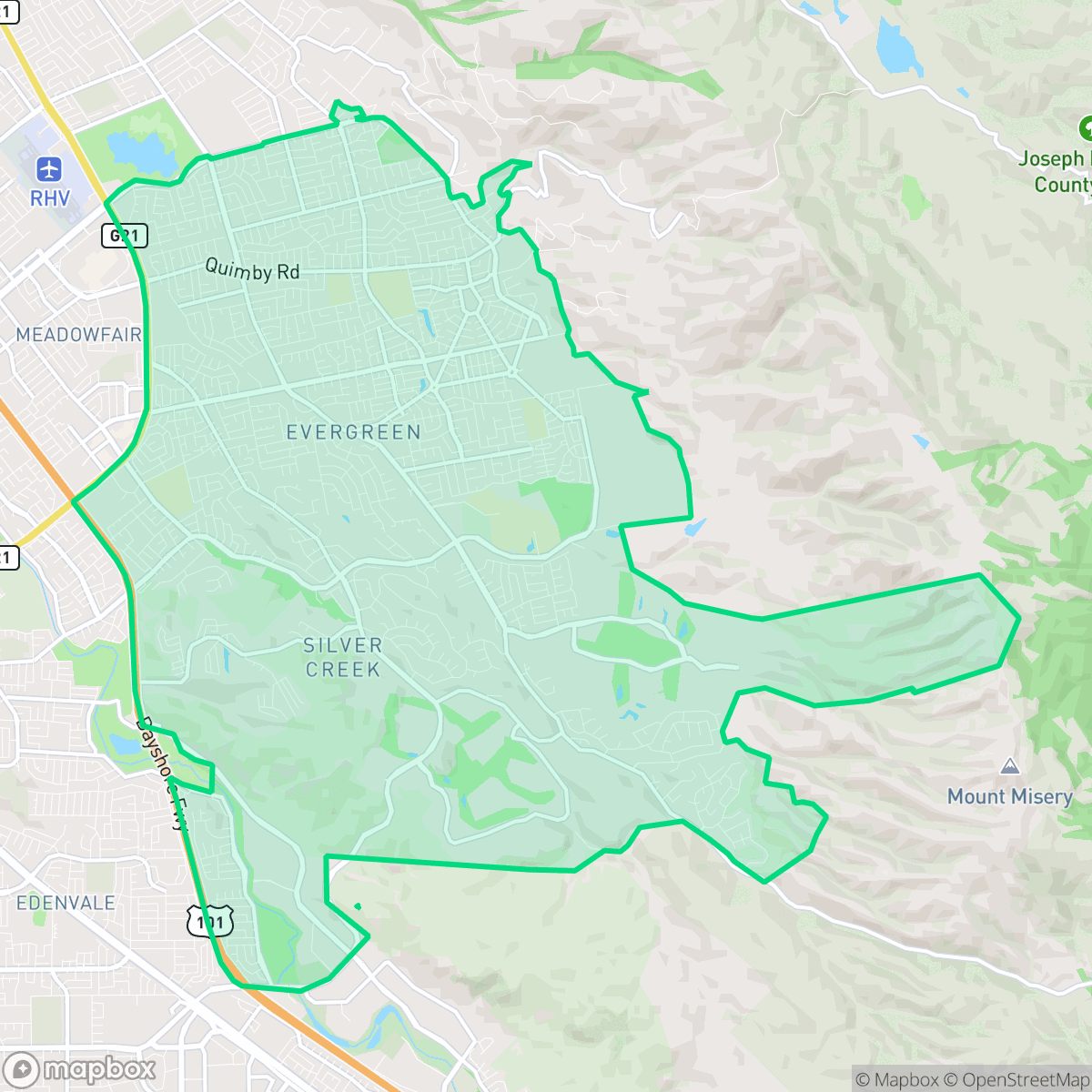
Evergreen is a quiet, suburban enclave in southeastern San Jose defined by its rolling foothill topography and manicured residential landscapes. The area offers high walkability and abundant park space for pet owners, while maintaining a peaceful, purely residential atmosphere free from industrial activity.
Key Highlights
About Evergreen
Evergreen, situated in southeastern San Jose, originated as part of the Mexican-era Rancho Yerba Buena, granted to Antonio Chaboya in the 1820s. For over a century, the area functioned as a prominent agricultural hub defined by orchards and vineyards. In 1911, the neighborhood became a site of aeronautical history when pioneer John J. Montgomery conducted successful gliding experiments on what is now known as Montgomery Hill. The late 20th century brought a rapid transformation from rural farmland to a suburban residential community. Today, Evergreen is characterized by its foothill topography and landmarks such as the Evergreen Village Square, Evergreen Valley College, and the Sikh Gurdwara San Jose. The neighborhood’s identity remains rooted in this shift from its 'Valley of Heart’s Delight' agricultural heritage to its modern role as a diverse residential enclave.
The area is characterized by its upscale, well-maintained homes and a semi-rural feel provided by the surrounding hills and open grasslands. Residents enjoy a high degree of pedestrian connectivity, with extensive sidewalk networks and park paths that make the neighborhood easy to navigate on foot. According to iHuus data, the community benefits from high levels of health insurance coverage and a diverse age demographic, creating a stable environment for families and professionals alike.
Prospective residents should be aware of specific environmental considerations, including a high risk of wildfire and significant flood hazards that may impact insurance costs. While the neighborhood is generally quiet, some areas experience moderate traffic noise from nearby thoroughfares. The local school landscape is notably complex, as the area is served by several different districts that exhibit significant performance disparities and ongoing fiscal transitions. This neighborhood is best suited for those prioritizing a clean, residential environment with easy access to outdoor recreation, provided they are prepared for the unique environmental and administrative realities of the region.
Neighborhood Scores Across 15 Qualities
Residential spacing is varied, featuring a mix of detached homes with small yards and denser clusters with shared property lines. This level of privacy is slightly higher than the San Jose average.
Extensive sidewalk networks on both sides of residential streets and well-marked crosswalks at major intersections make navigating the area easy on foot. This neighborhood offers even greater pedestrian connectivity than the San Jose average, particularly through safe cul-de-sacs and dedicated park paths.
Manicured landscapes, large homes, and frequent private backyard pools characterize this area, which offers a more visually polished environment than the San Jose average. Many properties feature expansive driveways and well-maintained yards, according to iHuus data.
Extensive public parks, walking trails, and wide green verges provide ample space for pets. This neighborhood offers more accessible green space for dogs than the San Jose average.
Open rolling hills and green spaces are more prominent here than in most parts of San Jose. Residents can expect a landscape characterized by scattered homes interspersed with woodland and undeveloped grassland.
The area offers a calm, low-density atmosphere characterized by significant open space and a primarily residential rhythm. While some pockets feature local dining and social hubs, the overall level of activity is slightly below the San Jose average.
Steady traffic sounds from nearby busy streets characterize the area, though acoustic comfort remains higher than the San Jose average according to iHuus data.
Air quality in Evergreen fluctuates between acceptable and unhealthy levels, sitting slightly below the San Jose average. Sensitive groups may experience occasional concern on certain days according to iHuus data.
Industrial activity and heavy warehouses are virtually nonexistent here, providing a cleaner environment than the San Jose average. According to iHuus data, the area consists primarily of residential, educational, and light commercial zones with no detectable industrial hazards.
Health insurance accessibility is notably higher here than the San Jose average, according to iHuus data. Most residents have access to medical coverage.
Voting patterns and census indicators show a very high concentration of liberal-leaning residents. This political leaning is nearly in line with the broader San Jose average according to iHuus data.
A balanced mix of young professionals, families, and seniors characterizes this area. According to iHuus data, the age distribution is slightly more varied than the San Jose average.
Elevated flood hazards and potential wave action in this area may result in high or prohibitive insurance costs. This level of risk is slightly higher than the average for San Jose, according to iHuus data.
Wildfire hazards in this area are significant and present a much higher risk than the typical San Jose neighborhood. Residents should maintain strict fire prevention measures according to iHuus data.
Address-Level Insights for Evergreen


iHuus Neighborhood Intelligence Insights
Get address-level neighborhood insights for Evergreen
- Street-level scores — see how individual blocks compare, not just neighborhood averages
- Micro-zone boundaries — identify quiet pockets, flood boundaries, and walkable clusters before you visit
- 15 dimensions in full — walkability, noise, air quality, school quality, insurance coverage, population age profile, urban/rural index, and more
- Boundary risk alerts — know if your address sits near a block boundary where scores drop, the kind of detail no listing will ever mention
- School insights — individual school ratings and insights, not just district-level data
- Compare before you commit — side-by-side data across neighborhoods, down to block precision
No credit card required
Compare with Any Neighborhood
| Dimension | Evergreen | Almaden Valley |
|---|---|---|
| 🚶 Walkabilityavg 9.17 | ||
| 🔊 Acoustic Comfortavg 3.12 | ||
| 🤫 Privacy Indexavg 4.96 | ||
| 🎨 Visual Appealavg 6.7 | ||
| 🐕 Dog Friendlinessavg 6.94 | ||
| 🗺️ Urban-Rural Indexavg 6.64 | ||
| ✨ Neighborhood Vibeavg 4.74 | ||
| 🏥 Health Insurance Coverageavg 8.07 | ||
| 🌿 Air Qualityavg 6.07 | ||
| 🏭 Industrial Proximityavg 8.85 | ||
| 🌊 Flood Safetyavg 1.56 | ||
| 🗳️ Ideological Leanavg 9.4 | ||
| 👥 Population Age Profileavg 4.88 | ||
| 🔥 Fire Safetyavg 0.17 | ||
| 🏫 School Quality |
Evergreen Rankings
School Districts Serving Evergreen
School Insights for Evergreen
Below average outcomes; significant attendance and academic challenges.
School Insights
See what's really behind every school rating near Evergreen
- Individual school ratings — each school's own score with outcome context, not just a district average
- Enrollment & class size data — student-to-teacher ratio and how it compares to the state average
- Full demographics breakdown — ethnicity and gender composition for every school in the enrollment zone
- Every school in the district — all schools within the enrollment boundary ranked by rating, not just the closest one
- Grade levels & benchmarks — elementary through high school, with below/above state-average flags
No credit card required