Edenvale - Seven Trees, San Jose
Updated · 39,034 residents
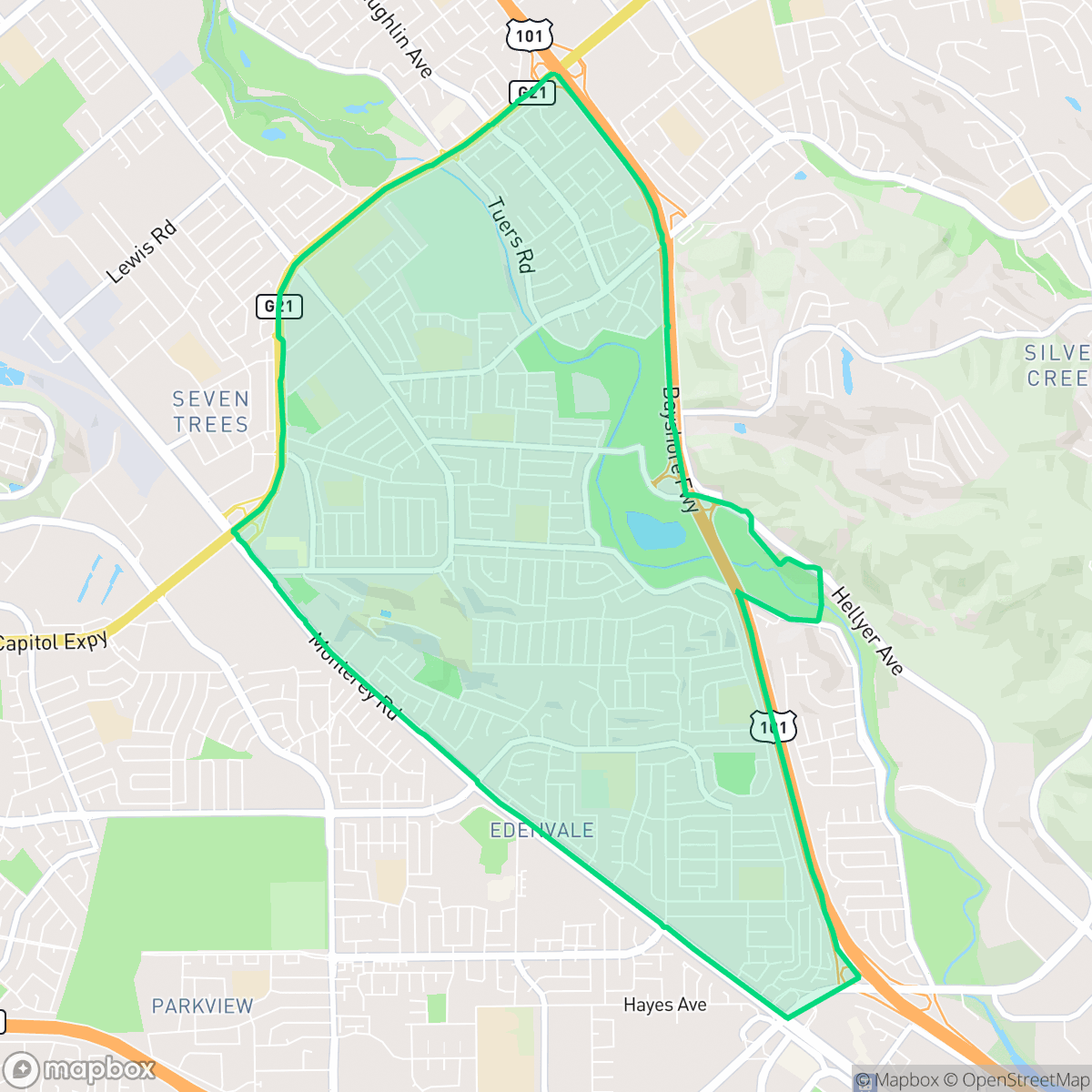
Edenvale - Seven Trees is a highly walkable suburban neighborhood in South San Jose characterized by a dense grid of single-family homes and abundant public green spaces. Residents enjoy convenient access to local parks and schools, though the area experiences noticeable road noise due to its proximity to major transit corridors.
Key Highlights
About Edenvale - Seven Trees
The Edenvale - Seven Trees area in South San Jose is defined by its transition from fertile agricultural lands and orchards to suburban residential development, which accelerated in the 1970s. Edenvale was once a distinct town named for its beauty, serving as a stopover along the historic Monterey Road, or El Camino Real. The neighborhood is anchored by the historic Hayes Mansion, a 1905 Mission Revival landmark built by the founders of the San Jose Mercury News. A notable chapter in its recent history was the Frontier Village amusement park, which operated from 1961 to 1980 on land formerly part of the Hayes estate; today, much of that site is preserved as Edenvale Garden Park. Seven Trees, formerly an unincorporated community, was annexed into San Jose in 2009, reflecting the area's broader evolution into a densely populated, diverse residential hub.
The neighborhood functions as a dense residential hub, defined by its consistent sidewalk networks and proximity to community parks. According to iHuus data, the area maintains a high degree of walkability, allowing residents to navigate between residential blocks and local recreational areas with ease. The housing stock consists primarily of standard suburban tract homes, offering a uniform aesthetic that reflects the area's transition from its agricultural roots to a modern metropolitan suburb.
Prospective residents should consider the trade-offs inherent in this suburban environment, including a higher than average noise level from surrounding traffic and a complex educational landscape. While some charter schools in the area achieve high performance ratings, the broader district schools face significant fiscal and academic challenges. The neighborhood is well-suited for those who prioritize pedestrian access and proximity to public green spaces, provided they are comfortable with the acoustic profile of a busy, well-connected suburban community.
Neighborhood Scores Across 15 Qualities
Housing structures range from closely packed multi-unit complexes and mobile home parks to detached houses with modest yard buffers. This density is roughly in line with the San Jose average, offering a blend of shared walls and small setbacks.
Extensive sidewalk networks and well-marked crosswalks provide safe, continuous paths for pedestrians and strollers throughout the residential streets. According to iHuus data, walkability in this area is nearly on par with the San Jose average.
Property aesthetics range from large, affluent homes with manicured landscaping and private pools to standard density tract housing and mobile home communities. This visual variety is largely in line with the broader San Jose area.
Extensive parklands, regional trails, and wide grassy verges provide ample space for pets. This accessibility to green space and continuous paths is notably higher than the San Jose average, according to iHuus data.
Frequent open land and scattered homes among fields or woodland provide a semi-rural atmosphere that is slightly more open than the typical San Jose landscape. According to iHuus data, the area features a mix of detached housing and green spaces that offer more spatial openness than the city average.
Suburban pockets offer a variety of local dining and parks, though some areas remain quiet and car-dependent. This level of activity is slightly higher than the San Jose average.
Proximity to busy freeways and railroad tracks contributes to notable acoustic disturbance. According to iHuus data, noise levels in this area are slightly higher than the San Jose average.
Air quality levels fluctuate between acceptable and unhealthy periods, which may cause occasional concern for sensitive groups. This stability is largely consistent with the broader San Jose area according to iHuus data.
This area is exclusively residential and recreational, with no warehouses, factories, or hazardous industrial sites detected. According to iHuus data, the neighborhood is free from heavy industrial activity, matching the city average for industrial proximity.
Health insurance enrollment among residents is slightly below the San Jose average, according to iHuus data. Most households in the area maintain coverage, though a small portion of the population remains uninsured.
Voting patterns and census indicators reflect a deeply liberal political leaning that is consistent with the broader San Jose area, according to iHuus data.
Residents live alongside a balanced mix of young adults, families, and older populations. According to iHuus data, the age distribution in this area is largely comparable to the broader San Jose community.
Properties in this area are located within a designated floodplain, which typically necessitates flood insurance. According to iHuus data, the risk level in this neighborhood is slightly higher than the San Jose average.
Fire hazards in this area are exceptionally high, representing a level of danger that is even greater than the San Jose average. Residents should prioritize maximum protection measures and remain vigilant regarding local safety protocols.
Address-Level Insights for Edenvale - Seven Trees


iHuus Neighborhood Intelligence Insights
Get address-level neighborhood insights for Edenvale - Seven Trees
- Street-level scores — see how individual blocks compare, not just neighborhood averages
- Micro-zone boundaries — identify quiet pockets, flood boundaries, and walkable clusters before you visit
- 15 dimensions in full — walkability, noise, air quality, school quality, insurance coverage, population age profile, urban/rural index, and more
- Boundary risk alerts — know if your address sits near a block boundary where scores drop, the kind of detail no listing will ever mention
- School insights — individual school ratings and insights, not just district-level data
- Compare before you commit — side-by-side data across neighborhoods, down to block precision
No credit card required
Compare with Any Neighborhood
| Dimension | Edenvale - Seven Trees | Almaden Valley |
|---|---|---|
| 🚶 Walkabilityavg 9.17 | ||
| 🔊 Acoustic Comfortavg 3.12 | ||
| 🤫 Privacy Indexavg 4.96 | ||
| 🎨 Visual Appealavg 6.7 | ||
| 🐕 Dog Friendlinessavg 6.94 | ||
| 🗺️ Urban-Rural Indexavg 6.64 | ||
| ✨ Neighborhood Vibeavg 4.74 | ||
| 🏥 Health Insurance Coverageavg 8.07 | ||
| 🌿 Air Qualityavg 6.07 | ||
| 🏭 Industrial Proximityavg 8.85 | ||
| 🌊 Flood Safetyavg 1.56 | ||
| 🗳️ Ideological Leanavg 9.4 | ||
| 👥 Population Age Profileavg 4.88 | ||
| 🔥 Fire Safetyavg 0.17 | ||
| 🏫 School Quality |
Edenvale - Seven Trees Rankings
School Districts Serving Edenvale - Seven Trees
School Insights for Edenvale - Seven Trees
Below average outcomes; significant attendance and academic challenges.
School Insights
See what's really behind every school rating near Edenvale - Seven Trees
- Individual school ratings — each school's own score with outcome context, not just a district average
- Enrollment & class size data — student-to-teacher ratio and how it compares to the state average
- Full demographics breakdown — ethnicity and gender composition for every school in the enrollment zone
- Every school in the district — all schools within the enrollment boundary ranked by rating, not just the closest one
- Grade levels & benchmarks — elementary through high school, with below/above state-average flags
No credit card required