Cambrian Park, San Jose
Updated · 66,616 residents
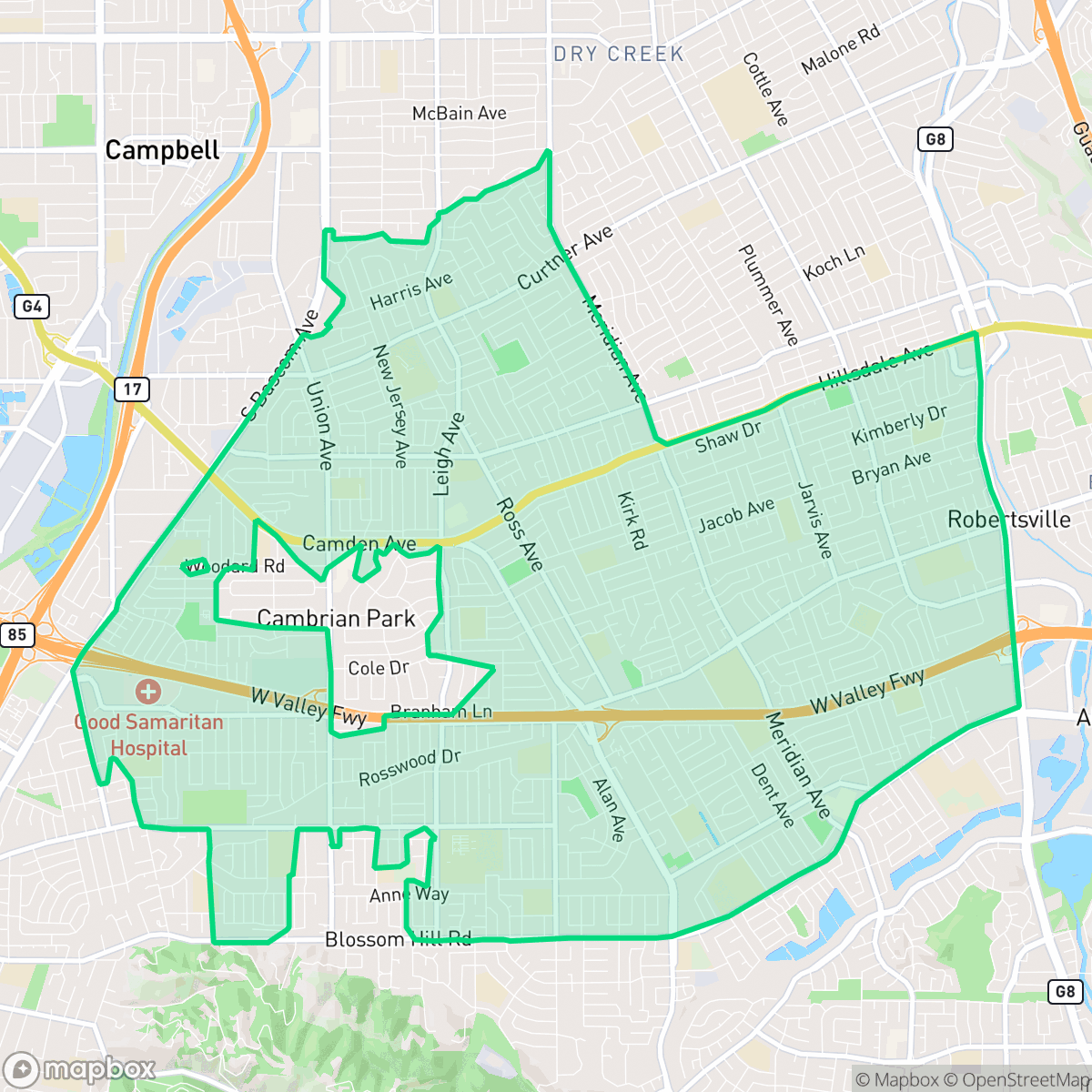
Cambrian Park is an established suburban community known for its high walkability and strong educational infrastructure, anchored by top-rated schools like Branham High and Steindorf STEAM Magnet. The neighborhood features a mix of mid-century tract housing and affluent properties with private pools, offering a quiet residential environment despite its proximity to major transit arteries.
Key Highlights
About Cambrian Park
The Cambrian Park neighborhood in San Jose originated from 19th-century Mexican land grants and mission lands, later transitioning into a productive agricultural area known for fruit orchards. Its name derives from the local Cambrian School District, established in the 1870s and named by ranch hand David Lewis for his Welsh birthplace, Cambria. The area remained largely rural until the post-WWII housing boom, when it was annexed by San Jose and transformed into a suburban community. A central landmark is the Cambrian Park Plaza, a shopping center built in 1953 that serves as the neighborhood's commercial core; its iconic carousel-themed sign is a designated historical landmark. The neighborhood also features the 1910 We and Our Neighbors Clubhouse, which is listed on the National Register of Historic Places.
The area is defined by a dense suburban layout that balances residential comfort with accessibility. It is a highly walkable neighborhood with a comprehensive sidewalk network and clear pedestrian paths, making it easy to navigate on foot. The landscape is characterized by well-maintained single-family homes, many featuring private backyard pools and multi-car driveways, which contribute to a consistent visual appeal. Residents benefit from excellent air quality and a lack of industrial hazards, as the land use is primarily residential and institutional.
While the neighborhood offers a serene atmosphere, it is primarily a car-dependent environment for daily errands, as local commercial options are limited. Noise levels are influenced by nearby highway traffic, which is a consideration for those sensitive to sound. Families are particularly drawn to the area due to the high-performing school districts, which provide consistent academic excellence. According to iHuus data, the area maintains a high level of health insurance coverage, reflecting a stable and established demographic suited for those seeking a quiet, school-focused lifestyle.
Neighborhood Scores Across 15 Qualities
Typical suburban spacing provides a reasonable buffer between neighbors, with many detached homes featuring private fenced yards. This level of separation is slightly higher than the San Jose average.
Continuous sidewalks on both sides of most streets and clear pedestrian crossings at major intersections facilitate easy movement throughout the neighborhood. This well-defined network is slightly above the San Jose average and provides reliable access to local shopping centers and parks.
Large, well-maintained homes with frequent backyard pools and manicured landscaping create a high level of visual appeal that sits above the San Jose average. Many properties feature substantial multi-car driveways and high-quality private yards, according to iHuus data.
Abundant greenbelts, public parks, and wide residential sidewalks provide ample space for pets. According to iHuus data, these walking options are roughly in line with the city average.
This area features a consistent suburban landscape of single-family homes and organized street patterns. The level of development and density is typical for San Jose.
A balanced mix of residential streets and local dining provides a steady rhythm of activity that is slightly more lively than the San Jose average. While some areas offer walkable access to various cafes and eateries, many parts of the neighborhood remain car-oriented with limited commercial density.
Local traffic from nearby busy streets creates a consistent background noise. This level of acoustic activity is slightly higher than the average found across San Jose.
Air quality is consistently good with rare instances of elevated readings. This level of cleanliness is notably higher than the San Jose average, according to iHuus data.
Industrial hazards and large warehouses are absent from the area, which consists primarily of residential, institutional, and light commercial land. This lack of heavy industry provides a cleaner environment than the San Jose average.
Health insurance accessibility is notably higher than the San Jose average, according to iHuus data. Residents in this area benefit from a higher rate of coverage compared to the rest of the city.
Voting patterns and census indicators reflect a deeply liberal political leaning, which is largely consistent with the broader San Jose area.
Residents live alongside a diverse range of generations, from young adults to older populations. This demographic spread is consistent with the broader San Jose area according to iHuus data.
Flood risk in this area is notably higher than the San Jose average. Residents should anticipate elevated or potentially prohibitive flood insurance costs due to the localized hazard level.
Fire safety protections and infrastructure in this area are notably lower than the San Jose average, according to iHuus data.
Address-Level Insights for Cambrian Park


iHuus Neighborhood Intelligence Insights
Get address-level neighborhood insights for Cambrian Park
- Street-level scores — see how individual blocks compare, not just neighborhood averages
- Micro-zone boundaries — identify quiet pockets, flood boundaries, and walkable clusters before you visit
- 15 dimensions in full — walkability, noise, air quality, school quality, insurance coverage, population age profile, urban/rural index, and more
- Boundary risk alerts — know if your address sits near a block boundary where scores drop, the kind of detail no listing will ever mention
- School insights — individual school ratings and insights, not just district-level data
- Compare before you commit — side-by-side data across neighborhoods, down to block precision
No credit card required
Compare with Any Neighborhood
| Dimension | Cambrian Park | Almaden Valley |
|---|---|---|
| 🚶 Walkabilityavg 9.17 | ||
| 🔊 Acoustic Comfortavg 3.12 | ||
| 🤫 Privacy Indexavg 4.96 | ||
| 🎨 Visual Appealavg 6.7 | ||
| 🐕 Dog Friendlinessavg 6.94 | ||
| 🗺️ Urban-Rural Indexavg 6.64 | ||
| ✨ Neighborhood Vibeavg 4.74 | ||
| 🏥 Health Insurance Coverageavg 8.07 | ||
| 🌿 Air Qualityavg 6.07 | ||
| 🏭 Industrial Proximityavg 8.85 | ||
| 🌊 Flood Safetyavg 1.56 | ||
| 🗳️ Ideological Leanavg 9.4 | ||
| 👥 Population Age Profileavg 4.88 | ||
| 🔥 Fire Safetyavg 0.17 | ||
| 🏫 School Quality |
Cambrian Park Rankings
School Districts Serving Cambrian Park
School Insights for Cambrian Park
Below average outcomes; significant attendance and academic challenges.
School Insights
See what's really behind every school rating near Cambrian Park
- Individual school ratings — each school's own score with outcome context, not just a district average
- Enrollment & class size data — student-to-teacher ratio and how it compares to the state average
- Full demographics breakdown — ethnicity and gender composition for every school in the enrollment zone
- Every school in the district — all schools within the enrollment boundary ranked by rating, not just the closest one
- Grade levels & benchmarks — elementary through high school, with below/above state-average flags
No credit card required