Almaden Valley, San Jose
Updated · 47,256 residents
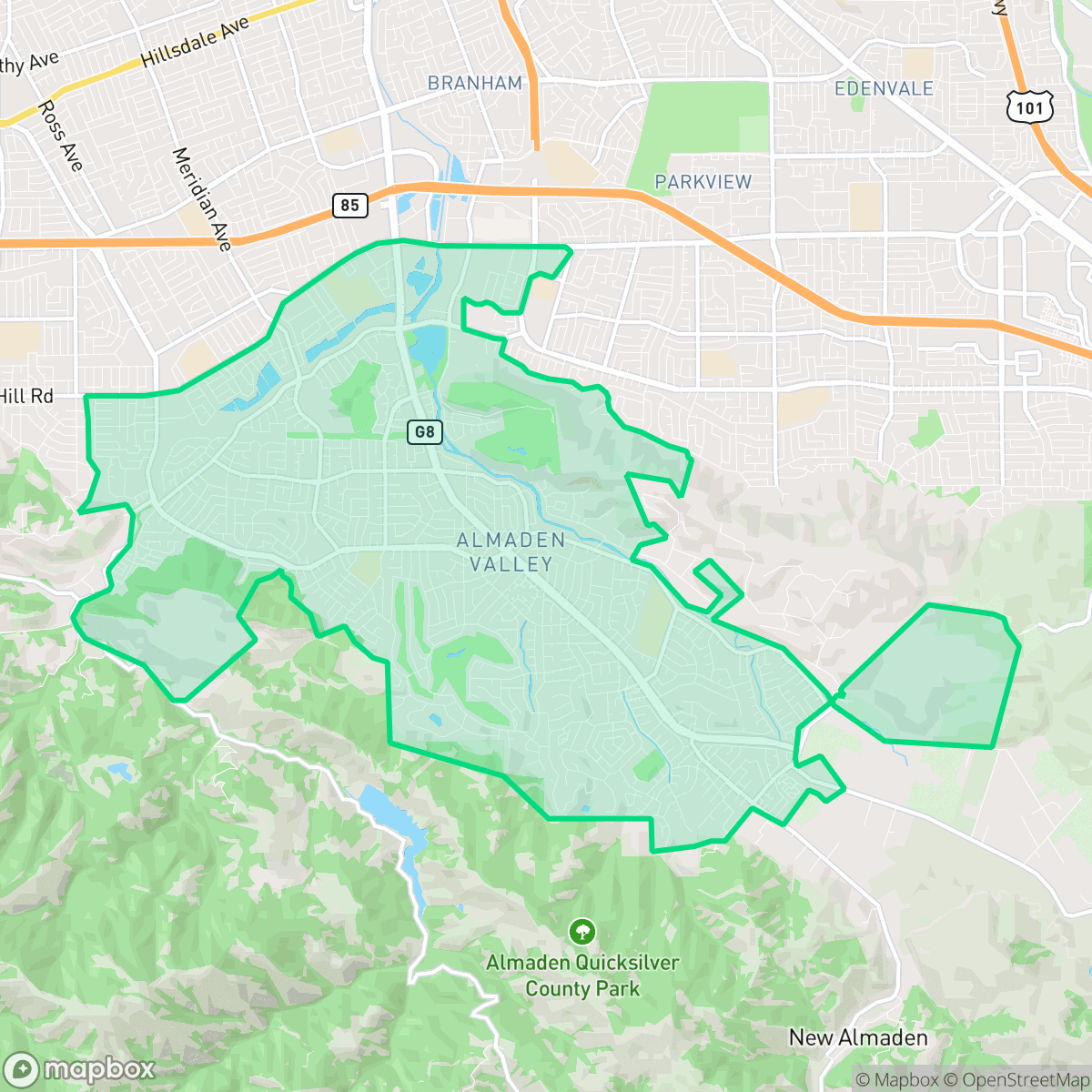
Almaden Valley is a quiet, affluent residential community in South San Jose defined by its expansive greenbelts and proximity to the Santa Cruz Mountains. The neighborhood features a highly walkable network of sidewalks and top-rated schools, offering a serene environment for families despite limited local commercial activity.
Key Highlights
About Almaden Valley
Almaden Valley, situated in South San Jose between the Santa Cruz Mountains and Santa Teresa Hills, is defined by its deep roots in the mercury mining industry. Originally inhabited by the Tamien Ohlone people who utilized local cinnabar for pigment, the area became home to the New Almaden mines in the 1840s, which were among the most productive in the nation and vital to the California Gold Rush. The neighborhood retains a distinct historical identity through the New Almaden National Historic District, featuring landmarks like the 1854 Casa Grande. The landscape, once characterized by mining enclaves like Spanishtown and Englishtown, has transformed into a residential community anchored by the Almaden Quicksilver County Park. Additionally, the area historically hosted California's first commercial winery, established by Charles LeFranc in 1852, and provided stone for iconic Bay Area structures from its Graystone Quarry.
This neighborhood is characterized by its spacious, well-manicured suburban layout, where large homes with private pools and mature landscaping are the standard. Residents benefit from a robust educational environment, with several highly rated schools such as Leland High and Graystone Elementary anchoring the community. The area maintains a high visual appeal and provides excellent access to outdoor recreation, including local greenbelts and the nearby Almaden Quicksilver County Park, which offers extensive trails for hiking and dog walking. According to iHuus data, the community is strictly residential and institutional, creating a peaceful atmosphere free from heavy industrial hazards.
Living in this area involves certain trade-offs, particularly regarding daily convenience and nightlife. With a low liveliness score, the neighborhood lacks a dense concentration of restaurants and entertainment venues, meaning residents typically rely on personal vehicles to reach major shopping hubs. While the sidewalk network is exceptionally comprehensive, the overall pace of life is slow and quiet. Prospective residents should also be aware of the environmental context, as the area sits at the intersection of suburban development and open space, which necessitates awareness of regional fire safety considerations. Overall, it remains a destination for those prioritizing school quality and a serene, family-oriented lifestyle over urban density.
Neighborhood Scores Across 15 Qualities
Suburban lot spacing and fenced backyards provide a level of seclusion that is higher than the San Jose average. While some areas feature closely spaced homes, most residents benefit from consistent buffers between properties.
Continuous sidewalks and well-marked crosswalks facilitate easy movement throughout residential streets and near local shopping centers. This level of pedestrian infrastructure is nearly identical to the San Jose average.
Large, well-maintained homes with manicured landscaping and frequent private backyard pools characterize the area. According to iHuus data, the visual quality of the neighborhood is notably higher than the San Jose average.
Abundant greenbelts, large school sports fields, and continuous grassy verges provide ample space for pets. This level of access to trails and parkland is notably higher than the San Jose average, according to iHuus data.
Residential areas often blend into vast open grasslands, hills, and woodlands, providing more undeveloped green space than the San Jose average. According to iHuus data, the landscape features a mix of dense suburban clusters and low-density estate properties near significant natural buffers.
Residential life here is primarily defined by a serene, low-density atmosphere with significant green space and far fewer commercial hubs than the San Jose average. While some social spots and dining options are reachable via walkable paths near Almaden Lake, most daily errands require a car due to the limited density of local businesses.
Steady sounds from nearby busy streets are present, though levels remain more tranquil than the San Jose average. According to iHuus data, residents may experience a consistent hum from local transit corridors.
Air quality remains mostly clean with only rare instances of elevated readings, performing slightly better than the San Jose average according to iHuus data.
Industrial activity is virtually non-existent here, providing a landscape free from warehouses or heavy manufacturing hazards. This area maintains a much cleaner profile regarding industrial proximity than the San Jose average.
Health insurance enrollment is exceptionally high in this area, notably surpassing the San Jose average according to iHuus data.
Voting patterns and census indicators reflect a strong liberal leaning, though this is slightly less pronounced than the average seen across San Jose.
A diverse range of age groups resides here, including young adults, families, and older residents. This demographic spread is slightly more varied than the San Jose average, according to iHuus data.
Flood risk in this area is notably higher than the San Jose average. Residents should anticipate potential for elevated or prohibitive insurance costs due to the presence of high-hazard zones.
Wildfire risk is exceptionally high in this area, representing a significantly greater danger than the San Jose average. Residents should be prepared for rigorous fire prevention measures and emergency preparedness protocols.
Address-Level Insights for Almaden Valley


iHuus Neighborhood Intelligence Insights
Get address-level neighborhood insights for Almaden Valley
- Street-level scores — see how individual blocks compare, not just neighborhood averages
- Micro-zone boundaries — identify quiet pockets, flood boundaries, and walkable clusters before you visit
- 15 dimensions in full — walkability, noise, air quality, school quality, insurance coverage, population age profile, urban/rural index, and more
- Boundary risk alerts — know if your address sits near a block boundary where scores drop, the kind of detail no listing will ever mention
- School insights — individual school ratings and insights, not just district-level data
- Compare before you commit — side-by-side data across neighborhoods, down to block precision
No credit card required
Compare with Any Neighborhood
| Dimension | Almaden Valley | Alum Rock-East Foothills |
|---|---|---|
| 🚶 Walkabilityavg 9.17 | ||
| 🔊 Acoustic Comfortavg 3.12 | ||
| 🤫 Privacy Indexavg 4.96 | ||
| 🎨 Visual Appealavg 6.7 | ||
| 🐕 Dog Friendlinessavg 6.94 | ||
| 🗺️ Urban-Rural Indexavg 6.64 | ||
| ✨ Neighborhood Vibeavg 4.74 | ||
| 🏥 Health Insurance Coverageavg 8.07 | ||
| 🌿 Air Qualityavg 6.07 | ||
| 🏭 Industrial Proximityavg 8.85 | ||
| 🌊 Flood Safetyavg 1.56 | ||
| 🗳️ Ideological Leanavg 9.4 | ||
| 👥 Population Age Profileavg 4.88 | ||
| 🔥 Fire Safetyavg 0.17 | ||
| 🏫 School Quality |
Almaden Valley Rankings
School Districts Serving Almaden Valley
School Insights for Almaden Valley
Below average outcomes; significant attendance and academic challenges.
School Insights
See what's really behind every school rating near Almaden Valley
- Individual school ratings — each school's own score with outcome context, not just a district average
- Enrollment & class size data — student-to-teacher ratio and how it compares to the state average
- Full demographics breakdown — ethnicity and gender composition for every school in the enrollment zone
- Every school in the district — all schools within the enrollment boundary ranked by rating, not just the closest one
- Grade levels & benchmarks — elementary through high school, with below/above state-average flags
No credit card required