Valencia Park, San Diego
Updated · 11,932 residents
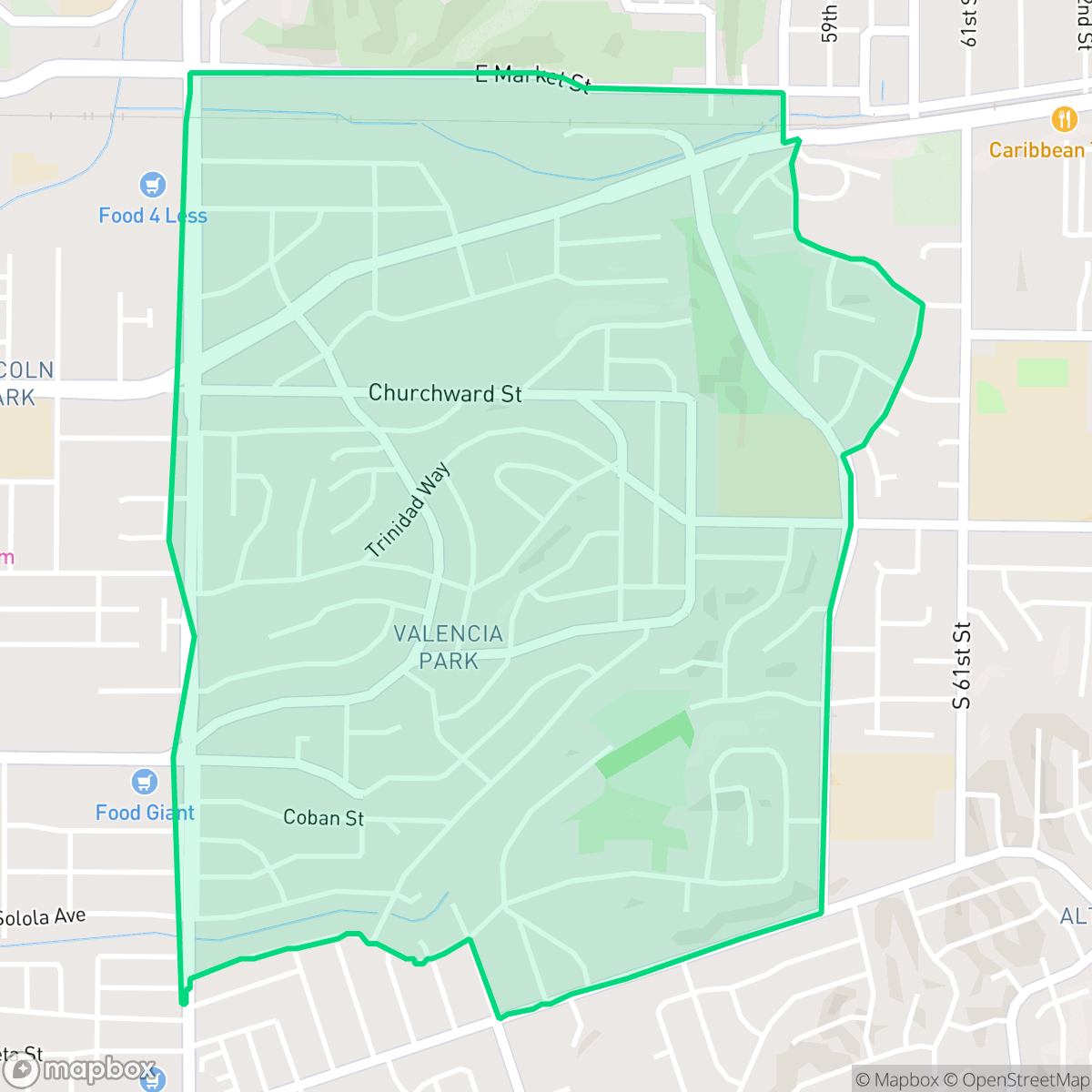
Valencia Park is a culturally rich neighborhood in southeastern San Diego, defined by its rolling hills and the community-focused Malcolm X Library. The area offers a quiet, dense suburban environment with consistent sidewalk access, though residents should expect moderate noise levels from nearby road traffic.
Key Highlights
About Valencia Park
Valencia Park, an urban neighborhood in southeastern San Diego, developed significantly through the efforts of Astor Basmajian, an Armenian immigrant and jeweler who built the Astor Heights subdivision and donated land for Valencia Park Elementary School. During the 1950s and 1960s, the neighborhood became a key destination for African American families seeking homeownership. From the Vietnam War era through the 1990s, Valencia Park also welcomed a large influx of Filipino immigrants, many of whom served in the U.S. Navy and settled there due to its proximity to Naval Base San Diego. Today, the neighborhood's cultural identity is anchored by the 26,000-square-foot Malcolm X Library, which serves as a major community and performing arts hub, and Chollas Creek, which winds through the area's rolling hills.
This neighborhood serves as a residential hub characterized by a standard suburban grid and consistent pedestrian infrastructure. The landscape is marked by Chollas Creek, which provides natural green space, and the presence of the Malcolm X Library, which acts as a central gathering point for local performing arts and community engagement. The housing stock consists primarily of traditional tract homes, creating a uniform residential fabric that blends into the surrounding southeastern San Diego landscape. According to data, the area maintains a stable urban-rural balance with a focus on residential and educational use.
Prospective residents will find a community that prioritizes accessibility and suburban calm, though it is important to consider the trade-offs regarding acoustic comfort due to local road traffic. While the area provides reliable sidewalk access for pedestrians, the local school district currently faces academic challenges and leadership transitions. The neighborhood is well-suited for those seeking a stable, established residential setting with strong community roots, provided they are prepared for the realities of living in a high-density suburban environment.
Neighborhood Scores Across 15 Qualities
Residential spacing varies between closely packed clusters and more open lots near canyon edges. This level of privacy is slightly lower than the San Diego average due to several high-density pockets where homes are situated near one another.
Sidewalks and safe crossings are available along most streets, though canyon topography and highway barriers can limit connectivity compared to the city average. Pedestrian access is generally reliable within residential blocks and along main arterials according to iHuus data.
Uniform rooflines and small yards characterize this area, which offers less visual variety than the San Diego average. Most residences consist of modest tract housing and multi-family units with limited private luxury amenities.
Extensive canyon trails and large public parks provide ample exercise space for pets. According to iHuus data, the availability of connected green spaces and wide paths is slightly below the city average.
Residential blocks feature a mix of single-family homes, apartment complexes, and large open spaces. This landscape is typical of the wider city average, providing a balance of developed housing and nearby natural areas.
Suburban streets and green spaces create a serene environment that is slightly more subdued than the San Diego average. While local churches and select eateries are accessible, the area lacks dense commercial activity, offering a much calmer pace of life.
Steady sounds from nearby busy streets are present, though levels remain more tranquil than the city average according to iHuus data.
Air quality in this area fluctuates between acceptable and unhealthy levels on certain days. According to iHuus data, the air quality is slightly lower than the San Diego city average, which may cause occasional concern for sensitive groups.
Residential and recreational uses dominate the area, providing a landscape largely free of heavy industrial hazards. While a few large warehouses and truck loading docks are present along the southern edge, the neighborhood remains very similar to the city average for industrial proximity.
Health insurance access among residents is notably lower than the San Diego average. According to iHuus data, a minority of the population holds coverage, which may impact local healthcare accessibility and planning.
Voting patterns and census indicators reflect a predominantly liberal leaning, which is more pronounced here than the San Diego city average.
Residents live alongside a balanced mix of young adults, families, and older populations. According to iHuus data, this demographic distribution is consistent with the city average.
Flood risk levels in this area remain uncertain because FEMA has not yet completed a detailed study for this specific location. According to iHuus data, the risk level is slightly lower than the average seen throughout San Diego.
Address-Level Insights for Valencia Park


iHuus Neighborhood Intelligence Insights
Get address-level neighborhood insights for Valencia Park
- Street-level scores — see how individual blocks compare, not just neighborhood averages
- Micro-zone boundaries — identify quiet pockets, flood boundaries, and walkable clusters before you visit
- 15 dimensions in full — walkability, noise, air quality, school quality, insurance coverage, population age profile, urban/rural index, and more
- Boundary risk alerts — know if your address sits near a block boundary where scores drop, the kind of detail no listing will ever mention
- School insights — individual school ratings and insights, not just district-level data
- Compare before you commit — side-by-side data across neighborhoods, down to block precision
No credit card required
Compare with Any Neighborhood
| Dimension | Valencia Park | Adams North |
|---|---|---|
| 🚶 Walkabilityavg 8.58 | ||
| 🔊 Acoustic Comfortavg 3.33 | ||
| 🤫 Privacy Indexavg 4.87 | ||
| 🎨 Visual Appealavg 6.85 | ||
| 🐕 Dog Friendlinessavg 6.91 | ||
| 🗺️ Urban-Rural Indexavg 6.6 | ||
| ✨ Neighborhood Vibeavg 5.12 | ||
| 🏥 Health Insurance Coverageavg 7.53 | ||
| 🌿 Air Qualityavg 6.36 | ||
| 🏭 Industrial Proximityavg 9.12 | ||
| 🌊 Flood Safetyavg 4.2 | ||
| 🗳️ Ideological Leanavg 8.51 | ||
| 👥 Population Age Profileavg 4.8 | ||
| 🔥 Fire Safetyavg 0.61 | ||
| 🏫 School Quality |
Valencia Park Rankings
School Districts Serving Valencia Park
School Insights for Valencia Park
Below average outcomes; significant attendance and academic challenges.
School Insights
See what's really behind every school rating near Valencia Park
- Individual school ratings — each school's own score with outcome context, not just a district average
- Enrollment & class size data — student-to-teacher ratio and how it compares to the state average
- Full demographics breakdown — ethnicity and gender composition for every school in the enrollment zone
- Every school in the district — all schools within the enrollment boundary ranked by rating, not just the closest one
- Grade levels & benchmarks — elementary through high school, with below/above state-average flags
No credit card required