University Heights, San Diego
Updated · 13,692 residents
University Heights is a dense, urban neighborhood defined by its historic streetcar roots and a grid-based layout that offers high walkability for residents. While the area provides a vibrant mix of local dining and community spaces, it is characterized by tightly packed housing, limited privacy, and noticeable noise from nearby road traffic.
Key Highlights
About University Heights
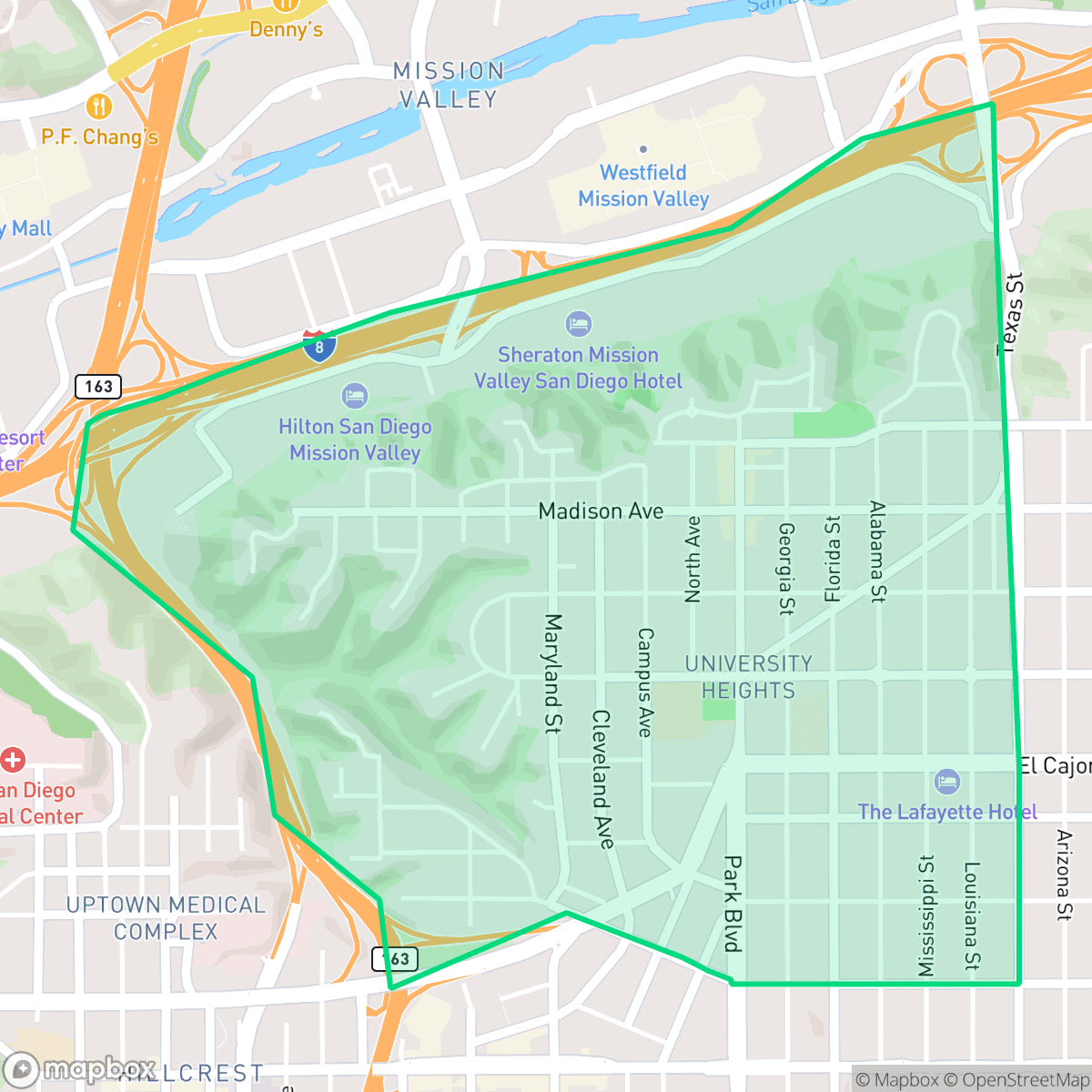
Subdivided in 1887 by the College Hill Land Association, University Heights in San Diego was named for a planned branch of the University of Southern California. While that plan fell through, the site hosted the 1898 State Normal School—predecessor to San Diego State University—of which only the 1910 Italian Renaissance Revival Teachers Training Annex remains. In the early 20th century, the neighborhood became a major streetcar hub. John D. Spreckels developed the popular Mission Cliff Gardens here in 1898, leaving behind historic cobblestone walls. Nearby, the 1904 Harvey Bentley Ostrich Farm and a 1913 trolley car barn once drew crowds. Today, the former car barn is the beloved Trolley Barn Park, and the neighborhood's history is celebrated by its iconic street sign, supported by stone pillars topped with golden ostrich statues.
The neighborhood functions as a dense, low-rise urban environment that blends single-family homes with multi-unit apartments. It features active commercial nodes, including local eateries and community landmarks like the Dharma Bum Temple. According to iHuus data, the area maintains high levels of health insurance coverage and a strong sense of community, which is reflected in its active dining scene and accessible local parks. The layout prioritizes a consistent grid with sidewalks on both sides of most streets, supporting a lifestyle that values neighborhood connectivity over sprawling private space.
Living in this area involves specific trade-offs, particularly regarding acoustic comfort and privacy. Due to the high-density residential structure, homes are often situated within meters of one another, and road traffic contributes to a noticeable ambient noise level. The neighborhood is best suited for individuals who prioritize walkability and proximity to urban amenities over quiet, expansive living. While residents should be aware of fire safety considerations, the area benefits from excellent flood safety and a stable, engaged population.
Neighborhood Scores Across 15 Qualities
Residential structures and multi-family units are often closely packed with minimal setbacks or shared walls. This density results in less personal separation between buildings than is typical for San Diego.
A complete grid of sidewalks and frequent crosswalks makes navigating the area on foot easy. This level of connectivity is even higher than the San Diego average, though some residential hills present slightly more difficulty for pedestrians than the flatter sections of the neighborhood.
Residential scenery consists mostly of multi-family housing and compact bungalows with minimal private yard space. This visual profile is slightly below the San Diego average for landscape variety.
Access to large public parks and green trails is below the city average, though some residential areas benefit from nearby canyon trails and wooded riparian corridors. Many parts of the neighborhood consist of a dense urban grid with narrow sidewalk verges and minimal public green space, according to iHuus data.
A blend of low-rise apartment blocks and single-family homes provides a mix of street density and greenery. This area feels less urbanized than much of San Diego, offering more open space relative to the city average.
Social and local hubs are notably more concentrated here than in the rest of San Diego. Residents can access a diverse range of dining and community spots, though some areas remain car-dependent due to the suburban layout near major highways.
Frequent noise from nearby freeways and railroad tracks characterizes this area. According to iHuus data, acoustic comfort levels are slightly below the San Diego average.
Air quality fluctuates between acceptable and unhealthy levels, presenting occasional concerns for sensitive groups. According to iHuus data, conditions here are slightly lower than the San Diego city average.
Residential and light commercial uses dominate the area, with no heavy warehouses or industrial facilities detected. This absence of industrial zoning makes the neighborhood slightly cleaner of heavy-duty transit hazards than the San Diego average, according to iHuus data.
Health insurance enrollment among residents is significantly higher than the San Diego average, according to iHuus data. This indicates a high level of access to medical coverage within the community.
Voting patterns and census indicators show a very high concentration of liberal-leaning residents, which is notably more pronounced than the San Diego average according to iHuus data.
A balanced mix of young adults, families, and older residents characterizes the area. According to iHuus data, this demographic spread is slightly more varied than the San Diego city average.
Properties within this area are located inside a designated floodplain, which represents a higher risk than the San Diego average. Residents should prepare for potential drainage issues and may find that flood insurance is a standard requirement for their policies.
Fire hazards in this area are notably higher than the San Diego average. Residents should be aware of significant fire risks and the necessity for enhanced mitigation measures, according to iHuus data.
Address-Level Insights for University Heights


iHuus Neighborhood Intelligence Insights
Get address-level neighborhood insights for University Heights
- Street-level scores — see how individual blocks compare, not just neighborhood averages
- Micro-zone boundaries — identify quiet pockets, flood boundaries, and walkable clusters before you visit
- 15 dimensions in full — walkability, noise, air quality, school quality, insurance coverage, population age profile, urban/rural index, and more
- Boundary risk alerts — know if your address sits near a block boundary where scores drop, the kind of detail no listing will ever mention
- School insights — individual school ratings and insights, not just district-level data
- Compare before you commit — side-by-side data across neighborhoods, down to block precision
No credit card required
Compare with Any Neighborhood
| Dimension | University Heights | Adams North |
|---|---|---|
| 🚶 Walkabilityavg 8.58 | ||
| 🔊 Acoustic Comfortavg 3.33 | ||
| 🤫 Privacy Indexavg 4.87 | ||
| 🎨 Visual Appealavg 6.85 | ||
| 🐕 Dog Friendlinessavg 6.91 | ||
| 🗺️ Urban-Rural Indexavg 6.6 | ||
| ✨ Neighborhood Vibeavg 5.12 | ||
| 🏥 Health Insurance Coverageavg 7.53 | ||
| 🌿 Air Qualityavg 6.36 | ||
| 🏭 Industrial Proximityavg 9.12 | ||
| 🌊 Flood Safetyavg 4.2 | ||
| 🗳️ Ideological Leanavg 8.51 | ||
| 👥 Population Age Profileavg 4.8 | ||
| 🔥 Fire Safetyavg 0.61 | ||
| 🏫 School Quality |
University Heights Rankings
School Districts Serving University Heights
School Insights for University Heights
Below average outcomes; significant attendance and academic challenges.
School Insights
See what's really behind every school rating near University Heights
- Individual school ratings — each school's own score with outcome context, not just a district average
- Enrollment & class size data — student-to-teacher ratio and how it compares to the state average
- Full demographics breakdown — ethnicity and gender composition for every school in the enrollment zone
- Every school in the district — all schools within the enrollment boundary ranked by rating, not just the closest one
- Grade levels & benchmarks — elementary through high school, with below/above state-average flags
No credit card required