University City, San Diego
Updated · 49,385 residents
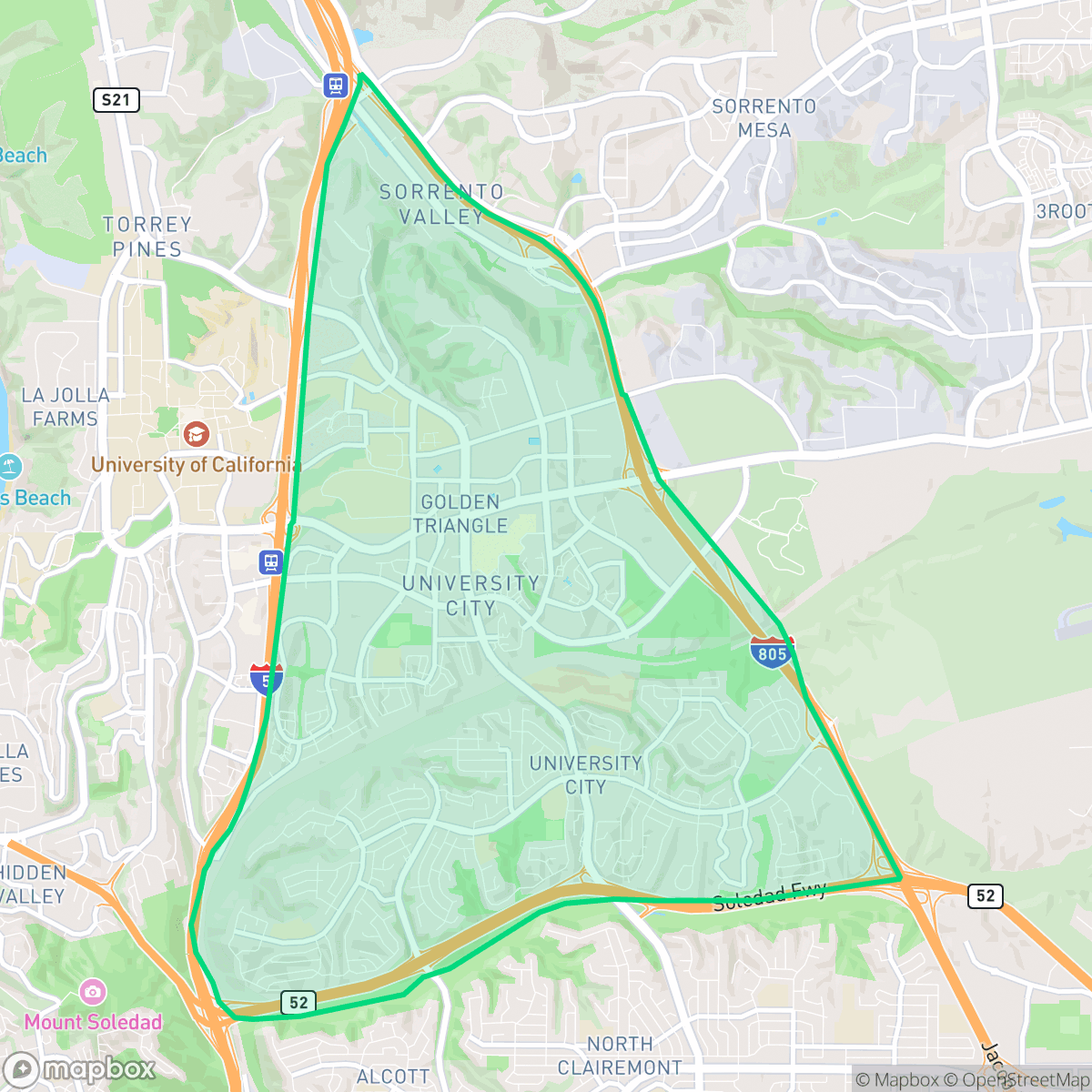
University City is a highly walkable San Diego community defined by a contrast between its quiet, mid-century residential southern core and the high-density, tech-focused Golden Triangle in the north. Residents benefit from extensive pedestrian infrastructure and proximity to canyon trails, though the area experiences notable noise levels from regional road traffic.
Key Highlights
About University City
Originally a Kumeyaay trade route and later the site of the military's Camp Calvin B. Matthews, San Diego's University City was established in 1960. Master-planned by developers Carlos Tavares, Irvin Kahn, and others on 2,500 acres of former ranch land, the neighborhood was envisioned as a diverse residential haven for the nearby University of California, San Diego. Today, the community is bisected by Rose Canyon Open Space Park, named after 19th-century pioneer Louis Rose. South of the canyon, the neighborhood retains a quiet, mid-century suburban character centered around Governor Drive. To the north, the high-density "Golden Triangle" has evolved into a major commercial, tech, and biotech hub, anchored by the Westfield UTC open-air mall and defined by the soaring spires of the San Diego California Temple, completed in 1993.
The area functions as a central hub for academic and professional activity, anchored by its proximity to major research institutions and local biotech campuses. The built environment is diverse, ranging from detached single-family homes with modest yards in the southern sectors to high-density apartment complexes and corporate office parks in the north. According to iHuus data, the neighborhood maintains a strong walkability profile, supported by a continuous network of sidewalks and pedestrian-friendly paths that connect residential zones to local commercial centers.
Prospective residents should note that the neighborhood presents specific trade-offs regarding acoustic comfort, as the prevalence of nearby highway infrastructure contributes to elevated noise levels. While the community offers exceptional access to green spaces and dog-friendly trails, the density of the northern sector means that privacy can be limited in some multi-family developments. It is well-suited for professionals and families who prioritize educational access and a central location, provided they are comfortable with the acoustic realities of a bustling, integrated urban environment.
Neighborhood Scores Across 15 Qualities
Housing density varies between closely spaced multi-family units and detached homes with moderate buffers. According to iHuus data, the level of separation between neighbors is roughly average for the city of San Diego.
Extensive sidewalk networks and pedestrian-priority crossings make navigating the area easy on foot. This connectivity is slightly above the San Diego average, particularly within the campus and residential sectors.
Manicured landscapes and large homes with private pools characterize affluent residential clusters, though some areas consist of standard high-density apartment complexes. This mix of high-quality amenities and residential density provides a visual appeal that is slightly above the San Diego average.
Extensive canyon trails and interconnected green spaces provide much more room for pet walking than the San Diego average. According to iHuus data, the presence of large public parks and natural buffers ensures plenty of safe, off-street areas for exercise.
A mix of dense apartment complexes and commercial centers is balanced by significant undeveloped canyon land and natural scrubland. This landscape offers more open space and natural scenery than the typical San Diego urban environment.
Mixed pockets of lively dining and social spots exist alongside much quieter, low-density suburban blocks. This energy level is consistent with the city average, offering a blend of active commercial nodes and serene, green residential spaces.
Frequent noise from nearby freeway and railroad corridors creates a level of acoustic disturbance that is higher than the San Diego average. Residents should expect consistent ambient sound from heavy transit infrastructure, according to iHuus data.
Air quality in this area fluctuates between acceptable and unhealthy levels, which may cause occasional concern for sensitive groups. This level of air quality is slightly lower than the San Diego city average, according to iHuus data.
Residential and educational zones dominate the area with a notable absence of heavy manufacturing or industrial hazards. According to iHuus data, this neighborhood is even more free of industrial proximity than the San Diego average.
Health insurance access among residents is notably higher than the San Diego average, according to iHuus data.
Voting patterns and census indicators reflect a predominantly liberal leaning that is more pronounced than the San Diego average, according to iHuus data.
Residents live alongside a balanced blend of students, families, and older adults. According to iHuus data, this demographic variety is slightly lower than the San Diego average.
Flood risk in this area is higher than the San Diego average, though detailed FEMA studies for this specific zone are currently incomplete. Residents should remain aware of potential vulnerabilities during heavy rain events according to iHuus data.
Fire hazard levels in this area are significantly higher than the San Diego average. Residents should be aware of increased mitigation needs, according to iHuus data.
Address-Level Insights for University City


iHuus Neighborhood Intelligence Insights
Get address-level neighborhood insights for University City
- Street-level scores — see how individual blocks compare, not just neighborhood averages
- Micro-zone boundaries — identify quiet pockets, flood boundaries, and walkable clusters before you visit
- 15 dimensions in full — walkability, noise, air quality, school quality, insurance coverage, population age profile, urban/rural index, and more
- Boundary risk alerts — know if your address sits near a block boundary where scores drop, the kind of detail no listing will ever mention
- School insights — individual school ratings and insights, not just district-level data
- Compare before you commit — side-by-side data across neighborhoods, down to block precision
No credit card required
Compare with Any Neighborhood
| Dimension | University City | Adams North |
|---|---|---|
| 🚶 Walkabilityavg 8.58 | ||
| 🔊 Acoustic Comfortavg 3.33 | ||
| 🤫 Privacy Indexavg 4.87 | ||
| 🎨 Visual Appealavg 6.85 | ||
| 🐕 Dog Friendlinessavg 6.91 | ||
| 🗺️ Urban-Rural Indexavg 6.6 | ||
| ✨ Neighborhood Vibeavg 5.12 | ||
| 🏥 Health Insurance Coverageavg 7.53 | ||
| 🌿 Air Qualityavg 6.36 | ||
| 🏭 Industrial Proximityavg 9.12 | ||
| 🌊 Flood Safetyavg 4.2 | ||
| 🗳️ Ideological Leanavg 8.51 | ||
| 👥 Population Age Profileavg 4.8 | ||
| 🔥 Fire Safetyavg 0.61 | ||
| 🏫 School Quality |
University City Rankings
School Districts Serving University City
School Insights for University City
Below average outcomes; significant attendance and academic challenges.
School Insights
See what's really behind every school rating near University City
- Individual school ratings — each school's own score with outcome context, not just a district average
- Enrollment & class size data — student-to-teacher ratio and how it compares to the state average
- Full demographics breakdown — ethnicity and gender composition for every school in the enrollment zone
- Every school in the district — all schools within the enrollment boundary ranked by rating, not just the closest one
- Grade levels & benchmarks — elementary through high school, with below/above state-average flags
No credit card required