Torrey Pines, San Diego
Updated · 7,325 residents
Torrey Pines is a distinctive San Diego neighborhood defined by its proximity to the University of California San Diego and the iconic state natural reserve. While residents enjoy excellent access to green belts and dog-friendly canyons, the area experiences notable noise from nearby road traffic and features higher-density residential clusters.
Key Highlights
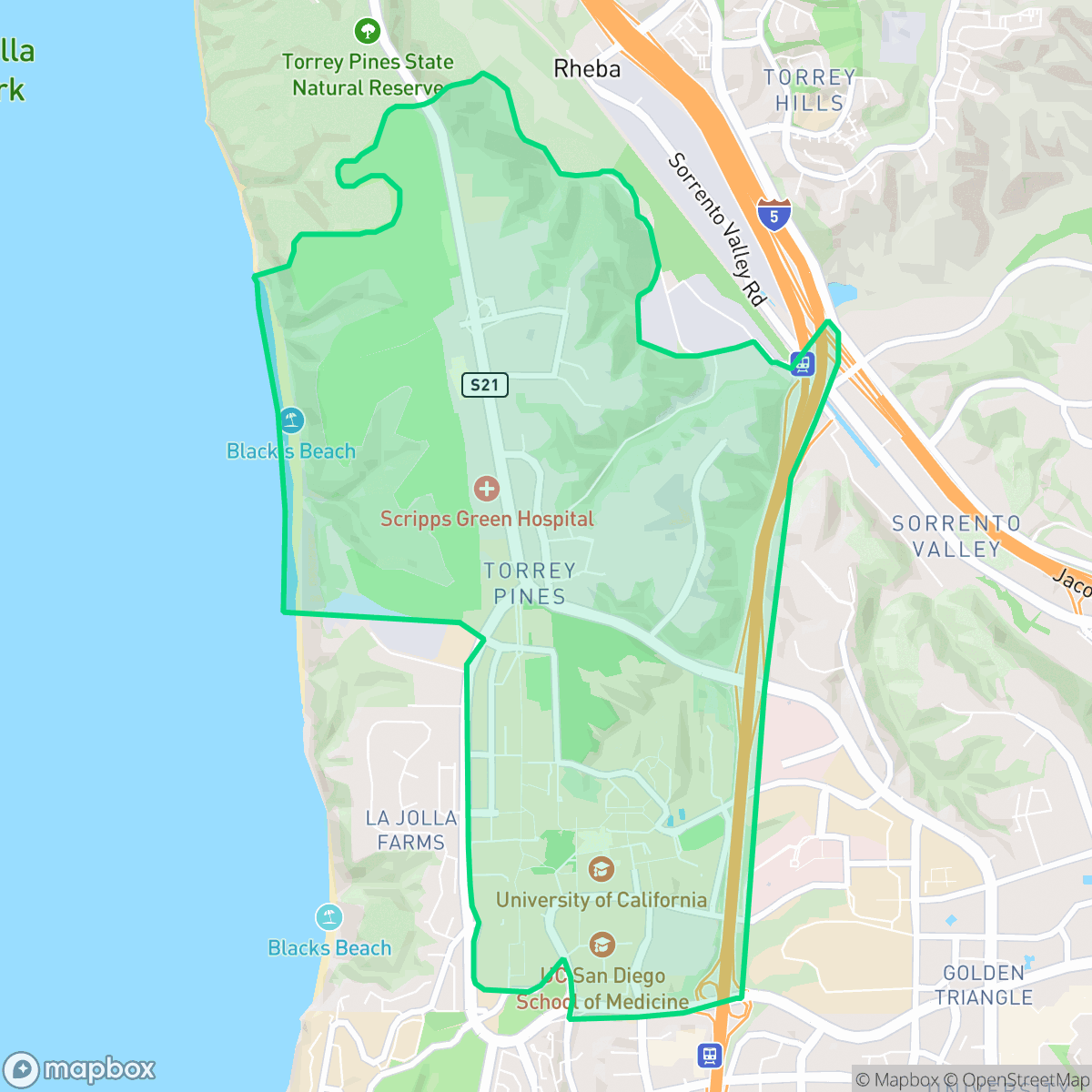
About Torrey Pines
Long home to the Kumeyaay people, the coastal Torrey Pines neighborhood of San Diego was dubbed Punto de Los Arboles ("Point of Trees") by Spanish explorers who used its unique pine groves as a maritime landmark. In 1850, botanist Charles C. Parry identified the rare Pinus torreyana here, naming it after his mentor John Torrey. To protect the species, the city set aside parkland in 1899. In the 1920s, philanthropist Ellen Browning Scripps and naturalist Guy Fleming spearheaded further preservation, funding the Hopi-style Torrey Pines Lodge designed by Richard S. Requa and Herbert Jackson. Today, the neighborhood is defined by the 2,000-acre Torrey Pines State Natural Reserve and the world-renowned Torrey Pines Golf Course, a multi-time host of the U.S. Open.
The neighborhood functions as an urban-fringe academic and residential hub, characterized by a blend of university-affiliated facilities and medium-density housing. It serves as a gateway to both intellectual and natural landscapes, offering residents immediate access to extensive trails and landscaped grounds. The area maintains a clean environment free from industrial hazards, supporting a lifestyle that balances academic activity with suburban convenience and a diverse array of local dining options.
Prospective residents should note that the area presents specific trade-offs regarding privacy and acoustic comfort. Densely situated housing units limit individual privacy, and the proximity to major roads results in persistent traffic noise. While the neighborhood is highly dog-friendly, those seeking a quiet, secluded retreat may find the academic-adjacent atmosphere and traffic levels to be significant factors in their decision-making process. The educational landscape is varied, ranging from elite elementary districts to high-performing secondary schools that currently navigate complex institutional challenges.
Neighborhood Scores Across 15 Qualities
Residential clusters and academic cores feature buildings in close proximity, resulting in a level of privacy that is slightly lower than the San Diego average. Mixed spacing provides some buffer between neighbors, though density increases in certain pockets of the area.
Internal campus paths and residential sidewalks provide safe routes for pedestrians. However, overall walkability remains slightly below the San Diego average.
Large homes and upscale amenities characterize much of the area, though density increases near university facilities. This level of visual variety is slightly below the San Diego average according to iHuus data.
Extensive green belts, canyons, and landscaped university grounds offer ample walking space and safe paths away from traffic. According to iHuus data, this area provides significantly more accessible outdoor space for dogs than the San Diego average.
Abundant undeveloped canyon land and woodland areas provide a semi-rural landscape that is slightly more open than the San Diego average. This mix of natural terrain and university-adjacent density creates a distinct urban-fringe atmosphere.
Social and local hubs are more concentrated here than in much of San Diego. While some areas are quiet and residential, the neighborhood features a notable variety of dining and wellness services that provide a more active atmosphere than the city average.
Frequent acoustic disturbances from nearby major freeways and transit corridors are common in this area. According to iHuus data, noise levels are notably higher than the San Diego average.
Air quality levels fluctuate between acceptable and unhealthy, appearing slightly lower than the San Diego average. According to iHuus data, sensitive groups should remain mindful of occasional periods of diminished air quality.
An absence of warehouses, heavy industrial facilities, or large-scale logistics hubs ensures a clean environment. This neighborhood maintains a more residential character than the San Diego average, with no detectable industrial hazards or significant semi-truck traffic according to iHuus data.
Health insurance access is exceptionally high among residents, significantly outpacing the San Diego city average according to iHuus data.
Voting patterns and census indicators reflect a predominantly liberal political leaning, which is more pronounced than the average found across San Diego.
A large majority of the population consists of young adults, making the demographic significantly younger than the San Diego average. According to iHuus data, there is a minimal presence of older residents or large families in the area.
Coastal high-hazard zones within this area are subject to wave action and significant flood vulnerability. According to iHuus data, this risk is considerably higher than the San Diego average and may lead to elevated or prohibitive insurance costs.
Fire hazards are notably higher here than in most of San Diego due to surrounding vegetation. Residents should be aware of moderate risks and follow standard local mitigation protocols according to iHuus data.
Address-Level Insights for Torrey Pines


iHuus Neighborhood Intelligence Insights
Get address-level neighborhood insights for Torrey Pines
- Street-level scores — see how individual blocks compare, not just neighborhood averages
- Micro-zone boundaries — identify quiet pockets, flood boundaries, and walkable clusters before you visit
- 15 dimensions in full — walkability, noise, air quality, school quality, insurance coverage, population age profile, urban/rural index, and more
- Boundary risk alerts — know if your address sits near a block boundary where scores drop, the kind of detail no listing will ever mention
- School insights — individual school ratings and insights, not just district-level data
- Compare before you commit — side-by-side data across neighborhoods, down to block precision
No credit card required
Compare with Any Neighborhood
| Dimension | Torrey Pines | Adams North |
|---|---|---|
| 🚶 Walkabilityavg 8.58 | ||
| 🔊 Acoustic Comfortavg 3.33 | ||
| 🤫 Privacy Indexavg 4.87 | ||
| 🎨 Visual Appealavg 6.85 | ||
| 🐕 Dog Friendlinessavg 6.91 | ||
| 🗺️ Urban-Rural Indexavg 6.6 | ||
| ✨ Neighborhood Vibeavg 5.12 | ||
| 🏥 Health Insurance Coverageavg 7.53 | ||
| 🌿 Air Qualityavg 6.36 | ||
| 🏭 Industrial Proximityavg 9.12 | ||
| 🌊 Flood Safetyavg 4.2 | ||
| 🗳️ Ideological Leanavg 8.51 | ||
| 👥 Population Age Profileavg 4.8 | ||
| 🔥 Fire Safetyavg 0.61 | ||
| 🏫 School Quality |
Torrey Pines Rankings
School Districts Serving Torrey Pines
School Insights for Torrey Pines
Below average outcomes; significant attendance and academic challenges.
School Insights
See what's really behind every school rating near Torrey Pines
- Individual school ratings — each school's own score with outcome context, not just a district average
- Enrollment & class size data — student-to-teacher ratio and how it compares to the state average
- Full demographics breakdown — ethnicity and gender composition for every school in the enrollment zone
- Every school in the district — all schools within the enrollment boundary ranked by rating, not just the closest one
- Grade levels & benchmarks — elementary through high school, with below/above state-average flags
No credit card required