Torrey Highlands, San Diego
Updated · 4,186 residents
Torrey Highlands is a master-planned community defined by its quiet, low-density residential streets and extensive preserved open space. Residents benefit from high walkability and proximity to essential services, though the area experiences notable noise from the nearby State Route 56 corridor.
Key Highlights
About Torrey Highlands
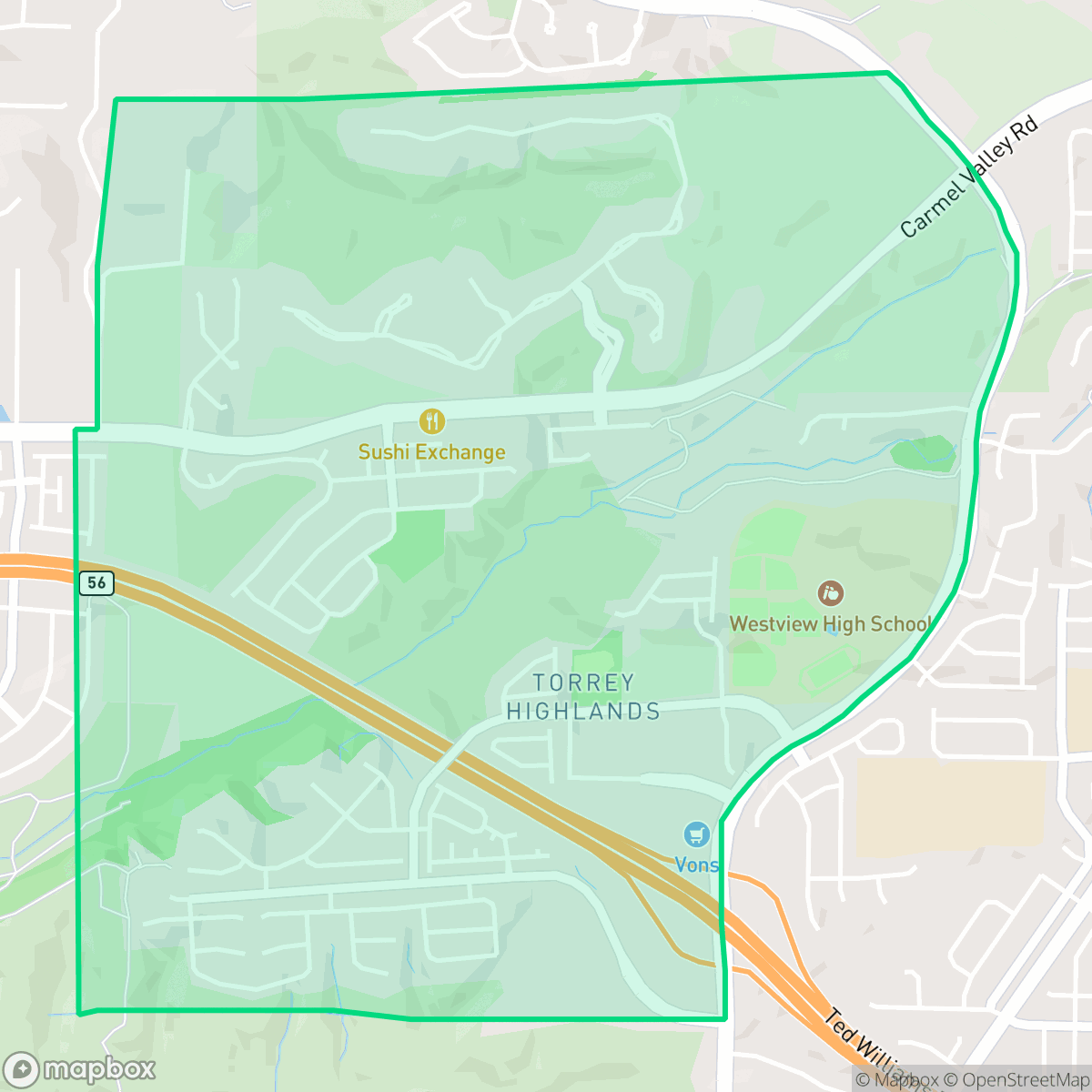
Prior to its residential development, the Torrey Highlands area of northern San Diego was primarily used for agricultural purposes, containing ranches and plant nurseries. In 1994, it became home to displaced migrant agricultural workers from the Rancho de los Diablos encampment, who resided in the local canyons until the 2010s. The neighborhood's modern era began in 1996 when San Diego voters and the City Council approved the Torrey Highlands Subarea Plan, transitioning the 1,134-acre territory from the North City Future Urbanizing Area. Developed primarily in the 2000s, the master-planned community is bisected by State Route 56 and features homes blending Mediterranean, Craftsman, and contemporary architectural styles. Key local landmarks include Westview High School, and the community's design preserves half of its acreage for parks, open space, and canyon trails.
The area functions as a serene, suburban enclave characterized by a blend of Mediterranean, Craftsman, and contemporary housing. It offers a distinct balance of quiet residential living and convenient access to local dining and retail hubs, such as those near the highway intersection. While the neighborhood maintains a lower profile regarding overall liveliness, it provides a high quality of life for those prioritizing air quality and access to recreational green spaces. Educational opportunities are a primary draw, with the community served by the Poway Unified School District and the highly-regarded Westview High School.
Prospective residents should consider the trade-offs of living in this environment, particularly regarding acoustic comfort and safety. Road traffic noise from the adjacent highway is a consistent factor, and the area faces elevated fire safety risks common to many canyon-adjacent communities in Southern California. The neighborhood is best suited for families and individuals who value a tranquil, suburban setting with modern amenities and are comfortable with a commute-oriented lifestyle.
Neighborhood Scores Across 15 Qualities
Residential spacing offers a balanced level of separation between homes, providing more personal distance than is typical for the San Diego average. According to iHuus data, the neighborhood features a mix of densities with noticeable buffers between adjacent properties.
Sidewalks and safe crossings are widely available, making the area slightly more pedestrian friendly than the San Diego average. Most local movement is supported by established infrastructure for walkers.
Larger residential lots and frequent upscale amenities contribute to an aesthetically pleasing environment that is notably more polished than the San Diego average. According to iHuus data, the area features prominent architecture and well-maintained surroundings.
Extensive parklands, trails, and open spaces provide ample room for pets. This availability of recreational area is significantly higher than the San Diego average, according to iHuus data.
Frequent open spaces and scattered homes among woodlands provide a more rural atmosphere than most parts of San Diego. This landscape offers more significant distance from dense urban development according to iHuus data.
Low-density residential streets and significant open spaces create a serene environment, though the area lacks the commercial variety found in more active parts of San Diego. Most local activity is limited to a few essential services and scattered dining options near major transit corridors.
Frequent acoustic disturbances from nearby major freeways and transit corridors characterize this area. According to iHuus data, noise levels here are notably higher than the San Diego average.
Air quality remains consistently high with infrequent instances of poor air readings. According to iHuus data, the atmosphere in Torrey Highlands is notably cleaner than the San Diego city average.
No warehouses, industrial facilities, or hazard sites are present within the neighborhood. According to iHuus data, this area is more strictly residential than the San Diego average.
Health insurance coverage among residents is notably higher than the San Diego city average, according to iHuus data.
Political leanings in this area are more moderate than the city average, featuring a liberal majority alongside a notable presence of opposing viewpoints according to iHuus data.
Residents live alongside a balanced variety of young adults, families, and older individuals. This demographic distribution is consistent with the broader San Diego area, according to iHuus data.
Flood risk levels are currently difficult to determine because FEMA has not completed a detailed study for this area. This lack of data indicates a slightly higher level of uncertainty regarding flood safety compared to the San Diego average.
Significant fire hazards exist within this area, representing a higher risk level than the San Diego average. Residents should remain aware of enhanced mitigation requirements according to iHuus data.
Address-Level Insights for Torrey Highlands


iHuus Neighborhood Intelligence Insights
Get address-level neighborhood insights for Torrey Highlands
- Street-level scores — see how individual blocks compare, not just neighborhood averages
- Micro-zone boundaries — identify quiet pockets, flood boundaries, and walkable clusters before you visit
- 15 dimensions in full — walkability, noise, air quality, school quality, insurance coverage, population age profile, urban/rural index, and more
- Boundary risk alerts — know if your address sits near a block boundary where scores drop, the kind of detail no listing will ever mention
- School insights — individual school ratings and insights, not just district-level data
- Compare before you commit — side-by-side data across neighborhoods, down to block precision
No credit card required
Compare with Any Neighborhood
| Dimension | Torrey Highlands | Adams North |
|---|---|---|
| 🚶 Walkabilityavg 8.58 | ||
| 🔊 Acoustic Comfortavg 3.33 | ||
| 🤫 Privacy Indexavg 4.87 | ||
| 🎨 Visual Appealavg 6.85 | ||
| 🐕 Dog Friendlinessavg 6.91 | ||
| 🗺️ Urban-Rural Indexavg 6.6 | ||
| ✨ Neighborhood Vibeavg 5.12 | ||
| 🏥 Health Insurance Coverageavg 7.53 | ||
| 🌿 Air Qualityavg 6.36 | ||
| 🏭 Industrial Proximityavg 9.12 | ||
| 🌊 Flood Safetyavg 4.2 | ||
| 🗳️ Ideological Leanavg 8.51 | ||
| 👥 Population Age Profileavg 4.8 | ||
| 🔥 Fire Safetyavg 0.61 | ||
| 🏫 School Quality |
Torrey Highlands Rankings
School Districts Serving Torrey Highlands
School Insights for Torrey Highlands
Below average outcomes; significant attendance and academic challenges.
School Insights
See what's really behind every school rating near Torrey Highlands
- Individual school ratings — each school's own score with outcome context, not just a district average
- Enrollment & class size data — student-to-teacher ratio and how it compares to the state average
- Full demographics breakdown — ethnicity and gender composition for every school in the enrollment zone
- Every school in the district — all schools within the enrollment boundary ranked by rating, not just the closest one
- Grade levels & benchmarks — elementary through high school, with below/above state-average flags
No credit card required