Tierrasanta, San Diego
Updated · 29,625 residents
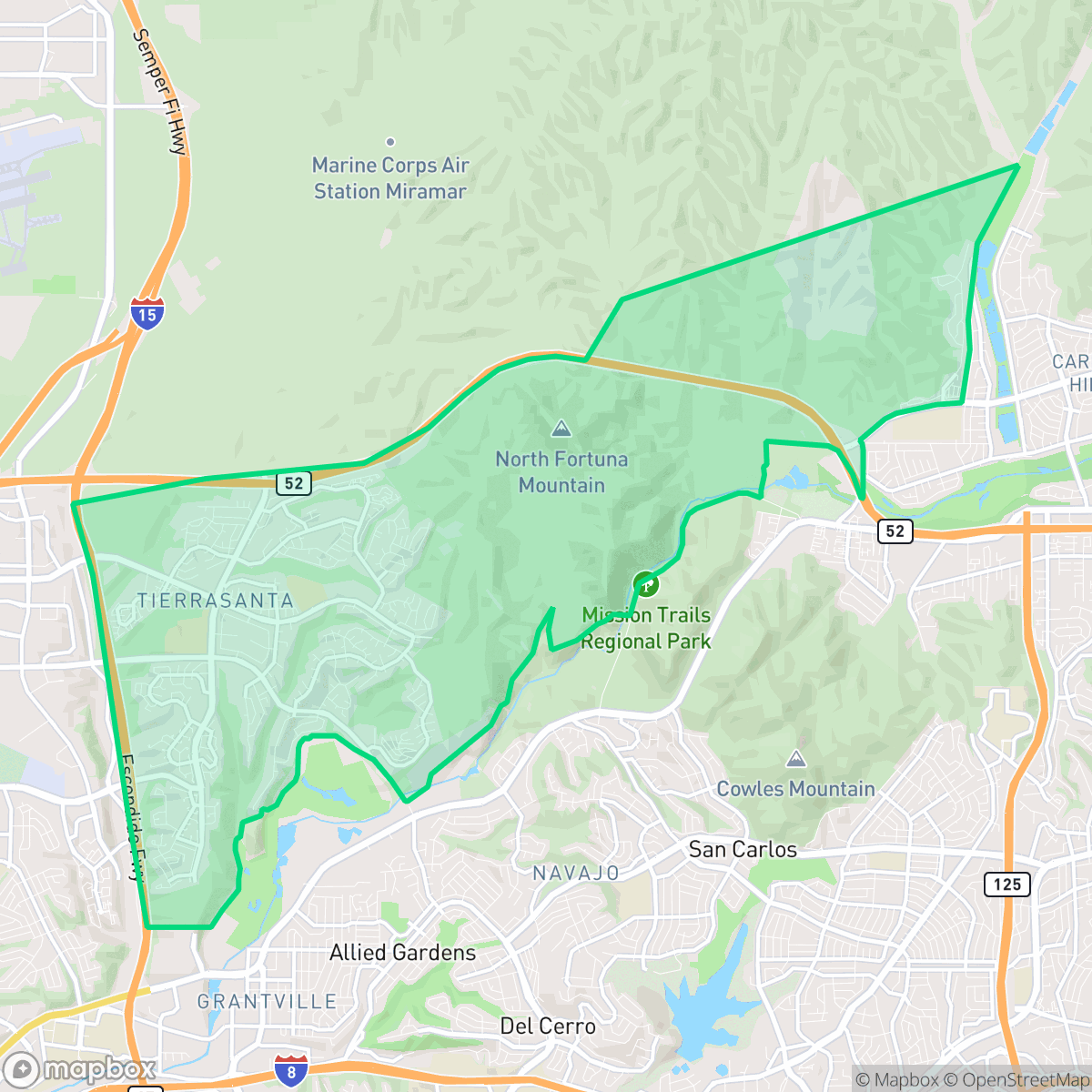
Tierrasanta is a master-planned community known for its winding streets and extensive canyon green spaces. It offers a quiet, suburban environment with high dog-friendliness and access to recreational trails, though residents must contend with road traffic noise and limited local commercial options.
Key Highlights
About Tierrasanta
Originally part of the Mission San Diego de Alcalá ranch, the land that became Tierrasanta was purchased by the U.S. military in 1941 to establish Camp Elliott, a Marine Corps training facility. Deactivated after World War II, the federal government declared the base surplus, and the City of San Diego adopted the Elliott Community Plan in 1962. Founded in 1971, Tierrasanta was developed as one of San Diego’s first master-planned communities, characterized by Spanish-inspired architecture, winding streets, and extensive canyon green spaces. Known locally as "The Island in the Hills" due to its limited entry roads, the neighborhood's military legacy remains visible through the Murphy Canyon naval housing complex. Its proximity to Mission Trails Regional Park and dedicated open spaces maintained by a local assessment district since 1972 define its modern, nature-integrated character.
The area functions as a dense suburban enclave, characterized by a mix of detached homes and townhome clusters that prioritize access to natural surroundings. Residents benefit from a comprehensive sidewalk network and proximity to outdoor amenities, making it a popular choice for pet owners and those who value a nature-integrated lifestyle. While it maintains a calm, residential atmosphere, the neighborhood is largely car-dependent, with limited local dining and retail destinations compared to more urban parts of San Diego.
Living here involves specific trade-offs, particularly regarding acoustic comfort and environmental safety. According to iHuus data, road traffic noise is a notable factor, and the area faces a higher fire risk than the city average. Prospective residents should also consider the variability in local school performance, which ranges from high-achieving institutions to those requiring more support. Despite these challenges, the community remains a stable, well-maintained option for those seeking a balance between suburban comfort and direct access to regional open spaces.
Neighborhood Scores Across 15 Qualities
Residential layouts offer a mix of detached homes and denser townhome clusters. According to iHuus data, the level of privacy is higher than the San Diego average due to the presence of canyon-facing lots and moderate buffering between structures.
Extensive sidewalk networks and low-traffic cul-de-sacs provide safe walking conditions, though the local highway and steep topography can act as barriers to movement. This level of walkability is slightly below the San Diego average.
Manicured landscaping, private pools, and large multi-car homes create a visual landscape that is more polished than the San Diego average. According to iHuus data, the area features significant density in well-maintained properties and spacious residential lots.
Abundant canyon trails, green verges, and large surrounding nature preserves provide superior opportunities for pet owners. Access to these connected green spaces is notably higher than the San Diego average, according to iHuus data.
Abundant natural canyon systems and preserved coastal sage scrub define the landscape, offering a more open and semi-rural feel than much of the San Diego area. This characteristic provides residents with significant access to undeveloped greenery and natural terrain integrated directly into the suburban layout.
Low business density and a reliance on major highways create a peaceful but primarily car-oriented environment. This area lacks the social energy found in more active parts of the city, offering a serene landscape with limited walkable amenities.
Proximity to major transit corridors and flight paths results in audible disturbances. According to iHuus data, acoustic comfort in this area is slightly below the San Diego average.
Air quality in this area fluctuates between acceptable and unhealthy levels, occasionally posing a risk to sensitive groups. According to iHuus data, these conditions are slightly lower than the typical levels found throughout San Diego.
Residential and institutional land uses dominate the area, with no visible warehouses, heavy machinery, or industrial hazards detected. This lack of industrial presence is very similar to the broader San Diego average.
Health insurance access is exceptionally high among residents, significantly surpassing the San Diego average according to iHuus data.
Political leanings in this area lean liberal, though the community is notably less progressive than the San Diego average according to iHuus data.
Residents live alongside a balanced variety of young professionals, families, and seniors. This demographic spread is slightly more even than the typical San Diego profile according to iHuus data.
Properties in this area are located within a designated floodplain, which means residents may face a higher risk of flooding and likely require flood insurance. According to iHuus data, the flood risk in Tierrasanta is higher than the San Diego average.
Extreme fire hazards are present in this area, representing a significantly higher risk level than the San Diego average. Residents should be aware of the intensive protection measures required due to the local terrain and vegetation according to iHuus data.
Address-Level Insights for Tierrasanta


iHuus Neighborhood Intelligence Insights
Get address-level neighborhood insights for Tierrasanta
- Street-level scores — see how individual blocks compare, not just neighborhood averages
- Micro-zone boundaries — identify quiet pockets, flood boundaries, and walkable clusters before you visit
- 15 dimensions in full — walkability, noise, air quality, school quality, insurance coverage, population age profile, urban/rural index, and more
- Boundary risk alerts — know if your address sits near a block boundary where scores drop, the kind of detail no listing will ever mention
- School insights — individual school ratings and insights, not just district-level data
- Compare before you commit — side-by-side data across neighborhoods, down to block precision
No credit card required
Compare with Any Neighborhood
| Dimension | Tierrasanta | Adams North |
|---|---|---|
| 🚶 Walkabilityavg 8.58 | ||
| 🔊 Acoustic Comfortavg 3.33 | ||
| 🤫 Privacy Indexavg 4.87 | ||
| 🎨 Visual Appealavg 6.85 | ||
| 🐕 Dog Friendlinessavg 6.91 | ||
| 🗺️ Urban-Rural Indexavg 6.6 | ||
| ✨ Neighborhood Vibeavg 5.12 | ||
| 🏥 Health Insurance Coverageavg 7.53 | ||
| 🌿 Air Qualityavg 6.36 | ||
| 🏭 Industrial Proximityavg 9.12 | ||
| 🌊 Flood Safetyavg 4.2 | ||
| 🗳️ Ideological Leanavg 8.51 | ||
| 👥 Population Age Profileavg 4.8 | ||
| 🔥 Fire Safetyavg 0.61 | ||
| 🏫 School Quality |
Tierrasanta Rankings
School Districts Serving Tierrasanta
School Insights for Tierrasanta
Below average outcomes; significant attendance and academic challenges.
School Insights
See what's really behind every school rating near Tierrasanta
- Individual school ratings — each school's own score with outcome context, not just a district average
- Enrollment & class size data — student-to-teacher ratio and how it compares to the state average
- Full demographics breakdown — ethnicity and gender composition for every school in the enrollment zone
- Every school in the district — all schools within the enrollment boundary ranked by rating, not just the closest one
- Grade levels & benchmarks — elementary through high school, with below/above state-average flags
No credit card required