Teralta West, San Diego
Updated · 4,352 residents
Teralta West is a highly walkable urban neighborhood in San Diego known for its dense residential grid and proximity to local dining. While it offers excellent pedestrian access to daily amenities, residents should expect a high-density living environment with significant noise levels from nearby freeway traffic.
Key Highlights
About Teralta West
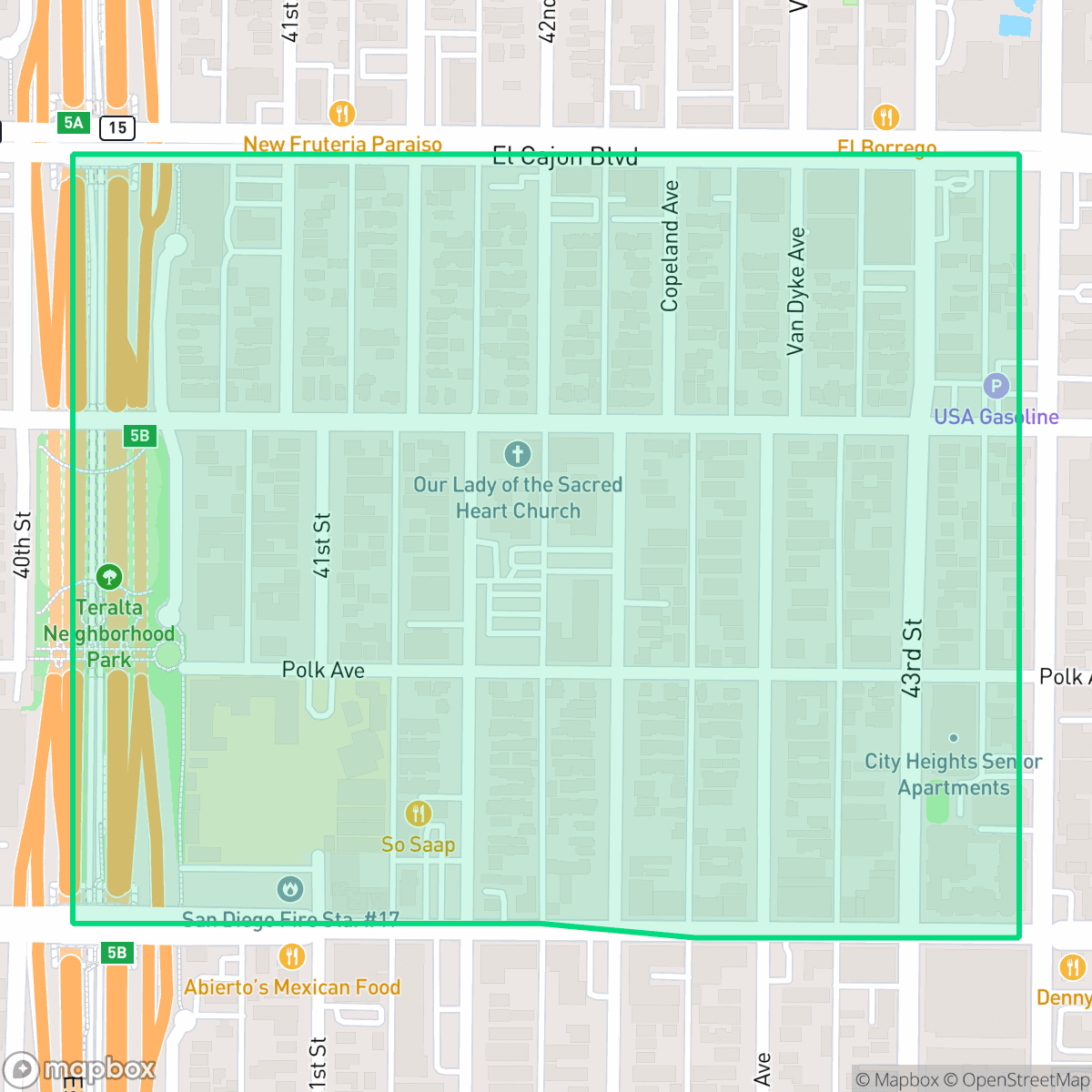
Teralta West, a neighborhood within San Diego’s City Heights, was originally part of East San Diego before its 1920s annexation. The neighborhood is defined by its historic struggles against urban division; when the construction of Interstate 15 threatened to bisect the community, decades of grassroots activism by the City Heights Community Development Corporation culminated in the 2001 opening of Teralta Park. Spanning across the freeway, it was California’s first freeway cap park, designed to physically reunite the neighborhood. Architecturally, the area features the historic Art Deco facade of the former Superior Furniture Co. on El Cajon Boulevard, which was preserved and integrated into "The Teralta" affordable housing development in 2026. Culturally, Teralta West is a vibrant immigrant hub, characterized by significant Vietnamese-speaking and East African communities.
The neighborhood functions as a dense, low-rise urban grid characterized by a mix of multi-story apartments and commercial blocks. It serves as a central hub for residents who prioritize walkability, as the area features continuous sidewalks and pedestrian-priority crossings that make daily errands convenient. Local hotspots like Banda Burrito and Dark Horse Coffee Roasters contribute to a community-focused atmosphere that balances suburban-style streets with the energy of a major metropolitan corridor. Prospective residents should weigh the benefits of this high walkability against the realities of urban density and acoustic conditions. Homes are typically situated in close proximity to one another, resulting in limited private outdoor space and a lower privacy index. Additionally, the proximity to major highway infrastructure contributes to elevated ambient noise levels. The area is best suited for those who value transit-oriented living and cultural diversity over quiet, secluded environments.
Neighborhood Scores Across 15 Qualities
Residential structures are positioned in close proximity to one another, with many buildings sharing walls or separated by very small gaps. This level of density results in significantly less privacy than is typical for the San Diego area, according to iHuus data.
Pedestrians benefit from a continuous sidewalk network and ample marked crossings throughout the neighborhood. This grid layout offers superior connectivity for walking compared to the San Diego average, according to iHuus data.
Standard mid-century tract housing and apartment blocks define the landscape, featuring compact lots and minimal private yard space. This level of visual variety is slightly below the San Diego city average according to iHuus data.
Access to public green space for pets is below the San Diego average. While some residential streets offer sidewalks and nearby parks, many areas feature limited public greenery or narrow verges.
A blend of low-rise apartment blocks and single-family homes defines the area. This layout provides a more developed urban feel that is largely consistent with the broader San Diego average.
Suburban streets and green spaces sit alongside lively social hubs and diverse dining options. According to iHuus data, this area offers a more active atmosphere than the typical San Diego neighborhood.
Constant aircraft noise from the nearby airport runway makes this area significantly noisier than the San Diego average. Residents should expect frequent loud interruptions from flight paths according to iHuus data.
Air quality fluctuates between acceptable and unhealthy levels, which may present occasional concerns for sensitive groups. According to iHuus data, these conditions are slightly below the San Diego average.
Industrial presence is virtually non-existent in this area, which consists almost entirely of residential and light commercial uses. According to iHuus data, the neighborhood lacks the warehouses and heavy industrial hazards found in many other parts of San Diego.
Health insurance accessibility is lower than the San Diego average, according to iHuus data. Residents may find fewer local options for employer-sponsored or subsidized coverage compared to other parts of the city.
Voting patterns and census indicators show a predominantly liberal political leaning, which is notably more pronounced than the San Diego city average according to iHuus data.
Residents live alongside a diverse mix of young adults, families, and older individuals. This age distribution is relatively comparable to the broader San Diego area.
Properties in this area are situated within a designated floodplain, which makes the presence of flood insurance a common necessity. This risk level is notably higher than the average for San Diego, according to iHuus data.
Address-Level Insights for Teralta West


iHuus Neighborhood Intelligence Insights
Get address-level neighborhood insights for Teralta West
- Street-level scores — see how individual blocks compare, not just neighborhood averages
- Micro-zone boundaries — identify quiet pockets, flood boundaries, and walkable clusters before you visit
- 15 dimensions in full — walkability, noise, air quality, school quality, insurance coverage, population age profile, urban/rural index, and more
- Boundary risk alerts — know if your address sits near a block boundary where scores drop, the kind of detail no listing will ever mention
- School insights — individual school ratings and insights, not just district-level data
- Compare before you commit — side-by-side data across neighborhoods, down to block precision
No credit card required
Compare with Any Neighborhood
| Dimension | Teralta West | Adams North |
|---|---|---|
| 🚶 Walkabilityavg 8.58 | ||
| 🔊 Acoustic Comfortavg 3.33 | ||
| 🤫 Privacy Indexavg 4.87 | ||
| 🎨 Visual Appealavg 6.85 | ||
| 🐕 Dog Friendlinessavg 6.91 | ||
| 🗺️ Urban-Rural Indexavg 6.6 | ||
| ✨ Neighborhood Vibeavg 5.12 | ||
| 🏥 Health Insurance Coverageavg 7.53 | ||
| 🌿 Air Qualityavg 6.36 | ||
| 🏭 Industrial Proximityavg 9.12 | ||
| 🌊 Flood Safetyavg 4.2 | ||
| 🗳️ Ideological Leanavg 8.51 | ||
| 👥 Population Age Profileavg 4.8 | ||
| 🔥 Fire Safetyavg 0.61 | ||
| 🏫 School Quality |
Teralta West Rankings
School Districts Serving Teralta West
School Insights for Teralta West
Below average outcomes; significant attendance and academic challenges.
School Insights
See what's really behind every school rating near Teralta West
- Individual school ratings — each school's own score with outcome context, not just a district average
- Enrollment & class size data — student-to-teacher ratio and how it compares to the state average
- Full demographics breakdown — ethnicity and gender composition for every school in the enrollment zone
- Every school in the district — all schools within the enrollment boundary ranked by rating, not just the closest one
- Grade levels & benchmarks — elementary through high school, with below/above state-average flags
No credit card required