Talmadge, San Diego
Updated · 10,500 residents
Talmadge is a historic San Diego neighborhood defined by its eclectic architectural character and exceptional walkability. Residents enjoy a dense, grid-based street layout that facilitates easy pedestrian access to local dining and community institutions, though the area experiences notable road noise and limited privacy due to closely spaced homes.
Key Highlights
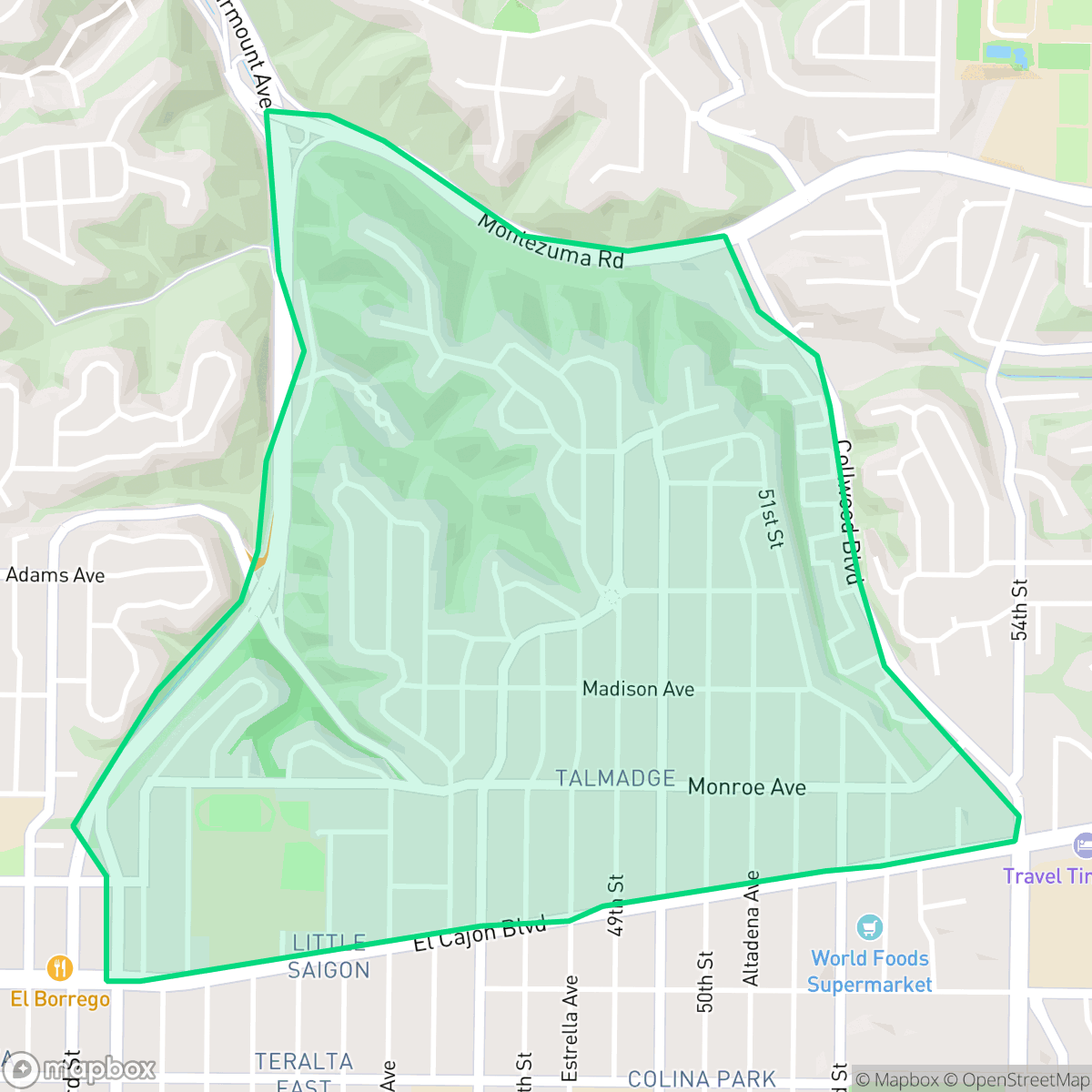
About Talmadge
Established in 1925 by real estate developers Roy and Guy Lichty, the historic San Diego neighborhood of Talmadge was funded by United Artists president Joseph Schenck. It was named in honor of his wife, Norma Talmadge, and her sisters Natalie and Constance, who were prominent silent film stars. The neighborhood’s grand opening on January 3, 1926, drew over 10,000 attendees, including Hollywood icons Buster Keaton and William S. Hart. Geographically isolated by canyons, the community is marked by the historic Talmadge Gates and a central traffic circle. Its eclectic architectural landscape features Spanish Revival, Cape Cod, and Normandy-style homes, including several designed by renowned architect Cliff May. In March 2024, the neighborhood's historic core was officially listed on the National Register of Historic Places as the Talmadge Park Estates Historic District.
The neighborhood offers a distinct urban residential experience characterized by a continuous sidewalk network that makes it easy to navigate on foot. While the area lacks significant industrial presence and maintains a quiet, purely residential atmosphere, it remains lively with diverse local dining options and community-focused institutions. According to iHuus data, the area maintains a high level of health insurance coverage and a strong sense of community engagement, reflecting a stable and active local population.
Prospective residents should consider that the neighborhood features high-density housing with limited space between structures, which can impact personal privacy. Acoustic comfort is a notable factor, as road traffic contributes to higher noise levels compared to the city average. While the area is well-suited for those who prioritize walkability and proximity to urban amenities, the lack of expansive private green space and specific fire safety considerations are important trade-offs to weigh when choosing a home.
Neighborhood Scores Across 15 Qualities
Residential spacing in Talmadge is tighter than the San Diego average, characterized by houses positioned close to one another and several shared-wall structures. This density means neighbors are often in closer proximity compared to more spread out parts of the city.
Continuous sidewalks and well-defined crosswalks facilitate safe pedestrian movement throughout the area. This interconnected street network offers a level of accessibility that is higher than the San Diego average.
Residential vistas range from large homes with manicured landscaping and private pools to denser, more standard urban housing. According to iHuus data, the overall visual appeal is slightly below the San Diego city average.
Walking routes for pets are generally adequate due to sidewalk verges and nearby school athletic fields, though opportunities for dog walking are slightly below the San Diego average. Large central parks and open fields are available in certain pockets of the neighborhood, according to iHuus data.
A blend of residential streets and green spaces defines the area, offering a suburban feel that is slightly less dense than the San Diego average. According to iHuus data, the neighborhood features a mix of single-family homes and low-rise multi-unit structures.
Diverse dining options and social destinations provide a level of activity significantly higher than the San Diego average. While some residential blocks remain quiet and suburban, many areas offer a lively mix of international restaurants and local amenities.
Steady sounds from nearby busy streets are present, though the level of acoustic disturbance remains slightly higher than the San Diego average according to iHuus data.
Air quality in Talmadge fluctuates between acceptable and unhealthy levels, sitting slightly below the San Diego average. Sensitive individuals should monitor local conditions, as occasional periods of poor air quality are noted in iHuus data.
Industrial activity is absent here, as the area consists exclusively of residential, institutional, and light commercial zones. According to iHuus data, this lack of heavy industry and warehouse complexes makes the neighborhood even more free of industrial hazards than the San Diego average.
Health insurance access is notably lower in Talmadge compared to the San Diego average, according to iHuus data.
Voting patterns and census indicators reflect a significantly more liberal political leaning than the San Diego average, according to iHuus data.
Demographics in Talmadge reflect a balanced distribution of young adults, families, and older residents, mirroring the general age profile seen across San Diego. According to iHuus data, there is no significant skew toward any specific age group within the neighborhood.
Properties in this area are situated within a designated floodplain, making flood insurance a common requirement for residents. According to iHuus data, the risk of flooding in Talmadge is notably higher than the San Diego city average.
Fire safety conditions in Talmadge are notably lower than the San Diego average. Residents should be aware of elevated risks identified by iHuus data.
Address-Level Insights for Talmadge


iHuus Neighborhood Intelligence Insights
Get address-level neighborhood insights for Talmadge
- Street-level scores — see how individual blocks compare, not just neighborhood averages
- Micro-zone boundaries — identify quiet pockets, flood boundaries, and walkable clusters before you visit
- 15 dimensions in full — walkability, noise, air quality, school quality, insurance coverage, population age profile, urban/rural index, and more
- Boundary risk alerts — know if your address sits near a block boundary where scores drop, the kind of detail no listing will ever mention
- School insights — individual school ratings and insights, not just district-level data
- Compare before you commit — side-by-side data across neighborhoods, down to block precision
No credit card required
Compare with Any Neighborhood
| Dimension | Talmadge | Adams North |
|---|---|---|
| 🚶 Walkabilityavg 8.58 | ||
| 🔊 Acoustic Comfortavg 3.33 | ||
| 🤫 Privacy Indexavg 4.87 | ||
| 🎨 Visual Appealavg 6.85 | ||
| 🐕 Dog Friendlinessavg 6.91 | ||
| 🗺️ Urban-Rural Indexavg 6.6 | ||
| ✨ Neighborhood Vibeavg 5.12 | ||
| 🏥 Health Insurance Coverageavg 7.53 | ||
| 🌿 Air Qualityavg 6.36 | ||
| 🏭 Industrial Proximityavg 9.12 | ||
| 🌊 Flood Safetyavg 4.2 | ||
| 🗳️ Ideological Leanavg 8.51 | ||
| 👥 Population Age Profileavg 4.8 | ||
| 🔥 Fire Safetyavg 0.61 | ||
| 🏫 School Quality |
Talmadge Rankings
School Districts Serving Talmadge
School Insights for Talmadge
Below average outcomes; significant attendance and academic challenges.
School Insights
See what's really behind every school rating near Talmadge
- Individual school ratings — each school's own score with outcome context, not just a district average
- Enrollment & class size data — student-to-teacher ratio and how it compares to the state average
- Full demographics breakdown — ethnicity and gender composition for every school in the enrollment zone
- Every school in the district — all schools within the enrollment boundary ranked by rating, not just the closest one
- Grade levels & benchmarks — elementary through high school, with below/above state-average flags
No credit card required