Swan Canyon, San Diego
Updated · 4,593 residents
Swan Canyon is a diverse, grid-based neighborhood in City Heights defined by its central canyon and ongoing ecological restoration efforts. Residents benefit from high walkability and excellent dog-friendly amenities, though the area remains a quiet residential enclave with limited commercial activity.
Key Highlights
About Swan Canyon
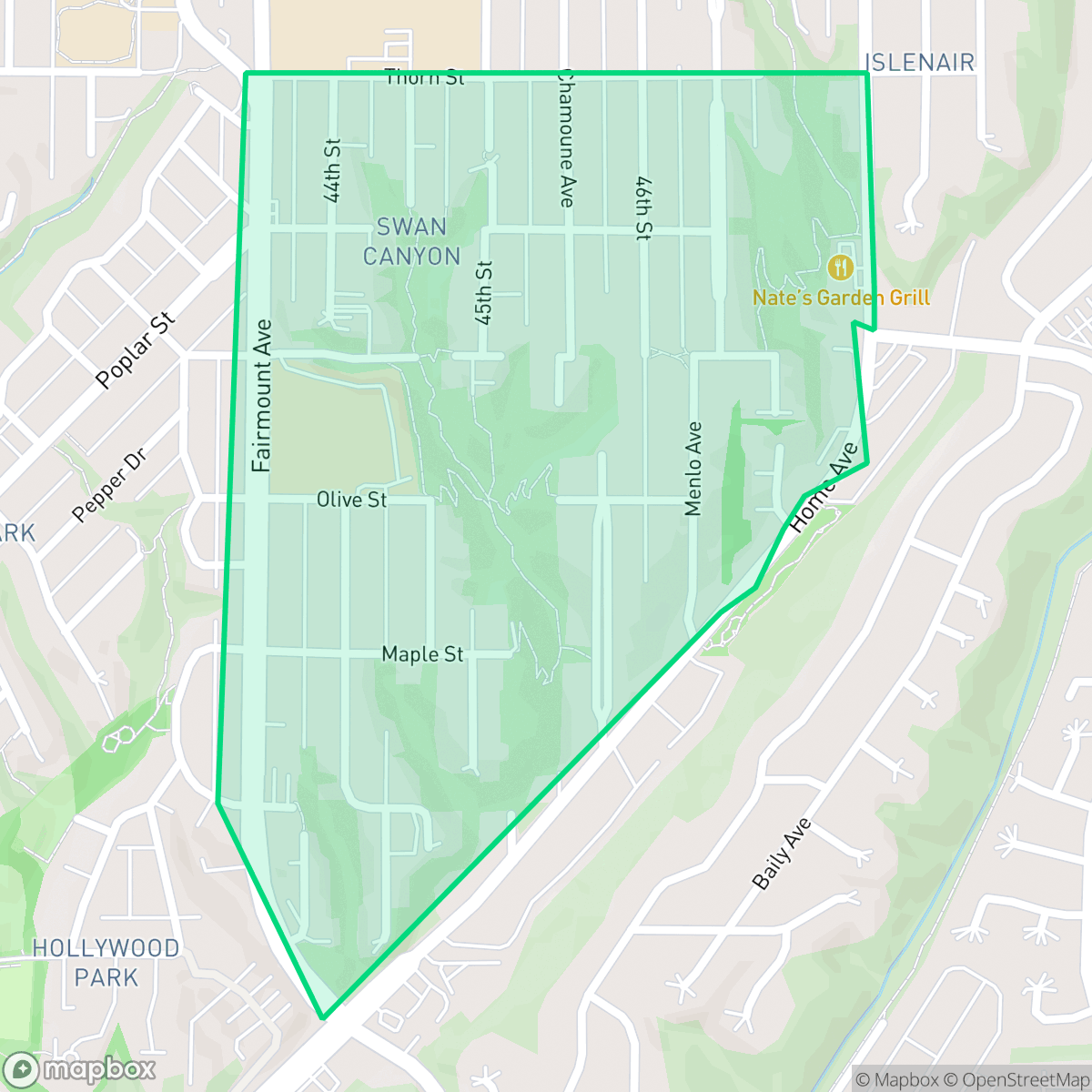
Named for the 30-acre natural canyon running north-to-south through its center, Swan Canyon is a densely populated neighborhood in San Diego’s City Heights community. The neighborhood’s residential landscape consists primarily of mid-to-late 20th-century single-family homes and apartments. Historically, the central canyon suffered from degradation and invasive species, but it has become a major focus of ecological restoration led by the California Coastal Conservancy and San Diego Canyonlands, featuring trails like the Olive Street and Quince Street paths. Culturally, Swan Canyon is highly diverse, featuring a significant Mexican-American population and a notable Cambodian community. Local landmarks that define its community character include the long-standing City Farmers Nursery and Nate's Garden Grill.
The neighborhood features a dense suburban layout characterized by mid-20th-century housing and a grid-like street network that encourages pedestrian movement. Families are well-served by local educational options, including the highly-rated Hamilton Elementary, which maintains strong community standing within the broader San Diego City Unified School District. The area maintains a distinct residential feel, free from industrial encroachment, and benefits from a strong sense of community fostered by its diverse cultural makeup and active local environmental stewardship.
Neighborhood Scores Across 15 Qualities
Residential spacing provides more separation between neighbors than the typical San Diego area. According to iHuus data, canyon-facing lots offer particularly higher levels of privacy compared to the more densely packed urban grids found elsewhere in the city.
Pedestrian-friendly streets with continuous sidewalks on both sides and ample crossings make most trips easy on foot. This neighborhood offers a more walkable environment than the San Diego average, according to iHuus data.
Residential properties vary from large, well-manicured estates with private pools to standard suburban tract housing. This level of visual amenity is slightly below the San Diego average, according to iHuus data.
Large school fields and adjacent undeveloped canyons provide ample space for exercise. Sidewalks with grass verges offer safe walking routes, making the area's dog friendliness roughly comparable to the San Diego average.
Residential lots are characterized by significant natural canyon buffers and a mix of single-family homes. This layout provides a semi-rural feel that is very similar to the broader San Diego area.
Residential streets and green spaces blend with localized social hubs and dining options. According to iHuus data, the area maintains a level of activity comparable to the rest of San Diego.
A steady hum of local traffic from nearby busy streets is present. This level of acoustic activity is higher than the San Diego city average, according to iHuus data.
Air quality levels fluctuate between acceptable and unhealthy, presenting occasional concerns for sensitive groups. According to iHuus data, these conditions are slightly lower than the San Diego city average.
Land use in Swan Canyon is exclusively residential, educational, and light commercial. According to iHuus data, this area is free from warehouses, industrial facilities, or visible hazardous sites, making it cleaner than the San Diego average.
Health insurance access among residents is notably lower than the San Diego average, according to iHuus data.
Voting patterns and census indicators reflect a highly liberal community that is more politically progressive than the San Diego average, according to iHuus data.
Residents live among a balanced mix of young adults, families, and older populations. According to iHuus data, the age distribution is slightly more concentrated in specific age brackets than the San Diego average.
Located within a 100-year floodplain, this area faces a significantly higher risk of flooding than the San Diego average. Residents should be aware that flood insurance is typically required for properties here according to iHuus data.
Address-Level Insights for Swan Canyon


iHuus Neighborhood Intelligence Insights
Get address-level neighborhood insights for Swan Canyon
- Street-level scores — see how individual blocks compare, not just neighborhood averages
- Micro-zone boundaries — identify quiet pockets, flood boundaries, and walkable clusters before you visit
- 15 dimensions in full — walkability, noise, air quality, school quality, insurance coverage, population age profile, urban/rural index, and more
- Boundary risk alerts — know if your address sits near a block boundary where scores drop, the kind of detail no listing will ever mention
- School insights — individual school ratings and insights, not just district-level data
- Compare before you commit — side-by-side data across neighborhoods, down to block precision
No credit card required
Compare with Any Neighborhood
| Dimension | Swan Canyon | Adams North |
|---|---|---|
| 🚶 Walkabilityavg 8.58 | ||
| 🔊 Acoustic Comfortavg 3.33 | ||
| 🤫 Privacy Indexavg 4.87 | ||
| 🎨 Visual Appealavg 6.85 | ||
| 🐕 Dog Friendlinessavg 6.91 | ||
| 🗺️ Urban-Rural Indexavg 6.6 | ||
| ✨ Neighborhood Vibeavg 5.12 | ||
| 🏥 Health Insurance Coverageavg 7.53 | ||
| 🌿 Air Qualityavg 6.36 | ||
| 🏭 Industrial Proximityavg 9.12 | ||
| 🌊 Flood Safetyavg 4.2 | ||
| 🗳️ Ideological Leanavg 8.51 | ||
| 👥 Population Age Profileavg 4.8 | ||
| 🔥 Fire Safetyavg 0.61 | ||
| 🏫 School Quality |
Swan Canyon Rankings
School Districts Serving Swan Canyon
School Insights for Swan Canyon
Below average outcomes; significant attendance and academic challenges.
School Insights
See what's really behind every school rating near Swan Canyon
- Individual school ratings — each school's own score with outcome context, not just a district average
- Enrollment & class size data — student-to-teacher ratio and how it compares to the state average
- Full demographics breakdown — ethnicity and gender composition for every school in the enrollment zone
- Every school in the district — all schools within the enrollment boundary ranked by rating, not just the closest one
- Grade levels & benchmarks — elementary through high school, with below/above state-average flags
No credit card required